


Stoyan R. Vezenkov and Violeta R. Manolova
Center for applied neuroscience Vezenkov, BG-1582 Sofia, e-mail: info@vezenkov.com
For citation: Narcissism by Proxy: A Proposed Transgenerational Construct Linking Pathological Narcissism, Coercive Control, and Factitious Disorder Imposed on Another in the Digital Era. Nootism 2(3), 38-52, https://doi.org/10.64441/nootism.2.3.2
Abstract
The transgenerational transmission of narcissistic traits has been widely discussed in the literature, particularly in relation to parental overvaluation, impaired empathy, maladaptive parenting styles, attachment disturbance, and broader developmental pathways. In parallel, Factitious Disorder Imposed on Another (FDIA), historically known as Münchausen syndrome by proxy, has been described as a severe form of caregiver-mediated abuse in which a child is used to obtain attention, sympathy, validation, or medical legitimacy through fabricated, exaggerated, or induced illness. Although these phenomena are usually examined separately, both involve the instrumentalization of the child within a disturbed relational system.
This article proposes narcissism by proxy as a conceptual and clinically informed construct linking pathological narcissism, coercive control, and FDIA. The term refers to a family dynamic in which one parent instrumentalizes the other parent and recruits the child as a proxy object through whom self-worth regulation, domination, symbolic continuity, retaliation, or narcissistic enhancement are enacted. Unlike classical narcissistic parenting, this proposed construct is explicitly triangular: the child becomes the site through which interparental conflict is continued and organized.
The article further argues that narcissism by proxy and FDIA may be understood as partially overlapping forms of proxy-mediated child abuse. Their dominant rewards differ—admiration, prestige, and symbolic elevation in the first case; sympathy, caregiving legitimacy, and medical recognition in the second—but both rely on the use of the child as an external regulator of adult deficits and unresolved conflict. A transgenerational mechanism is proposed in which parental narcissistic injury and/or coercive control lead to partner instrumentalization, recruitment of the child as proxy, developmental distortion in the child, and possible repetition or cross-over into similar proxy-based dynamics in the next generation.
The article further proposes that, in some family systems, screen exposure in infancy and early childhood, as well as the deliberate or functionally purposeful reintroduction of screens during recovery, may operate as a low-threshold form of screen-mediated proxy harm. Because screen-based dysregulation, screen addiction and screen trauma are relatively easy to induce, normalize, and maintain in young children, screens may become a particularly effective instrument not only for parents, but also for grandparents and other caregivers seeking to preserve developmental impairment, addiction, caregiving centrality, or leverage over the other parent.
Although narcissism by proxy is not presented as a validated diagnostic category, it is proposed as a useful conceptual framework for understanding hidden forms of family violence enacted through the child.
Keywords: Narcissism by proxy, Pathological narcissism, Coercive control, Factitious Disorder Imposed on Another (FDIA), Proxy-mediated child abuse, Transgenerational transmission, Parent-child relations, Developmental trauma, Digital parenting, Screen addiction, Screen trauma
Introduction
Domestic violence remains a major public health problem worldwide rather than merely a social or private family matter (García-Moreno et al., 2013, 2015). Its prevalence, health consequences, and structural determinants continue to make it one of the most serious threats to the safety and development of women, children, and families (Carter, 2015; García-Moreno et al., 2015; Samarasekera & Horton, 2015; Temmerman, 2015). Although physical assault is often the most visible form of violence, contemporary scholarship has shown that intimate partner violence (IPV) includes a much broader spectrum of behaviors, including sexual violence, psychological abuse, coercive control, stalking, economic abuse, and technology-mediated surveillance or intimidation (Johnson, 2012). These less visible forms are often chronic, strategic, and relationally organizing, shaping the everyday reality of victims long before, or even without, overt physical assault.
A major advance in the field has been the recognition that violent relationships differ not only by the form of aggressive acts but also by their underlying dynamics. Johnson’s typology distinguishes situational couple violence, intimate terrorism or coercive controlling violence, violent resistance, and mutual violent control, thereby shifting attention from isolated incidents to the relational architecture of domination and resistance (Johnson, 2012). Walker’s classic description of the cycle of violence—tension building, acute incident, reconciliation, and relative calm—further illustrates how abusive systems maintain themselves through repetition, unpredictability, and emotional dependency (Walker, 1979). Stark deepened this understanding by conceptualizing coercive control as a strategic pattern through which one partner regulates the other’s time, mobility, resources, communication, and subjectivity itself (Stark, 2007). In a related vein, Dutton’s work on the abusive personality helps bridge intimate partner violence with enduring patterns of domination, attachment dysregulation, and control, thereby placing violence within a broader personality-organizational framework (Dutton, 2006).
Within such coercive environments, children are never neutral bystanders. Even when they are not the direct targets of physical or sexual assault, they are exposed to chronic states of fear, humiliation, instability, and relational fragmentation. Developmentally, the child who grows up in a household marked by coercive control or intimate partner violence may internalize the effects of violence through hypervigilance, dysregulated attachment, emotional insecurity, and distortions in self-development. The Adverse Childhood Experiences (ACE) literature has shown that abuse, neglect, and household dysfunction leave profound and measurable long-term consequences for physical and mental health (Felitti et al., 1998). From a developmental psychopathology perspective, child maltreatment is best understood not as a discrete event, but as a developmental process affecting adaptation, self-organization, resilience, and vulnerability across time (Toth & Cicchetti, 2013).
Child maltreatment itself encompasses a wide range of harmful experiences, including physical abuse, emotional abuse, sexual abuse, neglect, and exploitation (WHO, 2024). Global estimates indicate that violence against children remains extremely common, affecting hundreds of millions worldwide (UNICEF, 2024). Beyond overt maltreatment, children may also be harmed through more concealed patterns of caregiving failure and relational distortion, including emotional non-responsiveness, medical neglect, educational neglect, chronic manipulation, or forced involvement in adult conflicts. Such hidden forms of harm may be especially difficult to recognize because they can coexist with outwardly involved, sacrificial, or socially admired parenting. For this reason, the study of violence against children requires attention not only to discrete acts of abuse but also to the relational functions children are made to serve within troubled family systems.
Trauma theory provides an additional framework for understanding how coercive, humiliating, and attachment-disrupting environments shape development across generations. Herman (2015) located interpersonal trauma within broader systems of domination and captivity, showing that repeated abuse reorganizes the victim’s sense of safety, agency, and relational trust (Herman, 2015). Van der Kolk (2014) emphasized that traumatic experience may become embodied in compromised affect regulation, self-control, attention, pleasure, and interpersonal engagement. (van der Kolk, 2014) Together, these perspectives suggest that chronic exposure to violence is not simply remembered cognitively; it may become inscribed in the developing body, relational expectations, and emerging sense of self.
Attachment and mentalization models deepen this developmental account. Fonagy and Target (1997) argued that self-organization depends in part on the caregiver’s capacity to recognize and contain the child’s internal states, while Slade (2005) extended this logic through the construct of parental reflective functioning. (Fonagy & Target, 1997; Slade, 2005) Where caregiving is intrusive, controlling, humiliating, or self-referential, the child’s mind may be insufficiently mirrored as a separate subjectivity. Instead of being known as an autonomous person, the child may be treated as an extension, instrument, burden, or symbolic carrier of parental needs. Such conditions are particularly relevant for the study of narcissistic family dynamics, in which the child’s developmental needs may be subordinated to parental self-regulation, image maintenance, or unresolved conflict.
One important framework for understanding such distortions is the literature on pathological narcissism and its developmental transmission. Parents may use children to meet their own unmet needs for admiration, specialness, continuity, or self-cohesion, thereby shaping the child not as an autonomous subject but as an extension of parental self-regulation (Miller, 2008). Empirical work has shown that narcissism in children is associated with parental overvaluation, particularly when the child is treated as more exceptional or entitled than others, rather than simply with low parental warmth (Brummelman et al., 2015). More broadly, pathological narcissism has long been described as involving grandiosity, vulnerability, impaired empathy, entitlement, unstable self-esteem, and disturbed interpersonal functioning (Freud, 1914; Kernberg, 1975; Kohut, 2009b, 2009a; Krizan & Herlache, 2018; Ronningstam, 2009; Rosenthal et al., 2020). Existing literature further suggests that narcissistic traits may be transmitted across generations through intertwined developmental, relational, and possibly epigenetic pathways, particularly where maladaptive parenting styles, attachment disturbances, and chronic emotional invalidation are present (Dentale, 2015; Hart et al., 2017; Hewitt et al., 2024; Loewenstein, 1977; Luo et al., 2014; Michell, 1989; Morf & Rhodewalt, 2001; Philipson, 1982; Pincus & Lukowitsky, 2010).
A parallel but distinct body of literature concerns Factitious Disorder Imposed on Another (FDIA), historically known as Münchausen syndrome by proxy. In FDIA, a caregiver fabricates, exaggerates, or induces symptoms in a dependent person—most commonly a child—in order to obtain attention, sympathy, validation, or medical legitimacy. Although the medical context is central in FDIA, the broader relational logic is equally important: the child becomes the medium through which the caregiver regulates identity, attachment, control, and external recognition. In this respect, FDIA represents a particularly severe form of proxy-mediated child instrumentalization, in which the child’s suffering is recruited into the caregiver’s psychological economy. This makes FDIA highly relevant to any broader theory of parental proxy use, especially where illness narratives, dependency, and caregiving status become tools of interpersonal regulation.
The present article proposes that another, insufficiently described pattern may exist at the intersection of pathological narcissism, coercive control, and proxy-mediated child abuse. We refer to this proposed pattern as narcissism by proxy. By this term, we mean a relational configuration in which a parent instrumentalizes both the partner and the child in order to regulate self-worth, status, domination, retaliation, or symbolic continuity through the child as a proxy object. In such a configuration, the child may be overvalued, displayed, pressured, emotionally neglected, or recruited into an interparental struggle in which he or she comes to embody the grandiosity, grievance, or unmet psychological needs of the parent. Unlike more familiar descriptions of narcissistic parenting, this model emphasizes not only self-centered parenting but also the triangular structure of coercive control: the partner is devalued or subordinated, while the child becomes the site through which the conflict is continued, organized, and transmitted.
This framework may be especially relevant in families where chronic interparental hostility can no longer be enacted directly and is instead displaced onto the child. In such cases, the child functions not merely as a witness to violence, but as a proxy medium through which one parent asserts superiority, secures narcissistic validation, punishes the other parent, or constructs a moral or victimized identity. The comparison with FDIA is conceptually productive here. Although the dominant “reward” may differ—admiration, exceptionalism, and symbolic status in one case; sympathy, medical recognition, and caregiving legitimacy in the other—both patterns involve the use of the child as an external regulator of parental deficits. The child is thus transformed from a developing person into a relational instrument.
These dynamics may be amplified in the digital era. Social media, algorithmic visibility, continuous comparison, public performance of parenting, and technology-mediated control create new conditions for proxy-based regulation through the child. The child may become not only a private extension of parental identity but also a public carrier of parental grandiosity, suffering, or moral positioning. At the same time, digital environments may intensify coercive surveillance, competitive parenting displays, and the use of screen exposure itself as a tool of control, pacification, compensation, or relational manipulation. This broader cultural context makes it increasingly important to examine how proxy-mediated forms of child instrumentalization may evolve in contemporary family life.
This article therefore proposes a conceptual and clinically informed model rather than a validated diagnostic entity. It draws on literature concerning pathological narcissism, coercive control, intimate partner violence, child maltreatment, trauma, attachment, mentalization, and FDIA, while also incorporating developmental and trauma-informed perspectives and repeated clinical observations from therapeutic work with families of children presenting with severe early screen addiction and neurodevelopmental vulnerability. The aim is not to establish a new formal diagnosis, but to articulate a clinically useful transgenerational construct that may help integrate otherwise fragmented observations across family violence, narcissistic pathology, proxy abuse, and digital-era parenting.
2. Theoretical Background
2.1. Pathological narcissism and developmental transmission
Parents may use their children to satisfy their own needs for admiration and validation (Miller, 2008). In such contexts, the child may develop a false self in order to remain loved and accepted, becoming narcissistically injured in the process. Narcissism in children has been shown to correlate with parental overvaluation of the child (e.g., “My child is more special than other children”) rather than simply with a lack of parental warmth (Brummelman et al., 2015).
Narcissism, or narcissistic personality disorder, has been described for more than a century (Freud, 1914; Kohut, 2009b, 2009a; Ronningstam, 2009). More recently, the main forms of narcissism—grandiose and vulnerable—and the broader narcissistic spectrum have been described in greater detail (Krizan & Herlache, 2018; Rosenthal et al., 2020). Across this literature, the core features of pathological narcissism include grandiosity, entitlement, unstable self-esteem, diminished empathy, fantasies of unlimited success or uniqueness, and marked interpersonal dysfunction.
The transgenerational “inheritance” of narcissism has also been discussed in the literature through developmental, relational, and epigenetic mechanisms (Brummelman et al., 2015; Dentale, 2015; Hart et al., 2017; Hewitt et al., 2024; Kernberg, 1975; Loewenstein, 1977; Luo et al., 2014; Michell, 1989; Morf & Rhodewalt, 2001; Philipson, 1982; Pincus & Lukowitsky, 2010). Narcissistic parents typically show reduced empathy and are associated with non-optimal parenting styles, especially authoritarian and permissive patterns of caregiving (Hart et al., 2017). These styles may distort the child’s emerging subjectivity and identity, especially where the child is treated less as an autonomous person and more as a vehicle for parental self-regulation, compensation, or symbolic continuity.
In this sense, pathological narcissism is relevant not only as an individual personality phenomenon, but also as a relational and developmental force. It may shape family organization, expectations toward the child, emotional attunement, and the broader climate in which the child’s self develops. This transgenerational dimension is especially important when narcissistic dynamics become entangled with coercive control, partner devaluation, and the instrumental use of children within family conflict.
2.2. FDIA as a proxy-mediated pattern of child instrumentalization
A parallel and clinically important phenomenon is Münchausen syndrome, including the fabrication or exaggeration of medical symptoms and the intentional production, induction, or manipulation of illness in order to obtain medical or therapeutic attention, validation, or sympathy. When such behavior is enacted through another dependent person—most often a child—it is commonly referred to as Münchausen syndrome by proxy, now more often termed Factitious Disorder Imposed on Another (FDIA). In these cases, the caregiver harms a dependent individual, most commonly his or her own child or another person in his or her care, in the pursuit of attention, validation, sympathy, or medical recognition.
FDIA has been more commonly described in women and mothers, particularly in relation to caregiving roles and medically framed child suffering. At its core, however, the syndrome is not reducible to medical deception alone. It also reflects a relational configuration in which the child becomes a medium through which the caregiver regulates identity, control, attachment, and recognition. The dependent child is thus transformed into a proxy instrument within the caregiver’s psychological economy.
This proxy logic is particularly important for the present article because it provides the closest existing analogue for the proposed construct of narcissism by proxy. In both patterns, the child is not encountered primarily as a separate subject with independent developmental needs, but as a vehicle through which unresolved parental needs, conflicts, and self-regulatory deficits are enacted. In FDIA, this enactment is organized around illness, suffering, and caregiving legitimacy; in the proposed construct of narcissism by proxy, it is organized around greatness, status, symbolic continuity, domination, and retaliatory family dynamics.
The literature and the authors’ prior clinical work in families of children with severe early screen addiction, autism spectrum disorder, ADHD, and related developmental vulnerability suggest that FDIA and other forms of concealed parental abuse may coexist with chronic interparental conflict and pathological family organization (Manolova et al., 2025; Manolova & Vezenkov, 2025a, 2025b; Pashina et al., 2025; Petkova et al., 2025; Petrov et al., 2025; Petrova et al., 2025; Vezenkov & Manolova, 2025).
These observations provide a conceptual bridge toward the next section, where narcissism by proxy is introduced as a proposed construct at the intersection of pathological narcissism, coercive control, and proxy-mediated child instrumentalization.
3. Defining the Proposed Construct: Narcissism by Proxy
3.1. Proposed definition
The present article introduces narcissism by proxy as a proposed pathological relational pattern in which one parent instrumentalizes the other parent and uses the child as a proxy through whom narcissistic needs, symbolic continuity, control, and interparental aggression are enacted. In its classical form, this pattern was more often associated with fathers, who perceived the other parent—most often the mother—as a means for transmitting genes, greatness, or genius, while harming, controlling, or degrading that parent through physical, psychological, or relational violence. The child then becomes the proxy through whom the parent’s narcissistic project is continued, often developing similar narcissistic traits in the process.
In earlier generations, this pattern may have been more characteristic of men and fathers, whereas in the contemporary world this role may be assumed by the dominant parent regardless of sex, particularly in the context of social media and the increasing cultural opportunities for the cultivation and display of narcissism. In the authors’ formulation, the non-dominant parent historically had two broad pathways of response: either to raise a child shaped in the narcissistic direction of the dominating parent, or to injure, impair, or manipulate the child in response to the dominating parent, including through attention-seeking or validation-seeking forms of proxy use of the child. In both cases, severe distortions in the child’s development may occur.
Unlike classical narcissism considered at the level of the individual personality, narcissism by proxy is proposed here as a triangular relational construct. Its central feature is not only narcissistic self-regulation, but the use of the child as an intermediary object within a conflictual system involving both parents. In this model, the child is not simply loved, neglected, or controlled, but recruited into a structure of symbolic representation: the child becomes the carrier of parental genes, value, superiority, injury, grievance, or revenge.
3.2. Core clinical features
A defining feature of narcissism by proxy is the explicit prioritization of the child as the carrier of “my genes,” “my greatness,” or “my continuation,” at the expense of the other parent, who is reduced to an instrumental role. In contrast to more familiar forms of narcissistic parenting, the relationship between the two parents in such families is often already severely damaged, formally preserved, or effectively collapsed. These families are frequently divorced, separated, never married, or legally still together but functionally non-cohabiting. The parental relationship itself is no longer the emotional center of the system. Instead, the conflict is continued through the child, who serves as the proxy battlefield.
In ordinary parental conflict, the child may already be exposed to intimate partner violence (IPV) and suffer developmental consequences even without being directly beaten or sexually abused. When the conflict can no longer be enacted directly through conventional forms of violence, proxies emerge. In such situations, the child becomes the medium through which the parental war is continued by other means.
The narcissistic parent typically overvalues the child and derives meaning, self-importance, or continuity through the child. This overvaluation may take multiple forms. The pathological parenting style is often materially overinvolved, indulgent, or overproviding in practical terms—through purchases, constant transportation, exaggerated ambitions, inflated interests, and similar forms of external investment—while remaining emotionally neglectful, which is characteristic of narcissistic relating. The result may be a narcissistically shaped child who functions as a copy or extension of the narcissistic parent and may continue the pressure, devaluation, or domination of the victimized parent. At times, even brief contact with the narcissistic parent—for example during weekends or vacations—may function as a renewed “charging” of the child into the proxy role.
In some families, this proxy function may also be mediated through screens. The intentional, strategic, or functionally purposeful introduction of screens during infancy and early childhood may contribute to dysregulation, addiction, traumatization, developmental delay, impaired attachment, and reduced autonomy in the child. Because intensive screen exposure is relatively easy to initiate, socially normalized, and difficult to classify as overt abuse, it may become a particularly effective proxy tool not only for parents, but also for grandparents and other caregivers. During recovery from early screen addiction, the repeated reintroduction of screens may serve to “recharge” the child into dysregulated and trauma-addictive functioning, thereby preserving the child’s proxy role and maintaining leverage over the other parent.
Within this pattern, the child may be displayed, idealized, pressured, and emotionally instrumentalized rather than recognized as a separate developmental subject. At the same time, the child’s need for therapy and for overcoming screen addiction is not recognized; on the contrary, the addiction is used to manage the child and, through the child, the entire family dynamic. Performance, superiority, uniqueness, and symbolic value become more central than emotional attunement, autonomy, or genuine caregiving. In this sense, narcissism by proxy is not simply narcissistic parenting intensified; it is narcissistic family organization mediated through the child.
3.3. Distinction from classical narcissism
Narcissism by proxy differs from classical or “pure” narcissism because it includes a more explicit structure of partner instrumentalization plus child recruitment into conflict. In standard descriptions of narcissism, the emphasis falls on grandiosity, entitlement, impaired empathy, and self-regulatory instability. In narcissism by proxy, these features are still present, but they are embedded in a broader interpersonal system in which the other parent is subordinated, devalued, or treated primarily as a reproductive, functional, or symbolic instrument, while the child is elevated as the privileged extension of the narcissistic parent.
Thus, the focus shifts from individual narcissistic pathology to a relational mechanism involving coercive control, proxy use of the child, and developmental transmission. The child is not merely idealized but enlisted. The family is not simply narcissistically organized but structurally polarized. The interparental relationship is not only conflictual but displaced into proxy-mediated forms.
At the same time, the non-dominant or victimized parent may also injure the child through non-optimal parenting styles or through Münchausen syndrome by proxy, now more commonly referred to as Factitious Disorder Imposed on Another (FDIA), as a form of retaliation against the abusive parent. This response may be entirely unconscious, precisely because the child again functions as a means through which the adult conflict is continued. As the most valued object of the abusive parent, the child becomes the target through which retaliatory injury is delivered. Where more than one child is present, a distribution of proxy roles may emerge, with one parent recruiting one child and the other parent recruiting another. In such cases, the conflict between the parents may be reproduced as conflict between siblings themselves.
For this reason, narcissism by proxy should not be reduced to child overvaluation alone. It refers instead to a specific proxy-based family dynamic in which parental narcissistic regulation, coercive control, and interparental aggression converge through the developmental use of the child.
4. Narcissism by Proxy, FDIA, and Coercive Control: Overlaps and Boundaries
4.1. Shared proxy logic
The proposed construct of narcissism by proxy and the established construct of Factitious Disorder Imposed on Another (FDIA) may be understood as distinct but partially overlapping forms of proxy-mediated child instrumentalization. In both patterns, the child becomes more than a developing person with independent needs: the child becomes the carrier of a parental psychological function. In this sense, the child serves as an external regulator of parental deficits, conflicts, and identity needs.
In narcissism by proxy, the child is used to validate greatness, uniqueness, symbolic continuity, status, and superiority. In FDIA, the child is used to validate the identity of the suffering, heroic, morally superior, or unjustly misunderstood caregiver. Although the dominant narrative differs, the underlying logic is comparable. In both cases, the child is transformed into a proxy object through whom the adult regulates self-worth, attachment, recognition, revenge, or control.
This shared proxy logic also helps clarify why narcissism by proxy and FDIA may coexist, alternate, or become cross-generationally linked. One parental pathway may organize itself around enhancement, display, and grandiosity; another may organize itself around illness, fragility, and caregiving legitimacy. Yet both involve triangular family dynamics in which the child becomes the medium through which unresolved adult conflict and dysregulated parental needs are enacted.
4.2. Distinct motivational profiles
Despite this shared structure, the two phenomena differ in their dominant motivational economy. In narcissism by proxy, the principal “reward” is admiration, prestige, exceptionalism, or symbolic victory through the child. The child is presented as gifted, superior, chosen, misunderstood, or exceptional. In FDIA, by contrast, the principal “reward” is sympathy, medical attention, moral legitimacy, and validation through the child’s suffering or vulnerability. The child is presented as ill, fragile, endangered, or inadequately recognized by others.
Thus, one pattern is organized primarily around enhancement, while the other is organized primarily around illness. One seeks admiration; the other seeks concern. One elevates the child into a trophy; the other stabilizes the child within a chronic narrative of suffering. Nevertheless, both may involve control of institutions, hostility toward doubters, manipulation of evidence, and severe intrusion into the child’s autonomy. For this reason, the distinction between them should not obscure their common function as forms of proxy violence.
At the same time, coercive control provides an important relational backdrop for both phenomena. In many such families, the child is not only overvalued or medicalized, but also embedded in a structure of partner devaluation, relational splitting, surveillance, intimidation, or retaliatory family organization. Coercive control thus links the narcissistic and factitious poles by showing how proxy use of the child may emerge within a broader system of domination and interparental struggle.
4.3. Comparative features
The following table summarizes the main parallels and distinctions between narcissism by proxy and FDIA.
Table 1. Comparative features of narcissism by proxy and FDIA
| Domain / indicator | Narcissism by proxy (enhancement / trophy mode) | FDIA (illness mode) | Shared features / remarks |
| Primary goal | To validate greatness, uniqueness, or superiority through the child: “genius,” “chosen,” “winner” | To validate the role of the “heroic caregiver” through the child’s illness or suffering | In both modes, the child carries the parent’s identity |
| Key reward | Admiration, prestige, competitive superiority | Sympathy, attention, medical legitimacy, moral superiority | Mixed gains are also possible |
| Dominant narrative about the child | “The child is exceptional; others are jealous or fail to understand” | “The child is very ill or fragile; no one believes us or helps us” | Both narratives are often black-and-white |
| Typical presentation to others | Display of achievements, talents, IQ, gifts, public performance | Display of symptoms, suffering, medical journeys, repeated stories of illness | In both cases, there is strong staging or direction |
| Behavior toward the child | Performance pressure, perfectionism, control, humiliation in case of “failure” | Induction, fabrication, or exaggeration of symptoms; overexposure; medical manipulation | In both cases, there is intrusion into the child’s autonomy |
| Response to criticism | Rage, shame, or devaluation when the child’s “greatness” is questioned | Rage, panic, or accusations when the child’s symptoms are doubted | Hostility toward “non-believers” is common |
| Medical trajectory | Usually secondary, unless useful for proving specialness or exceptionality | Central: repeated consultations, doctor shopping, dramatic illness narratives | FDIA is most clearly recognized in the medical context |
| Documents / evidence | Selective use of awards, certificates, convenient evaluations | Discrepancies between reports, symptoms, and objective findings; symptoms often present mainly near the caregiver | Triangulation across school, medicine, and observation is essential |
| Attitude toward school / institutions | Conflict when “special treatment” is not granted; demands for privilege | Conflict when symptoms or absences are not recognized; pressure for special accommodations | Shared pattern: perceived entitlement to exception |
| Role of the other parent / partner | Instrumentalized for status or resources; coercively controlled; discredited | Isolated or marginalized as “not understanding the illness”; may be blamed | Both modes often involve triangulation and splitting into “good” and “bad” |
| Social network | Selection of an admiring audience; competitiveness | Selection of a sympathetic audience; support campaigns | Online amplification is possible in both |
| Typical red flags | The child is not allowed to fail; emotional punishment through shame; public comparison | Symptoms that appear or worsen in the caregiver’s presence; unexplained recurrences; pressure for procedures | In FDIA, red flags may indicate high-risk situations requiring professional assessment |
| What happens when parental access is restricted | Conflict and pressure around achievement often decrease | Symptoms may decrease or disappear when the child is separately observed | This is an observational indicator, not a self-test |
| Key psychological function | Regulation of self-esteem through the child’s “glory” | Regulation of attachment, control, or recognition through the child’s “illness” | Common mechanism: external regulation through the child |
| Screen exposure, screen addiction, screen trauma | Screens may be used to preserve fusion, controllability, addiction, trauma, dependency, and symbolic possession of the child; reintroduction may “recharge” dysregulated functioning | Screens may be used to sustain regression, symptom persistence, fragility, treatment resistance, or caregiver centrality | Low-visibility, low-threshold, caregiver-accessible means of developmental destabilization |
| Risk to the child | Chronic anxiety, perfectionism, conditional identity, shame | Physical harm, medical trauma, educational and social degradation | Both patterns may lead to complex trauma |
This comparison suggests that narcissism by proxy and FDIA are best understood neither as identical nor as entirely separate. Rather, they may represent two partially overlapping configurations of proxy-mediated child abuse within a broader relational field shaped by narcissistic regulation, coercive control, and developmental vulnerability. Their differences matter clinically, but so does their common structure: the child is transformed into a medium for adult regulation rather than supported as an autonomous subject.
5. Proposed Mechanism of Transgenerational Transmission
5.1. Mechanistic pathway
The present article proposes that narcissism by proxy may be understood as a transgenerational relational mechanism through which parental narcissistic injury, coercive control, and child instrumentalization become developmentally organized and later reproduced across generations. In this model, the process begins with parental narcissistic injury and/or coercive control, especially in family systems marked by domination, humiliation, devaluation, chronic conflict, and unstable attachment. Within such systems, one parent may increasingly instrumentalize the other, reducing him or her to a reproductive, functional, or symbolic role.
From this point, the child is recruited as a proxy object. The child becomes the medium through which parental self-esteem regulation, symbolic continuity, revenge, or superiority is enacted. This may take the form of overvaluation, control, emotional domination, performance pressure, symptom amplification, or emotional neglect. Depending on the family configuration, the child may be idealized and displayed, or alternatively drawn into narratives of fragility, suffering, or vulnerability. In both cases, the child ceases to function primarily as an autonomous developmental subject and instead becomes an instrument of adult relational regulation.
The cumulative developmental effect of such proxy-mediated parenting may be a distortion in the child’s emotional, relational, and identity development. This distortion may include insecure attachment, dysregulated self-worth, chronic shame, anxiety, identity diffusion, trauma-related symptoms, and impaired interpersonal functioning. Over time, these developmental consequences may become incorporated into adult relational style, thereby increasing the likelihood that similar proxy-based patterns will be repeated, reversed, or crossed over in the next generation.
In this sense, the proposed pathway may be summarized as follows:
Parental narcissistic injury and/or coercive control
→ instrumentalization of the partner
→ recruitment of the child as a proxy object
→ overvaluation / control / symptom amplification / emotional neglect
→ developmental distortion in the child
→ adult relational pathology in the next generation
→ repetition or cross-over into FDIA-like dynamics and/or narcissism by proxy
5.2. Cross-over hypothesis
A central hypothesis of the present model is that narcissism by proxy and FDIA may be transmitted in linked or crossing forms across generations. That is, the two syndromes may not simply coexist, but may also alternate, neutralize, or transform into one another through an intermediate negative relational process. In the authors’ formulation, they may be “linked” or “crossed,” becoming imprinted across generations through adverse interpersonal experience.
Within this hypothesis, one parent may organize the child around greatness, symbolic value, superiority, or narcissistic continuity, while the other parent may respond through injury, impairment, punishment, or illness-based proxy use of the child. In earlier formulations, this dynamic was described as two broad parental outcomes: the child may be raised into a narcissistic developmental pathway in line with the dominating parent, or the child may be harmed, damaged, or medicalized in response to that parent. In this sense, one form of proxy pathology may emerge as a reaction against another, even while preserving the same underlying logic of child instrumentalization.
The authors further propose that the development of FDIA in the affected or victimized parent may function, in some cases, as a pathological interruption of the direct inheritance of narcissism by proxy. Such an interruption, however, does not represent recovery or protection of the child, but rather a shift from one form of proxy-mediated developmental violence to another. The child remains the battlefield upon which unresolved adult conflict is enacted.
This linked or cross-over transmission may also explain why the two phenomena appear to “go hand in hand” in the upbringing of children in the new digital era. Whether through enhancement, illness construction, retaliatory caregiving, or symbolic possession of the child, the same fundamental process remains visible: the damages of parental wars, consciously and unconsciously waged on the territory of the child, may be passed on from generation to generation if they are not recognized, treated, and prevented.
5.3. Interpersonal and epigenetic transmission
The present model does not argue for a simple genetic inheritance of these dynamics. Rather, it proposes that another form of inheritance, beyond purely genetic transmission, may occur openly through parenting, caregiving, and repeated relational organization across generations. In this sense, the term epigenetic-interpersonal transmission is used to indicate that developmental injury may be communicated not only through biological predisposition, but through chronic stress, coercive attachment environments, narcissistic overvaluation, emotional neglect, and proxy use of the child within family systems.
This proposition is broadly consistent with literature suggesting that chronic adversity, household dysfunction, maladaptive parenting, and relational trauma may leave enduring biological and psychological imprints on children (Felitti et al., 1998). It is also consistent with the literature on transgenerational narcissistic transmission cited earlier in this paper. However, in the present article these pathways are treated as a theoretical and clinically informed hypothesis, rather than as a fully validated explanatory model.
What is inherited, therefore, may be understood not merely as a trait, but as a relational position. The child may inherit a role within a family drama: as trophy, as wounded extension, as moral proof, as retaliatory instrument, or as carrier of unresolved parental conflict. Such positions may later shape adult identity, attachment, parenting style, and the likelihood of repeating analogous patterns with the next generation.
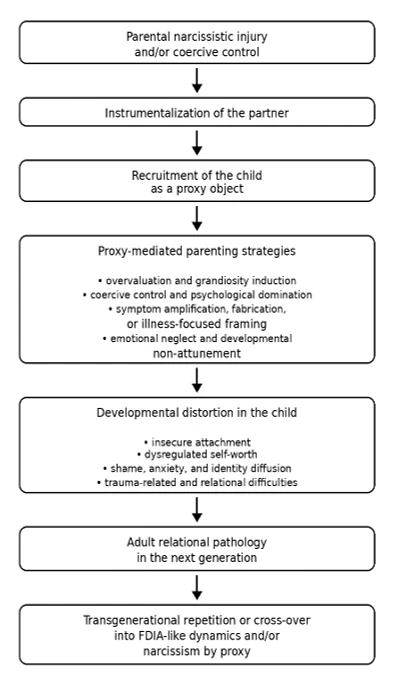
Figure 1. Proposed transgenerational pathway linking narcissistic regulation, proxy use of the child, and cross-over with FDIA.
Legend. The figure presents a conceptual transgenerational sequence in which parental narcissistic injury and/or coercive control lead to the instrumentalization of the partner and the recruitment of the child as a proxy object. In this model, the child becomes the medium through which parental self-esteem regulation, domination, retaliation, symbolic continuity, or illness-based validation is enacted. Proxy-mediated parenting strategies may include overvaluation, grandiosity induction, coercive control, symptom amplification or fabrication, emotional neglect, and developmental non-attunement. Over time, these dynamics may contribute to developmental distortion in the child, including insecure attachment, dysregulated self-worth, shame, anxiety, identity diffusion, and trauma-related relational difficulties, thereby increasing the likelihood of repetition or cross-over into FDIA-like dynamics and/or narcissism by proxy in the next generation.
This schematic is not intended as a validated causal model, but as a conceptual formulation designed to organize clinical observations and existing theoretical strands into a coherent transgenerational framework.
6. Narcissism by Proxy in the Digital Era
6.1. Social media amplification of proxy dynamics
The digital era has created new conditions for the amplification of proxy-mediated family dynamics. Social media platforms, continuous public visibility, algorithmic comparison, and the performative display of parenting may intensify pre-existing narcissistic and coercive patterns by offering constant opportunities for admiration, validation, competition, and public positioning. Under such conditions, the child may increasingly become not only a private relational extension of the parent, but also a public symbolic object through whom parental identity is displayed and regulated.
In families marked by narcissism by proxy, the child may be presented online as exceptional, gifted, highly intelligent, uniquely talented, unusually sensitive, or unjustly misunderstood. Such public presentation may serve to reinforce the parent’s self-image, specialness, or moral authority. The child’s achievements, traits, developmental profile, or even vulnerabilities may be selectively curated and displayed in ways that support the parental narrative. In this sense, digital culture may not create narcissism by proxy, but it may provide an especially powerful infrastructure for its expression and reinforcement.
The digital environment also expands the available audience. Whereas earlier proxy dynamics may have unfolded mainly within the family or immediate social network, contemporary parents may seek admiration, sympathy, alignment, or legitimacy from much wider publics. The child’s image, behavior, symptoms, or developmental trajectory may thus be woven into a broader economy of visibility, comparison, and reaction. The child becomes more easily recruitable as a public carrier of parental status, suffering, grievance, or symbolic value.
6.2. Digital coercive control and online family organization
The digital era has also broadened the forms of coercive control that may structure family life. Surveillance through phones, messages, social media, location tracking, shared accounts, and continuous digital access may extend the reach of domination beyond physical proximity. These technologies may be used to monitor the partner, undermine boundaries, sustain conflict, and organize family relations through chronic intrusion. In such settings, the child may become a central node within a wider digital system of control.
Within proxy-mediated family dynamics, the child may be used not only emotionally but also digitally: as a source of information, as a pretext for contact, as a public symbol, or as a relational lever through which the other parent is destabilized, bypassed, or kept engaged. Online exposure of the child, selective sharing of developmental or medical narratives, and the digital performance of caregiving may all function within this broader structure. What appears outwardly as parental involvement or concern may therefore also serve a coercive or narcissistically regulatory purpose.
These dynamics may also contribute to an apparent convergence between genders in proxy-related mechanisms in the digital era. Earlier cultural patterns may have associated enhancement-based proxy dynamics more often with fathers and illness-based caregiving dynamics more often with mothers. However, social media, digital parenting, and changing forms of relational control may be making both modes more available to both sexes. In this sense, the digital era may not only amplify proxy dynamics, but also reorganize their social expression.
6.3. Screen-mediated developmental harm and addiction induction
In the authors’ clinical observations, screen exposure in infancy and early childhood may, in some families, function not merely as a parenting failure, a regulatory shortcut, or a symptom of poor digital hygiene, but as a proxy-mediated relational instrument.
Screens may be especially suited to proxy-mediated family use because they are low-cost, highly accessible, socially tolerated, and capable of producing rapid behavioral capture, dysregulation, and addictive functioning in very young children. Unlike more visible forms of developmental harm, screen-based overexposure can be repeatedly administered by almost any caregiving figure without immediate external scrutiny.
This appears especially relevant in children aged 0–3 years, where intensive or repeated screen exposure may interfere with affect regulation, language development, attention, attachment processes, and overall developmental organization. In such cases, the screen may be introduced or maintained not only for convenience, but also because its dysregulating effects serve a broader family function (Manolova et al., 2025; Petrova et al., 2025; Vezenkov & Manolova, 2025; Manolova & Vezenkov, 2025a; 2025b).
Within FDIA-like dynamics, screens may serve as a covert, non-medical means of sustaining symptoms, developmental delay, emotional dysregulation, sleep disturbance, communication difficulties, and regression. This makes screen exposure and screen addiction particularly useful where the caregiver benefits from preserving the child’s fragility, chronicity, treatment resistance, or need for continued therapeutic attention. In such a configuration, the child’s impairment is not simply tolerated; it may become psychologically useful within an illness-based proxy narrative. The child’s compromised functioning may support repeated appeals to sympathy, therapeutic attention, special treatment, or moral validation.
Within narcissism by proxy, screen addiction may help preserve emotional fusion, controllability, and symbolic possession of the child. The more dysregulated, addicted, screen traumatized or compromised the child remains, the easier it may be to prevent separation, block autonomous development, stage selective forms of specialness or suffering, and keep the other parent in a position of chronic reactivity, helplessness, or defensive engagement.
This dynamic may become especially visible during recovery from early screen addiction. Rather than supporting a structured screen detoxification process, one caregiver may deliberately, strategically, or functionally reintroduce screens despite clear signs of deterioration, regression, or renewed addiction and traumatization. In such situations, screen re-exposure may serve as a form of “recharging” the child into dysregulated functioning. The child is thereby kept in a state of heightened addictive functioning, traumatization and reduced autonomy, while the interparental conflict is prolonged through the child’s symptoms, behavior, and impaired recovery (Manolova & Vezenkov, 2025; Petrov et al., 2025; Petrova et al., 2025).
In this sense, the screen may become a proxy tool through which one parent “holds” the other parent by holding the child in impairment, dependency, or chronic developmental instability. The child’s ongoing dysregulation then serves multiple adult functions at once: it may justify control, preserve emotional fusion, maintain caregiving centrality, produce conflict leverage, or block the child’s movement toward autonomy and recovery. What appears superficially as permissiveness, inconsistency, or poor judgment may therefore, in some cases, reflect a deeper proxy-based family organization.
For this reason, screen use in such family systems should not always be interpreted only in behavioral or educational terms. In some cases, it may represent a form of screen-mediated proxy harm, in which screen addiction and screen trauma are used to organize attachment, dependency, developmental distortion, and parental leverage within the family system. This possibility is particularly important in clinical work with children presenting with early screen addiction, developmental regression, autism-like symptoms, ADHD-related dysregulation, or marked fluctuation in functioning across caregiving contexts (Manolova et al., 2025; Petrov et al., 2025; Petrova et al., 2025; Vezenkov & Manolova, 2025).
Importantly, this mechanism is not limited to parents. Grandparents, extended family members, babysitters, and other caregivers may also participate in screen addiction, screen trauma and screen-mediated dependency induction, whether consciously or functionally, by repeatedly providing screens in ways that undermine recovery, weaken parental boundaries, or preserve the child in a state of regression, passivity, or heightened behavioral dependence and traumatization. The broader the caregiving network, the easier it may become to normalize such exposure and to maintain the child’s impaired functioning across settings.
7. Other Relational Configurations of Narcissism by Proxy
7.1. Extended family proxy dynamics
Narcissism by proxy is not limited to the mother-father-child triangle. Another form of narcissism by proxy may occur between the mother or father of one parent and the other parent, or through that parent’s own child and/or children. A classical example is the mother-in-law/daughter-in-law relationship mediated through the son as proxy, or the father-in-law/son-in-law relationship mediated through the daughter as proxy. Similar dynamics may also occur between parent and adult child through the grandchild as proxy.
In such configurations, the proxy mechanism remains structurally similar: one person does not engage the target directly as an autonomous relational other, but instead acts through an intermediary who carries emotional, symbolic, or power-regulatory functions. The proxy may be an adult son, an adult daughter, or a child in the next generation. What is preserved across these variations is the indirect organization of domination, loyalty, control, grievance, or narcissistic entitlement through a third person.
This broader formulation suggests that narcissism by proxy should not be understood narrowly as a phenomenon limited to biological parents of minor children. Rather, it may describe a wider family-system logic in which unresolved narcissistic dynamics are displaced onto intermediary relational figures. However, the developmental consequences are especially severe when the proxy is a child, because the child’s emotional, cognitive, and relational organization is still forming and therefore more vulnerable to long-term distortion.
7.2. Grandparental forms and contemporary caregiving patterns
A particularly important contemporary variation involves narcissistic grandparents who maintain control over their daughters or sons through harmful involvement with the grandchildren, most often through overly indulgent, overprotective, or overpermissive caregiving styles. In such cases, the grandparent may not appear overtly violent. Instead, the controlling function may be embedded in apparently loving, generous, or highly involved caregiving. Yet this involvement may carry a coercive or undermining family function, especially when it weakens parental authority, recruits the grandchild into loyalty conflicts, or uses the child to regulate tensions between generations.
Under contemporary conditions, one increasingly important example is the permissive, excessive, or strategically undermining introduction of screen devices by grandparents and other caregivers. In the authors’ clinical perspective, screens may function here not merely as a convenience or indulgence, but as a subtle means of alliance formation, sedation, screen addiction and screen trauma induction, and boundary violation within the family system. Because screen use is easy to administer and culturally normalized, it can become an especially effective transgenerational proxy tool: the child is calmed, captured, or dysregulated; parental limits are weakened; and the caregiving figure strengthens his or her position within the family through the child’s altered functioning.
These observations are consistent with the broader claim of the present article: narcissism by proxy may take multiple relational forms, but in each of them the child or younger family member risks becoming the site through which unresolved adult or intergenerational conflicts are enacted. The outward form may differ—achievement, illness, indulgence, rescue, or special treatment—but the proxy logic remains the same.
8. Clinical Implications
8.1. Assessment beyond the child’s symptoms
Clinical work with such families requires an assessment not only of the child’s symptoms, but also of the relational function those symptoms perform within the family system. In families marked by narcissism by proxy, FDIA, coercive control, or related proxy-mediated dynamics, the child’s presentation cannot be understood adequately in isolation. Symptoms may carry interpersonal meaning: they may stabilize parental roles, support family narratives, organize loyalty, express conflict, or serve as instruments of validation, revenge, or control.
For this reason, the assessment should extend beyond the child’s observable behavior or diagnostic profile and include the structure of parental relations, patterns of idealization and devaluation, forms of coercive control, asymmetries of power, and the degree to which the child has been drawn into interparental conflict. Special attention should be paid to discrepancies between how the child is presented in public, school, medical, and therapeutic contexts. Such discrepancies may indicate that the child’s difficulties are being organized differently depending on the audience and the parental narrative being advanced.
8.2. Relational red flags
Particularly important are patterns of overvaluation, instrumentalization, coercive control, digital surveillance, parental conflict, and inconsistency across institutional settings. In narcissism by proxy, one may observe exaggerated claims regarding the child’s exceptionalism, superiority, talent, fragility, or special status, often accompanied by pressure for privilege, intolerance of criticism, or emotional punishment in response to failure or shame. In FDIA-like presentations, one may observe repeated medical narratives, persistent emphasis on symptoms, pressure on institutions, inconsistencies between reported and observed functioning, or deterioration that appears closely linked to a specific caregiver’s presence or account.
The role of the other parent should also be carefully evaluated. One parent may be discredited, marginalized, or described as incapable of understanding the child’s needs, while the other assumes the position of exclusive interpreter of the child’s condition, value, or suffering. Such splitting processes may signal a proxy dynamic in which the child has become the terrain upon which adult conflict is enacted.
In the digital era, these red flags may also include technological monitoring, public exposure of the child, online performance of suffering or achievement, and the use of screen devices as tools of pacification, alliance-building, or relational manipulation. What appears as ordinary caregiving or parental involvement may therefore conceal more complex forms of developmental intrusion.
Additional red flags include repeated screen administration by a specific caregiver despite clear developmental concern; rapid deterioration after visits with a particular parent, grandparent, or caregiving figure; repeated undermining of agreed screen detoxification plans; normalization of heavy screen use in children aged 0–3 years; and caregiver behaviors that appear to preserve passivity, dysregulation, sleep disruption, language delay, or treatment non-response rather than support developmental recovery.
8.3. Implications for intervention
Interventions in such cases should aim at restoring the child’s subjectivity and developmental autonomy. This requires shifting the focus from the child as carrier of parental narratives toward the child as a person with independent emotional, relational, and developmental needs. Clinical work should therefore seek to identify and limit proxy dynamics, reduce triangulation, and strengthen safe, consistent, and reality-based caregiving.
A trauma-informed approach is essential. Because these children may present with anxiety, dysregulation, attachment insecurity, perfectionism, shame, behavioral disturbance, or developmental regression, intervention should not treat symptoms as isolated deficits alone. Rather, treatment should take into account the broader family ecology in which the child’s difficulties emerged and are maintained. This may include work on parental boundaries, reduction of coercive family patterns, improved reflective functioning, and protection of the child from being used as an instrument in adult conflict.
Where FDIA-like or severe coercive dynamics are suspected, careful multidisciplinary coordination may be necessary, including input from mental health, educational, social, and medical professionals. In all cases, triangulation of information across family report, school observation, therapy process, and, where relevant, medical data is especially important. The central clinical principle remains the same: the more the child is being used to regulate adult needs, the more urgent it becomes to re-establish developmental protection, continuity of care, and the child’s right to exist outside the proxy role.
9. Limitations
The proposed term narcissism by proxy does not represent an established diagnostic category, but rather a conceptual formulation derived from literature review, developmental interpretation, and clinical observation. Accordingly, its validity, boundaries, and distinctiveness in relation to adjacent phenomena remain to be established empirically. The present article therefore does not claim diagnostic finality, but proposes a clinically informed framework intended to organize a set of recurring relational observations that may otherwise remain fragmented across different fields of inquiry.
A first limitation concerns the construct’s overlap with already existing concepts. Narcissism by proxy may intersect with pathological narcissism, coercive control, parentification, enmeshment, achievement-by-proxy dynamics, emotional abuse, and FDIA. Although the present article argues that the proposed construct has a specific proxy-based triangular structure involving partner instrumentalization and child recruitment into adult self-regulation or conflict, its differentiation from these neighboring constructs requires further conceptual clarification and empirical testing.
A second limitation concerns the article’s transgenerational and epigenetic-interpersonal claims. Although existing literature supports the broader idea that chronic adversity, maladaptive parenting, and relational trauma may be transmitted across generations through developmental, relational, and possibly biological pathways, the specific mechanisms proposed here remain theoretical. The present model should therefore be understood as a hypothesis-generating framework rather than a validated explanatory system. Longitudinal, multimethod, and intergenerational studies would be necessary in order to test whether and how these proposed pathways operate.
A third limitation concerns the clinical basis of the formulation. Because the construct has been shaped partly through repeated therapeutic observations in families of children with severe early screen addiction and neurodevelopmental vulnerability, it may be influenced by selection bias and by the particular characteristics of this clinical population. The observations described here may not generalize automatically to all family systems or all forms of narcissistic parenting. At the same time, this clinical origin is also one of the reasons why the construct may have heuristic value: it emerged not from abstract speculation alone, but from attempts to make sense of recurring family patterns that appeared insufficiently captured by existing terminology.
Finally, the digital-era dimension of the argument also requires caution. Although the article proposes that social media, technological surveillance, and screen-mediated family practices may amplify proxy-based dynamics, the scope and direction of these effects remain to be studied systematically. The digital context should therefore be treated not as a proven causal variable in the present model, but as a contemporary condition that may intensify already existing vulnerabilities in family organization, narcissistic regulation, and proxy-mediated child instrumentalization.
Taken together, these limitations do not invalidate the usefulness of the proposed construct, but they do define its proper status. Narcissism by proxy should be approached as a provisional conceptual tool with potential clinical and theoretical value, pending clearer operationalization and empirical validation.
10. Directions for Future Research
Future research should aim to establish operational criteria for narcissism by proxy in order to improve conceptual clarity, support differential formulation, and facilitate clinical recognition. At present, the construct is proposed as a clinically informed theoretical model; its next developmental step is therefore methodological refinement. Clearer criteria would help distinguish narcissism by proxy from related phenomena such as pathological narcissism, coercive control, FDIA, enmeshment, parentification, and achievement-by-proxy dynamics.
A second priority is the systematic comparison of narcissism by proxy with FDIA and coercive control. The present article argues that these constructs share an underlying proxy logic while differing in dominant motivational organization and narrative presentation. Future studies should test whether they represent distinct categories, overlapping syndromes, different expressions along a shared spectrum, or sequential/cross-over configurations within the same family system. Such work would be especially valuable in clarifying where enhancement-based and illness-based proxy use converge and where they diverge.
Longitudinal family studies would be particularly important in tracing the developmental and transgenerational pathways through which such dynamics emerge, consolidate, and persist over time. If the proposed model is valid, then proxy-mediated family roles should be observable not only cross-sectionally but also developmentally, with identifiable patterns linking parental narcissistic injury, child instrumentalization, developmental distortion, and later adult relational style. Intergenerational research designs would be especially relevant for testing the hypothesis that proxy-based family violence may be repeated, crossed over, or transformed in the next generation.
In addition, mixed-method clinical studies combining qualitative observation, case-based formulation, structured interviews, and quantitative measures may help clarify both the phenomenology and the mechanisms involved. Because the construct concerns relational process rather than a single overt behavior, it is unlikely to be captured adequately by questionnaire data alone. Rich clinical and family-system data will be needed in order to understand how proxy roles are assigned, maintained, resisted, or internalized.
Special attention should also be given to the role of screen exposure and digital mediation, especially in relation to parental display, surveillance, symbolic competition, and proxy regulation through the child. The digital era may have created new channels through which the child can be used as a public extension of parental identity, suffering, moral positioning, or status. Future work should therefore explore whether digital environments merely amplify pre-existing dynamics or whether they generate qualitatively new forms of proxy-mediated family organization.
Finally, future studies should examine the apparent convergence between genders in proxy-related mechanisms in the digital era, including whether these dynamics are becoming more symmetrical in form, frequency, or social expression. Earlier formulations may have associated enhancement-based proxy dynamics more strongly with fathers and illness-based proxy dynamics more strongly with mothers, but these assumptions may no longer be sufficient. Contemporary research should investigate whether the digital and cultural reorganization of parenting, self-presentation, and control is altering the gender distribution and relational expression of proxy-based pathology.
Taken together, these directions suggest that future research on narcissism by proxy should move simultaneously toward conceptual clarification, comparative diagnosis, developmental validation, and contemporary cultural analysis. Only through such work can the proposed construct be properly assessed, refined, or rejected.
11. Conclusion
The present article proposes narcissism by proxy as a conceptual clinical construct describing a family dynamic in which the child is used as a means of regulating parental self-worth, status, control, symbolic continuity, or retaliation within a broader field of relational conflict. In this model, the child is not encountered primarily as a separate subject with autonomous developmental needs, but as a carrier of parental identity, injury, superiority, grievance, or unmet psychological demands. As a result, the child may be overvalued, displayed, pressured, emotionally neglected, or directly harmed.
The proposed framework places narcissism by proxy and Factitious Disorder Imposed on Another (FDIA) within a shared field of proxy-mediated violence, in which the child becomes the medium through which unresolved conflict, disturbed attachment, pathological self-regulation, and coercive control are enacted. Although the two phenomena differ in their dominant reward structure—admiration, prestige, and symbolic elevation in the case of narcissism by proxy; sympathy, medical legitimacy, and caregiving validation in the case of FDIA—they appear to share a deeper common mechanism: the use of the child as an external regulator of adult deficits and relational instability.
The article further argues that these processes may be intensified in the digital era, where social media, continuous visibility, public performance, comparison, technological surveillance, and screen-mediated caregiving create new opportunities for proxy-based family organization. Under such conditions, the child may increasingly become not only a private extension of parental dynamics, but also a public carrier of parental narratives, identity claims, suffering, or grandiosity.
At the same time, the present text does not propose a validated diagnostic category, but rather a hypothetical, clinically informed, transgenerational model that requires empirical examination. The construct is intended as a heuristic and integrative framework that may help organize recurrent observations at the intersection of pathological narcissism, coercive control, FDIA, developmental trauma, and proxy-mediated child abuse. Its value lies not in terminological novelty alone, but in its capacity to draw attention to those hidden forms of family violence in which adult wars are conducted on the territory of the child and may be transmitted across generations if not recognized, treated, and prevented.
In this sense, the central contribution of the present article is to suggest that beyond genetic inheritance, another form of inheritance may be openly transmitted through parenting, caregiving, and relational positioning across generations. Some secrets and distortions may never be fully spoken, yet their effects become visible in the child’s development, suffering, identity, and later adult life. To recognize these dynamics early is therefore not only a theoretical task, but a clinical and ethical one.
References
Brummelman, E., Thomaes, S., Nelemans, S. A., Orobio de Castro, B., Overbeek, G., & Bushman, B. J. (2015). Origins of narcissism in children. Proceedings of the National Academy of Sciences, 112(12), 3659–3662. https://doi.org/10.1073/pnas.1420870112
Carter, J. (2015). Patriarchy and violence against women and girls. The Lancet, 385(9978), e40–e41. https://doi.org/10.1016/S0140-6736(14)62217-0
Dentale, F. (2015). Relationship between Parental Narcissism and Children’s Mental Vulnerability: Mediation Role of Rearing Style. International Journal of Psychology and Psychological Therapy, 15(3), 337–347.
Dutton, D. G. (2006). The Abusive Personality: Violence and Control in Intimate Relationships. Guilford Press.
Felitti, V. J., Anda, R. F., Nordenberg, D., Williamson, D. F., Spitz, A. M., Edwards, V., Koss, M. P., & Marks, J. S. (1998). Relationship of Childhood Abuse and Household Dysfunction to Many of the Leading Causes of Death in Adults: The Adverse Childhood Experiences (ACE) Study. American Journal of Preventive Medicine, 14(4), 245–258. https://doi.org/10.1016/S0749-3797(98)00017-8
Fonagy, P., & Target, M. (1997). Attachment and reflective function: Their role in self-organization. Development and Psychopathology, 9(4), 679–700. https://doi.org/10.1017/S0954579497001399
Freud, S. (1914). On narcissism: An introduction. Read Books Ltd. https://books.google.com/books?hl=en&lr=&id=ZXx-CgAAQBAJ&oi=fnd&pg=PT4&dq=Freud,+S.+(1914)+%E2%80%93+On+Narcissism:+An+Introduction&ots=_A2yON5tYB&sig=IJLNx8UCDfs2keNpFWLHapImmkQ
García-Moreno, C., Pallitto, C., Devries, K., Stöckl, H., Watts, C., & Abrahams, N. (2013). Global and Regional Estimates of Violence Against Women: Prevalence and Health Effects of Intimate Partner Violence and Non-partner Sexual Violence. World Health Organization.
García-Moreno, C., Zimmerman, C., Morris-Gehring, A., Heise, L., Amin, A., Abrahams, N., Montoya, O., Bhate-Deosthali, P., Kilonzo, N., & Watts, C. (2015). Addressing violence against women: A call to action. The Lancet, 385(9978), 1685–1695. https://doi.org/10.1016/S0140-6736(14)61830-4
Hart, C. M., Bush-Evans, R. D., Hepper, E. G., & Hickman, H. M. (2017). The children of narcissus: Insights into narcissists’ parenting styles. Personality and Individual Differences, 117, 249–254. https://doi.org/10.1016/j.paid.2017.06.019
Herman, J. L. (2015). Trauma and Recovery: The Aftermath of Violence--From Domestic Abuse to Political Terror. Hachette UK.
Hewitt, J. M. A., Kealy, D., Hewitt, P. L., Ko, A., Chen, C., Brugnera, A., Madigan, S., & Birch, S. (2024). Parental pathological narcissism and child depression: The indirect effects of child attachment and perspective taking. Current Psychology, 43(19), 17039–17048. https://doi.org/10.1007/s12144-024-05683-5
Johnson, M. P. (2012). A Typology of Domestic Violence: Intimate Terrorism, Violent Resistance, and Situational Couple Violence. UPNE.
Kernberg, O. (1975). Borderline Conditions and Pathological Narcissism.
Kohut, H. (2009a). The Analysis of the Self: A Systematic Approach to the Psychoanalytic Treatment of Narcissistic Personality Disorders. University of Chicago Press.
Kohut, H. (2009b). The Restoration of the Self. University of Chicago Press.
Krizan, Z., & Herlache, A. D. (2018). The Narcissism Spectrum Model: A Synthetic View of Narcissistic Personality. Personality and Social Psychology Review, 22(1), 3–31. https://doi.org/10.1177/1088868316685018
Loewenstein, S. (1977). An overview of the Concept of Narcissism. Social Casework, 58(3), 136–142. https://doi.org/10.1177/104438947705800302
Luo, Y. L. L., Cai, H., & Song, H. (2014). A Behavioral Genetic Study of Intrapersonal and Interpersonal Dimensions of Narcissism. PLoS ONE, 9(4), e93403. https://doi.org/10.1371/journal.pone.0093403
Manolova, V., Pashina, I., Mateev, M., & Vezenkov, S. (2025). Munchausen Syndrome by Proxy and Other Forms of Parental Abuse in Children with Screen Addiction and a Diagnosis of Autism (ASD) and/or ADHD. Nootism, 1(2), 11–30. https://doi.org/10.64441/nootism.1.2.2
Manolova, V., & Vezenkov, S. (2025a). Parental Models: A Profile of the Dynamics in Children Dropping Out of Therapy Programs for Screen Addiction. Nootism, 1(1), 96–100. https://doi.org/10.64441/nootism.2NCSC.11
Manolova, V., & Vezenkov, S. (2025b). Screen Trauma – Specifics of the Disorder and Therapy in Adults and Children. Nootism, 1(1), 37–51. https://doi.org/10.64441/nootism.2NCSC.3
Manolova, V., & Vezenkov, S. (2025a). Parental Models: A Profile of the Dynamics in Children Dropping Out of Therapy Programs for Screen Addiction. Nootism, 1(1), 96–100. https://doi.org/10.64441/nootism.2NCSC.11
Manolova, V., & Vezenkov, S. (2025b). Unified Trauma-Addiction Functioning Model. Nootism, 1(4), 4–24. https://doi.org/10.64441/nootism.1.4.1
Michell, G. (1989). The Reproduction of Narcissism. Women & Therapy, 7(4), 35–52. https://doi.org/10.1300/J015V07N04_04
Miller, A. (2008). The Drama of the Gifted Child: The Search for the True Self. Hachette UK. https://books.google.com/books?hl=bg&lr=&id=ygE5DgAAQBAJ&oi=fnd&pg=PT8&ots=1R789eAiEq&sig=W5mhhBKjZpzPxHJQqZvTUMhjt8k
Morf, C. C., & Rhodewalt, F. (2001). Unraveling the Paradoxes of Narcissism: A Dynamic Self-Regulatory Processing Model. Psychological Inquiry, 12(4), 177–196. https://doi.org/10.1207/S15327965PLI1204_1
Pashina, I., Manolova, V., & Vezenkov, S. (2025). Parental Recovery as a Key Factor for the Recovery of Children with Screen Addiction – Biofeedback Therapy for Severe Disorders. Nootism, 1(1), 83–89. https://doi.org/10.64441/nootism.2NCSC.9
Petkova, S., Manolova, V., & Vezenkov, S. (2025). Restoring Attachment in Children with Early Screen Addiction. Nootism, 1(1), 74–78. https://doi.org/10.64441/nootism.2NCSC.7
Petrov, P., Manolova, V., & Vezenkov, S. (2025). Hidden Family Dynamics in a Case Study of a Child with Screen Addiction, Hyperactivity, and Language Deficits. Nootism, 1(1), 90–95. https://doi.org/10.64441/nootism.2NCSC.10
Petrova, S., Manolova, V., & Vezenkov, S. (2025). Reintroducing Screens: Severe Regression and Symptom Aggravation in Children with ASD/Screen Addiction. Nootism, 1(1), 59–65. https://doi.org/10.64441/nootism.2NCSC.5
Philipson, I. (1982). Narcissism and mothering: The 1950s reconsidered. Women’s Studies International Forum, 5(1), 29–40. https://doi.org/10.1016/0277-5395(82)90063-2
Pincus, A. L., & Lukowitsky, M. R. (2010). Pathological Narcissism and Narcissistic Personality Disorder. Annual Review of Clinical Psychology, 6(Volume 6, 2010), 421–446. https://doi.org/10.1146/annurev.clinpsy.121208.131215
Ronningstam, E. (2009). Narcissistic Personality Disorder: Facing DSM-V. Psychiatric Annals, 39(3), 111–121. https://doi.org/10.3928/00485713-20090301-09
Rosenthal, S. A., Hooley, J. M., Montoya, R. M., van der Linden, S. L., & Steshenko, Y. (2020). The Narcissistic Grandiosity Scale: A Measure to Distinguish Narcissistic Grandiosity From High Self-Esteem. Assessment, 27(3), 487–507. https://doi.org/10.1177/1073191119858410
Samarasekera, U., & Horton, R. (2015). Prevention of violence against women and girls: A new chapter. The Lancet, 385(9977), 1480–1482. https://doi.org/10.1016/S0140-6736(14)61775-X
Slade, A. (2005). Parental reflective functioning: An introduction. Attachment & Human Development, 7(3), 269–281. https://doi.org/10.1080/14616730500245906
Stark, E. (2007). Coercive control: How men entrap women in personal life. Oxford University Press. https://books.google.com/books?hl=en&lr=&id=rm8CPqTiDWMC&oi=fnd&pg=PR11&dq=Coercive+Control:+How+Men+Entrap+Women+in+Personal+Life&ots=b2GgdMWJ6x&sig=7ODfpDI3ubP2YgFoe4R6_uKUG6M
Temmerman, M. (2015). Research priorities to address violence against women and girls. The Lancet, 385(9978), e38–e40. https://doi.org/10.1016/S0140-6736(14)61840-7
Toth, S. L., & Cicchetti, D. (2013). A Developmental Psychopathology Perspective on Child Maltreatment. Child Maltreatment, 18(3), 135–139. https://doi.org/10.1177/1077559513500380
UNICEF. (2024, June 11). Nearly 400 million young children worldwide regularly experience violent discipline at home. https://www.unicef.org/press-releases/nearly-400-million-young-children-worldwide-regularly-experience-violent-discipline
van der Kolk, B. A. (2014). The body keeps the score: Brain, mind, and body in the healing of trauma (pp. xvi, 443). Viking.
Vezenkov, S., & Manolova, V. (2025). Neurobiology of Autism/Early Screen Addiction Recovery. Nootism, 1, 19–36. https://doi.org/10.64441/nootism.2NCSC.2
Walker, L. E. (1979). The Battered woman (1st ed). Harper & Row.
WHO. (2024, November 5). Child maltreatment. https://www.who.int/news-room/fact-sheets/detail/child-maltreatment