


Stoyan R. Vezenkov and Violeta R. Manolova
Center for applied neuroscience Vezenkov, BG-1582 Sofia, e-mail: info@vezenkov.com
For citation: Vezenkov, S.R. and Manolova V.R. (2026) Two Safeties, Ten States: A Clinical-Functional Ontology of Human Regulatory States Beyond the Polyvagal Debate. Nootism 2 (3), 4-37, https://doi.org/10.64441/nootism.2.3.1
Abstract
Objective. Current trauma-informed clinical practice and autonomic monitoring require a more differentiated regulatory-state ontology than existing stress/recovery models. While Polyvagal theory provided an influential map for three decades, its anatomical and psychophysiological premises are the subject of an unresolved dispute: they have been challenged as untenable and defended as mischaracterized by that challenge. This paper does not adjudicate the dispute. It brackets the contested claims and reconstructs the inherited clinical map at a methodologically explicit functional level, preserving its clinical utility on grounds that do not depend on the outcome.
Approach. We specify a three-level framework distinguishing anatomical, psychophysiological, and clinical-functional claims. By translating polyvagal vocabulary into level-explicit terminology, we define regulatory states as functional configurations rather than direct expressions of discrete neural pathways.
Proposed framework. We propose a ten-state ontology organized along seven functional axes: safety appraisal, arousal, flexibility, social availability, source of regulation, internal integration, and reality-referencing. These states are grouped into three families: open (relational) safety, defense, and closed safety. Beyond preserving the inherited map, the framework adds three original specifications: the distinction between open safety, which preserves access to a shared world, and closed safety, which quiets the organism by narrowing it; the reality-referencing axis, which separates a system anchored in a shared world from one anchored in a self-referential field; and, on that axis, the differentiation of two closed-safety attractors – cue-bound contractive closure (C1), in which consensual reality remains the avoided reference, and self-referential closure (C2), in which the operational criterion of reality has migrated inward. The ten-state map further adds low-arousal relational co-regulation (O5), separating solitary restorative rest from active, low-demand relational contact.
Conclusions. By changing the level of analysis rather than taking a side in the dispute, this reconstruction preserves the utility of the inherited clinical map while specifying new state discriminations and falsifiable predictions, each answerable to evidence at its own level. A central prediction addresses a common autonomic–relational dissociation: deep inverted-referent states may display favorable autonomic indices despite severe impairment in shared-world access. The result is a five-way discrimination among configurations that may all present as quiet – restorative regulation (O1), low-arousal relational co-regulation (O5), defensive collapse (D3), cue-bound contractive closure (C1), and self-referential closure (C2) – which the inherited three-state map could not state. Open safety is therefore not autonomic quieting as such, but regulation that preserves access to shared reality, reciprocal contact, and developmental movement.
Keywords: polyvagal theory; regulatory states; open safety; closed safety; reality-referencing; self-referential closure; screen trauma; HRV interpretation
1. Introduction
Why the polyvagal debate matters and why clinical practice still needs a map
Over the past three decades, Polyvagal theory has profoundly shaped trauma, attachment, and somatic therapies by offering a cohesive three-state map: social engagement, sympathetic mobilization, and dorsal-vagal shutdown (Porges, 1995, 2001, 2003, 2007a, 2009, 2021, 2023, 2025c, 2025b, 2025a, 2026; Porges et al., 1999). For many clinicians, this framework transformed a heterogeneous collection of techniques into an integrated clinical practice.
This influence has been accompanied by a sustained critique of the theory’s anatomical and psychophysiological commitments. Grossman (2023), drawing on decades of work in comparative anatomy and respiratory psychophysiology (Grossman, 2023; Grossman & Taylor, 2007), argues that the theory’s principal premises – the nucleus-ambiguus/dorsal-motor-nucleus specificity for RSA versus bradycardia, the uniquely mammalian status of RSA, and RSA as a direct index of cardiac vagal tone – do not survive contact with the evidence. The critique has since been consolidated into a multi-author evaluation (Grossman et al., 2026), and Porges has replied both earlier and directly to that evaluation (Porges, 2023, 2025c, 2026). Porges's reply does not concede the anatomical premises; it contests the terms of the critique itself. He argues that the evaluation engages a reconstructed version of the theory rather than its published formulation – conflating neuroanatomical description with neurophysiological function; that within the theory RSA denotes a pathway-specific, respiratory-gated index of ventral (nucleus-ambiguus) cardioinhibition rather than a global measure of vagal tone, so that respiratory–cardiac coupling documented in non-mammalian species does not by itself adjudicate the claim; that the "consensus" the evaluation invokes reflects a self-selected position paper rather than a formal adjudicative procedure; and that disagreements over measurement do not amount to falsification unless they specify conditions under which the theory's stated mechanisms would fail (Porges, 2026). The exchange is therefore live rather than resolved, and the clinical user can no longer assume the foundations are settled. The argument developed here does not turn on its outcome: it brackets the anatomical and psychophysiological claims and asks what clinical-functional structure remains useful however the dispute is decided.
This debate leaves clinical users and the consumer wearable industry in a difficult position. Even if the anatomical version is definitively refuted, the inherited "safety versus threat" map remains too coarse to capture complex regulatory configurations encountered in practice. Phenomena such as freeze, dissociation, low-arousal shutdown, screen-induced regulatory regimes, and reality-inverting configurations are not adequately captured by a three-state model (Manolova & Vezenkov, 2025g; Vezenkov & Manolova, 2026).
The stakes extend into the wearable industry, where the standard inference—that high HRV and low movement automatically signify "recovery"—is a dangerous oversimplification. As this paper argues, a deeply withdrawn organism may display favorable autonomic indices precisely because it has minimized the unpredictability of the shared world; thus, favorable signals can mark successful pathological closure rather than recovery (Vezenkov, 2026).
This paper asks a targeted question: what clinical-functional state ontology remains useful after the anatomical claims of polyvagal theory are set aside? The aim is not to defend or refute the theory's anatomy, but to reconstruct its clinical map at a level of abstraction that preserves clinical contributions while extending the framework to encompass modern regulatory dysfunctions.
The contribution has four primary components:
- A methodological discipline distinguishing anatomical, psychophysiological, and clinical-functional claims.
- A translation of polyvagal vocabulary into level-explicit terminology that discharges anatomical commitments.
- A substantive clinical-functional ontology of ten regulatory states across seven axes. This includes three original specifications: the distinction between open and closed safety; the reality-referencing axis; and, on that axis, the differentiation of two closed-state attractors – cue-bound contractive closure (C1) and self-referential closure (C2).
- The introduction of boundary layers for access-to-world modes and cardiac-expression constraints (e.g., sleep, medication), allowing for accurate autonomic interpretation without artificially inflating the state count.
2. A Three-Level Discipline for Regulatory-State Claims
The methodological discipline that organizes the claims and circumscribes the commitments
The model makes claims at three structurally distinct levels – anatomical, psychophysiological, and clinical-functional – which carry different evidentiary requirements, different conditions of refutation, and different degrees of present confidence. Much of the polyvagal debate (Grossman, 2023; Grossman et al., 2026; Porges, 2023, 2025c) can be read as a controversy in which participants are not always operating at the same level, and in which arguments persuasive at one level have been mis-applied to claims at another. This section makes the three levels explicit, declares the model’s commitments at each, and sets out the operational rules that govern the remainder of the paper (Figure 1).
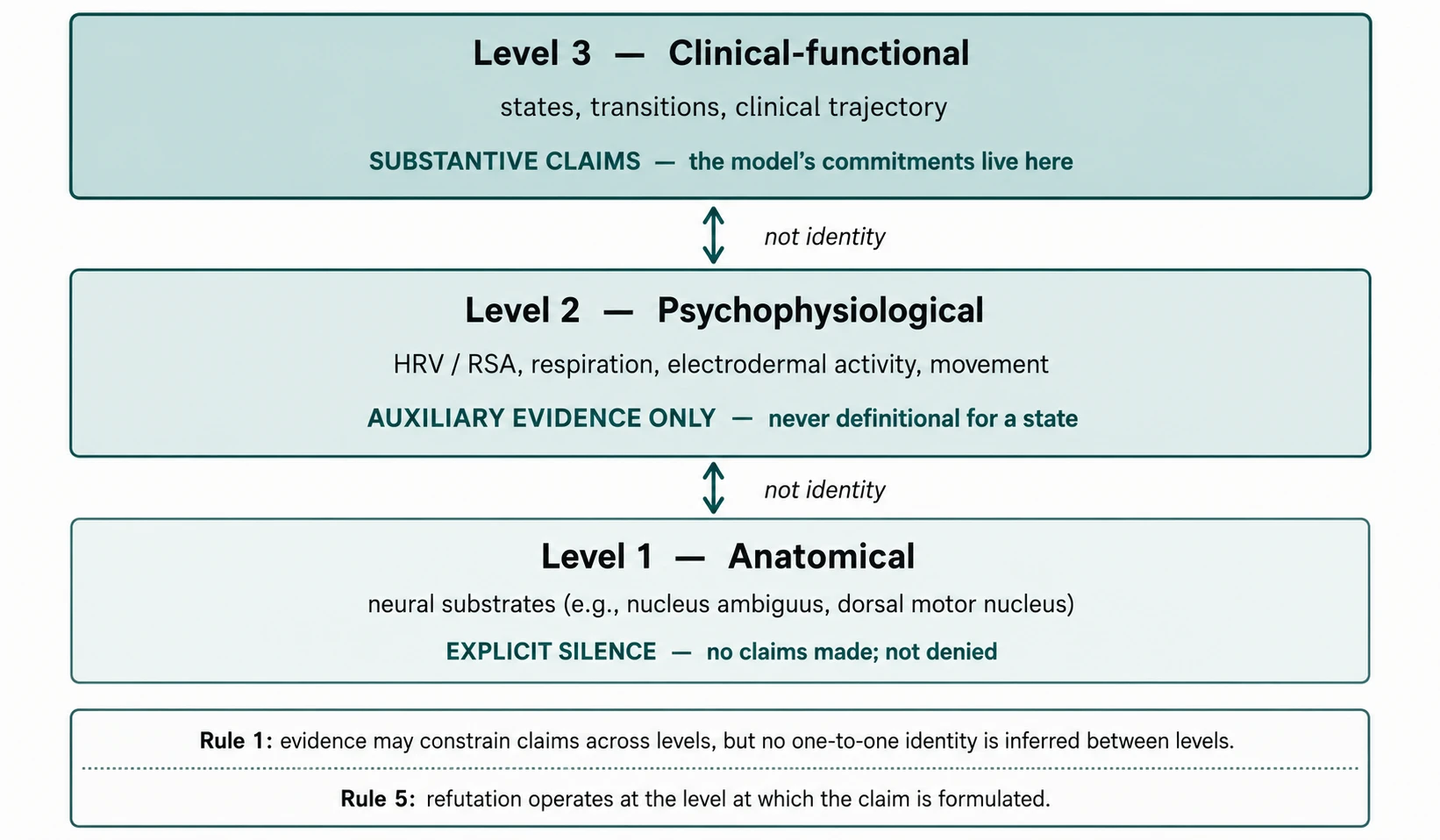
Figure 1. The three-level claim discipline. The three levels carry different evidence and different conditions of refutation. The model’s commitments are concentrated at Level 3; Level 2 signals are auxiliary; Level 1 is left as an explicit silence. The vertical relations between levels are not identities, and evidence at one level may constrain, but does not by itself establish, a claim at another.
2.1 The Three Levels
Level 1: Anatomical claims concern the structural substrates of regulatory function – the existence, location, projections, and developmental trajectories of specific neural pathways. The paradigmatic polyvagal instances are claims about the nucleus ambiguus and the dorsal motor nucleus as substrates of the “ventral” and “dorsal” branches of the three-state map (Porges, 1995, 2007a, 2007b). These are the level at which the debate has been most extensively contested, with Grossman (2023) and Grossman et al. (2026) identifying divergences between the theory’s anatomical claims and the comparative-anatomical and neurophysiological literature. Evidentially they require comparative anatomy, neurophysiology, neuroimaging, and lesion studies; a Level 1 claim is refuted by showing the claimed substrate does not exist, is located elsewhere, or has a different projection or developmental trajectory.
Level 2: Psychophysiological claims concern the measurable signals that correlate with regulatory state – heart rate, HRV indices (RMSSD, HF-HRV, RSA), respiration, electrodermal activity, muscle activity (Berntson et al., 1991; Grossman & Taylor, 2007; Laborde et al., 2017; Quigley et al., 2021). The paradigmatic instances are claims about RSA as a measure of “vagal tone.” They require well-controlled studies with appropriate measurement and statistics; a Level 2 claim is refuted by showing the signal does not correlate with the claimed state, that the correlation is confounded (most prominently by respiration and physical activity; (Grossman & Taylor, 2007)), or that the measurement does not capture the attributed process.
Level 3: Clinical-functional claims concern the patterns of regulatory functioning observable in clinical and developmental contexts – state, transition, recovery, dysregulation, developmental trajectory – and their relationships to clinical phenomena. The paradigmatic polyvagal instances are claims about social engagement as the therapeutic target, defensive states as adaptive but problematic when chronically stabilized, and therapy as the restoration of flexibility under safety. They require clinical observation, longitudinal research, and the integration of multimodal evidence; such a claim is refuted by showing the patterns do not exist, do not correspond to the clinical phenomena attributed to them, that the entailed interventions are ineffective when properly tested, or that the predicted developmental trajectories do not occur.
2.2 Commitments at Each Level
The model operates principally at Level 3, uses Level 2 signals as multimodal auxiliary evidence, and makes no substantive Level 1 claims.
At Level 3 it makes substantive claims. The ten-state ontology (Section 4), the two-safeties distinction (Section 5), the two closed-state attractors and their trajectories (Section 6), the intervention logic (Section 7), and the predictions (Section 8) are all Level 3 claims about clinical patterns, functional configurations, and developmental trajectories. Low-arousal relational co-regulation (O5) is introduced as a Level 3 claim only: it is defined by its seven-axis profile and transition logic, not by oxytocin, HRV, vagal tone, or any single biomarker.
At Level 2 it uses signals as auxiliary evidence. HRV indices, respiration, electrodermal activity, and movement estimate the probability that a given configuration corresponds to a given state, in combination with behavioral observation, context, and subjective report. No Level 2 signal is treated as definitional for any Level 3 state. This discipline is sharpened by the state discriminations of Section 4: a favorable autonomic profile may indicate recovery, but it may equally indicate successful contractive closure or sealed inversion, and the autonomic plane cannot, by itself, distinguish the three. The autonomic signature is therefore retained throughout as Level 2 evidence and a source of falsifiable prediction (Section 8), never as a defining axis of any state.
At Level 1 it makes no substantive claims. The translation in Section 3 discharges the anatomical commitments of the original theory while preserving the clinical map: where polyvagal theory said “ventral vagal,” the present model says “open-safety family of states”; where it said “dorsal vagal,” “low-arousal defensive immobilization.” This silence is not a denial. The model does not claim the anatomical commitments are incorrect, nor that future neuroscience will not specify substrates for the states it articulates; it claims only that those questions are not its questions and that its clinical contribution is structurally independent of their resolution. The model is in this sense methodologically conservative – it claims less than polyvagal theory claimed, and is correspondingly less exposed at the levels where the theory has been most contested. This is the model’s primary structural relation to Grossman’s critique, and it is stated once here rather than repeated at each subsequent term.
2.3 Operational Rules for Cross-Level Inference and State Assignment
The three-level architecture is not intended to divide anatomy, psychophysiology, and clinical functioning into unrelated domains. It specifies what evidence at each level can establish, what it can only constrain, and how uncertainty must be represented when relations across levels are proposed. Five operational rules govern all subsequent definitions, state assignments, interpretations, and empirical tests.
Rule 1: Evidence may constrain claims across levels, but no one-to-one identity is inferred between levels.
A finding at one level does not, by itself, establish or abolish a construct at another. Level 1 evidence concerning neural structures, projections, or pathways may constrain the mechanisms plausibly associated with a Level 3 regulatory state, but it cannot by itself determine whether a recurrent clinical-functional configuration exists. Conversely, the clinical usefulness, reproducibility, or therapeutic relevance of a Level 3 state does not validate a particular Level 1 anatomical account. The same principle applies to Level 2: a psychophysiological association may support or weaken a proposed relation between a state and a physiological process, but correlation does not establish identity.
Relations across levels must therefore be formulated as explicit bridge hypotheses rather than assumed equivalences. A bridge hypothesis specifies a probabilistic and testable relation—for example, that a given Level 3 state should, under defined conditions, increase the likelihood of a particular Level 2 pattern. Such a hypothesis may be supported, revised, or refuted without requiring the Level 3 state and the Level 2 pattern to be treated as the same entity. This rule blocks transfer errors in both directions: clinical utility cannot be used as proof of contested anatomy, and the failure of a particular anatomical or psychophysiological explanation cannot automatically be treated as proof that the clinical pattern it was intended to explain does not exist.
Rule 2: Level 2 measures are state-sensitive but not state-specific; no single physiological signal is necessary or sufficient for Level 3 state assignment.
Heart rate, HRV and RSA indices, respiration, electrodermal activity, temperature, and movement may vary systematically with regulatory state and may contribute useful evidence. None, however, uniquely identifies a Level 3 state. The relation is many-to-many: the same physiological pattern may occur in different functional configurations, and the same functional configuration may be expressed through different physiological patterns across persons, contexts, developmental stages, and measurement conditions.
The most consequential application concerns superficially quiet or low-output presentations. Restorative regulation (O1), low-arousal relational co-regulation (O5), low-arousal defensive immobilization (D3), cue-bound contractive closure (C1), and self-referential closure (C2) may each present with low movement, reduced overt reactivity, or apparently favorable cardiovascular indices.
N3 sleep and medication-constrained cardiac expression may reproduce parts of the same phenotype without constituting Level 3 regulatory states. HRV, heart rate, or behavioral stillness alone therefore cannot distinguish restoration from relational co-regulation, defensive immobilization, contractive closure, sealed inversion, sleep, or constrained cardiac output.
These configurations are distinguished by their full functional organization: the seven axes – safety appraisal, arousal, flexibility, social availability, source of regulation, internal integration, and reality-referencing – together with the shared-world access and perturbation response through which those axes are read clinically. Level 2 measures contribute to the probability of a classification; they do not define the classification.
Rule 3: Every use of Level 2 evidence requires explicit assessment of confounds, signal quality, and channel validity.
A physiological measure can inform state classification only to the extent that the measured channel is capable of expressing state-related variation and has been recorded under interpretable conditions. Respiration rate and depth, physical activity, posture, circadian timing, sleep stage, recent food or stimulant intake, acute illness, age, cardiovascular structure, rhythm status, endurance training, and measurement artifact may all alter heart-rate and HRV indices independently of the Level 3 configuration under investigation. These variables must be controlled where possible and documented where control is not possible (Grossman & Taylor, 2007; Quintana & Heathers, 2014).
A distinction must also be made between an ordinary confound and a channel constraint. A confound alters the measured signal while leaving some state-related information potentially recoverable through appropriate control. A channel constraint limits the capacity of the effector itself to express the variation from which state-related inferences would ordinarily be drawn. β-adrenergic blockade provides the clearest example: it constrains chronotropic range and may alter HRV or RSA indices in either direction without specifying whether the organism is resting, defending, co-regulating, closing, sleeping, or reorganizing. Antiarrhythmic medication, pacemaker function, arrhythmia, conduction disease, acute cardiovascular illness, and other pharmacological or medical conditions may impose related limitations.
Whenever cardiac measures are used as auxiliary evidence, the assessment should document medication class, dose, timing relative to recording, cardiovascular diagnosis, rhythm status, relevant symptoms, and device or signal quality. Where the cardiac channel is substantially constrained, its evidentiary weight must be reduced or suspended, and classification must rely more heavily on non-cardiac physiology, behavioral organization, context, relational responsiveness, subjective report, and the remaining functional axes. The cardiac-expression modifier is represented in the model’s notation in Section 4.8.4 and operationalized for HRV and wearable interpretation in Section 7.5.
Rule 4: State assignment must be multimodal, probabilistic, context-sensitive, and time-bounded.
A Level 3 state is not assigned from a single observation, signal, questionnaire response, or clinician impression. Assignment requires convergence among several sources: behavioral observation, situational context, developmental and medical history, relational responsiveness, subjective experience when self-report is possible and sufficiently reliable, collateral information where appropriate, and Level 2 measures when valid and available. The absence of self-report does not license its content to be inferred directly from physiology, and the absence of physiological data does not preclude a carefully qualified clinical-functional formulation.
Because regulatory configurations may overlap, alternate, or change during observation, classification should be expressed probabilistically rather than as an unconditional label. At minimum, an assessment should specify:
- the observation interval to which the assignment applies;
- the most probable state;
- plausible alternative or co-occurring configurations;
- the evidence supporting and contradicting each interpretation;
- the estimated confidence of the assignment;
- relevant boundary conditions or modifiers, including sleep–wake mode, transient events, medication effects, and measurement-channel constraints.
State assignment is therefore a time-limited inference about the organism’s current functional organization, not a permanent description of the person. Repeated assessments may be used to estimate state occupancy, episode duration, transition probabilities, recurrent attractors, and the availability or blockage of specific exits. This distinction is essential for separating momentary state, recurrent regulatory regime, longer developmental trajectory, and diagnostic category.
Rule 5: Claims are tested primarily at the level at which they are formulated, while repeated failure of their predicted cross-level and clinical consequences can weaken or refute the construct.
The primary evidence required to test a claim must correspond to the claim’s object. A Level 1 claim concerning neural anatomy requires anatomical or neurophysiological evidence. A Level 2 claim concerning a signal–process relation requires controlled psychophysiological evidence. A Level 3 claim concerning a regulatory state, transition, trajectory, or intervention response requires clinical, behavioral, longitudinal, and multimodal evidence.
This principle does not insulate Level 3 constructs from evidence at other levels. A proposed Level 3 state is weakened when its predicted discriminations cannot be reproduced, when independent observers cannot identify it with acceptable reliability, when its expected transition structure does not occur, when it fails to predict external outcomes or responses to standardized perturbations, or when an alternative continuous or categorical model explains the observations more parsimoniously. A bridge hypothesis is weakened or refuted when the predicted Level 2 association repeatedly fails under adequate measurement and control. Likewise, a treatment claim is weakened when state-matched interventions do not outperform plausible alternatives under appropriately designed comparisons.
The predictions in Section 8 are therefore not protected by the model’s absence of substantive Level 1 commitments. They are open to refutation through failures of multimodal discrimination, transition prediction, longitudinal prognosis, perturbation response, or clinical utility. Where a prediction includes a Level 2 component, the psychophysiological component must be tested with valid channels and adequate control, while the Level 3 state cannot be reduced to that component alone.
Together, these rules establish an asymmetry between definition, evidence, and mechanism. Level 3 states are defined by functional organization and transition logic; Level 2 measures provide probabilistic auxiliary evidence and testable bridge relations; Level 1 findings constrain possible mechanisms without being treated as direct state labels. No level serves as a universal arbiter of the others, but neither is any level isolated from evidentiary constraint. The resulting discipline is consistent with broader arguments for context-sensitive, multimodal interpretation of autonomic and interoceptive signals. (Berntson et al., 1991, 1993; Critchley & Garfinkel, 2018; P. M. Lehrer & Gevirtz, 2014; Quigley et al., 2021; Thayer & Lane, 2009). (Table 1)
Table 1. The three levels of claim, commitments, and conditions of refutation
| Level | Object of claim | Evidence required | Commitments | Conditions of refutation |
| Level 1 – Anatomical | Structural substrates (e.g. NA, DMN) | Comparative anatomy, neurophysiology, lesion, neuroimaging | None – explicit silence | Substrate does not exist, is located elsewhere, or has different projections |
| Level 2 – Psychophysiological | Signals correlating with state (HRV, RSA, EDA) | Controlled studies with appropriate measurement | Auxiliary use; never definitional | Signal–state correlation does not hold, is confounded, or is constrained by a non-state readout modifier. |
| Level 3 – Clinical-functional | Patterns of state, transition, recovery, trajectory | Clinical observation, longitudinal research, multimodal convergence | Substantive: ten states, two safeties, two closed attractors, low-arousal relational co-regulation, interventions, predictions | Patterns do not exist, do not correspond to phenomena, or interventions ineffective |
3. The Transition from Polyvagal Theory: What Is Preserved, Set Aside, and Reformulated
The translation from polyvagal vocabulary to level-explicit terminology
The model is a clinical-functional ontology that draws on the clinical map polyvagal theory made visible without inheriting its anatomical commitments. This section specifies the relationship between the two: an honest reading of the central critique, what is accepted and what is set aside, and the translation table.
3.1 Reading Grossman: Five Premises, Five Responses
Grossman’s critique (Grossman, 2023; Grossman et al., 2026), standing on the broader psychophysiological literature (Berntson et al., 1991; Grossman & Taylor, 2007), holds that polyvagal theory’s five principal premises do not survive contact with the comparative-anatomical and psychophysiological evidence. Table 2 summarizes the five premises and the response at each level.
Table 2. Grossman’s five premises and the response at each level
| # | Premise (target of critique) | Level | Response | Status |
| 1 | NA vs DMN specificity for RSA vs bradycardia | 1 | Critique accepted; model does not depend on NA/DMN specificity | Set aside |
| 2 | RSA as uniquely mammalian, tied to myelinated vagus | 1 | Phylogenetic narrative treated as metaphorical, not load-bearing | Set aside |
| 3 | RSA as direct index of cardiac vagal tone | 2 | Confounds acknowledged; HRV used as auxiliary only | Reformulated |
| 4 | PB-RSA / RSA computation as superior metric | 2 | Method selection is a Level 2 question; does not affect the ontology | Reformulated |
| 5 | RSA / bronchomotor tone as indices of emotional regulation | 2/3 | Extended claims not made; emotional claims rest on multimodal evidence | Set aside (not made) |
For Premises 1 and 2, the model accepts the critique at Level 1 and treats the phylogenetic narrative as heuristic: the clinical distinction between the open-safety family of states (Section 4.2) and low-arousal defensive immobilization (Section 4.3.3) can be specified on functional axes independent of any anatomical substrate. For Premise 3, RSA and related HRV indices are auxiliary evidence under Rule 3 and need not be defended as a direct vagal-tone index. For Premise 4, the choice of HRV computation method is a Level 2 question that does not affect the Level 3 ontology, which requires multimodal convergence rather than a single optimal metric. For Premise 5, the extended bronchomotor and emotional-regulation claims are not made and so need not be defended.
In summary, the model does not rest on the theory's anatomical or psychophysiological claims and declines to defend them; it preserves the Level 3 clinical map, which on this reading never required those commitments. Whether Grossman's refutation ultimately prevails or Porges's defense holds, the clinical ontology is unaffected, because it is specified on functional axes independent of the contested substrate.
A point Grossman himself concedes – that the phenomena the theory describes have a physiological substrate, even where that substrate is not what the anatomical claims specify – is the opening through which the translation operates. Grossman’s critique is treated not as the end of the clinical problem but as a constraint on the level at which any successor may responsibly operate.
3.2 What Is Preserved
The transition is not a wholesale abandonment. The theory made visible a clinical map the broader literatures had worked with implicitly, and five theses are preserved at Level 3. First, behavior is state-dependent: the same stimulus elicits different responses depending on regulatory state. Second, safety is a precondition for sociality: the engagement behaviors – language, joint attention, play, reciprocity, attachment – depend on the appraisal of safety, here reformulated as the dual configuration of Section 5. Third, defensive states are hierarchically organized, here specified on functional axes (Section 4.1) rather than anatomical commitments. Fourth, low-arousal defensive immobilization is not rest – a central commitment, with the discrimination specified in Section 4.3.3. Fifth, therapy operates through change in functional state, developed in Section 7 as the engineering of state transitions. The model’s contribution is to specify these theses at Level 3, add two original axes (source of regulation, and reality-referencing) and two original specifications (reintegration in Section 4.2.4; the two closed-state attractors in Sections 4.4–4.5 and 6).
3.3 The Translation Table
The translation operates throughout. Table 3 summarizes six translations; the first five carry the principal conceptual load, while the sixth clarifies that the phylogenetic narrative is retained only as heuristic background.
Table 3.Translation to level-explicit terminology
| # | Polyvagal formulation | Reformulation | Preserved / set aside |
| 1 | “Ventral vagal” = social engagement system | Open-safety family of states (O1–O5) | Clinical configuration preserved; anatomical attribution set aside |
| 2 | “Dorsal vagal shutdown” | Low-arousal defensive immobilization (D3) | Clinical content preserved; substrate specification set aside |
| 3 | “Sympathetic mobilization” (undifferentiated) | Mobilization in safety (O3) and defensive mobilization (D1), distinguished | Original distinction added; high-arousal configurations no longer collapsed |
| 4 | “RSA / vagal tone” as direct biomarker | HRV indices as Level 2 auxiliary evidence under multimodal discipline | Reformulated under Rules 2–4 and Section 7.5 |
| 5 | “Neuroception” as discrete sub-cortical mechanism | Implicit multimodal safety appraisal | Clinical thesis preserved; mechanism reformulated under interoceptive / predictive-processing literatures |
| 6 | Phylogenetic narrative | Metaphorically useful, not load-bearing | Heuristic value preserved; evolutionary claims set aside |
Translation 1 carries the clinical configuration of social availability and adaptive mobilization into the open-safety family of states without the anatomical attribution. Translation 2 carries the low-arousal defensive configuration – including the central thesis that it is defensive rather than restorative – into low-arousal defensive immobilization (D3) without the substrate claim. Translation 3 introduces the O3 / D1 distinction as a substantive contribution. Translation 4 places HRV under the auxiliary discipline of Rules 2–4, with the wearable-industry inferences that rely on a direct-biomarker reading identified for revision in Section 7.5. Translation 5 preserves the thesis that safety appraisal is largely automatic while reformulating the mechanism as implicit multimodal appraisal drawing on interoceptive, exteroceptive, contextual, and relational evidence (Barrett & Simmons, 2015; Critchley & Garfinkel, 2018; Quigley et al., 2021). Where the model uses polyvagal-adjacent language - “co-regulation,” “safety appraisal,” “engagement” - it does so under these translations, and the original Level 1 and Level 2 commitments are not entailed. Low-arousal relational co-regulation (O5) is included in the open-safety family not because it adds a new vagal substrate, but because it specifies a low-arousal form of human-mediated co-regulation that the inherited “social engagement” vocabulary could not distinguish from either solitary rest or active moderate-arousal engagement.
4. The Ten-state Ontology
A functional map of regulatory regimes from engagement to bonded rest, defense, and sealed inversion
4.1 Introduction to the State Map
Building on the methodological discipline and translation established in prior sections, this section presents the central framework: a ten-state ontology of human regulatory regimes. These states are organized along seven functional axes and grouped into three primary families (Figure 2):
- Open-Safety Family: restorative regulation (O1), social engagement (O2), mobilization in safety (O3), reintegration (O4), and low-arousal relational co-regulation (O5).
- Defense Family: defensive mobilization (D1), freeze (D2), and low-arousal defensive immobilization (D3).
- Closed-Safety Family: cue-bound contractive closure (C1) and self-referential closure (C2).
Defining a State: The Shift to a Ten-State Model
Earlier iterations of this model utilized eight states, treating specific configurations as subtypes or internal trajectories. The current expansion to ten states adheres strictly to a unified clinical criterion: a configuration qualifies as an independent state only if it demonstrates a recurring profile across the seven axes, a characteristic transition structure, and distinct clinical intervention implications. Subtypes or trajectories, conversely, reflect ordered movement within a state without shifting the primary source of regulation or reality-referencing axis.
Applying this strict criterion necessitates separating two specific configurations into their own distinct states:
- Self-referential closure (C2): This configuration must be separated from C1 because it possesses a fundamentally different source of regulation (internally generated rather than cue-dependent) and a unique reality-referencing value (internally anchored rather than consensual-but-avoided). It also features a specific entry transition (oscillation with C1 rather than threat collapse) and requires a distinct intervention logic (reality re-anchoring rather than detox). Treating it as a mere subtype of C1 would violate the ontology’s foundational logic.
- Low-arousal relational co-regulation (O5): Similarly, previous formulations grouped all low-arousal open-safety under restorative regulation (O1). However, O5 presents an axial profile unmatched by other engagement states: it combines low arousal with high, active relational availability. While O1 is reachable on demand, and O2 is engaged but requires moderate arousal, O5 captures active relational regulation during low-demand contact (e.g., post-discharge bonded afterglow, secure holding, awake co-sleeping). Entered through dyadic rather than solitary settling, its intervention logic centers on cultivating safe, co-regulated low arousal—often the final capacity to recover in trauma treatment.
Importantly, expanding the model does not artificially inflate the ontology by classifying every physiological phase as a state. Sleep acts as an access-to-world layer, orgasm remains a transient discharge event, and beta-blockade functions as a cardiac-expression modifier. O5 and C2 are included because they constitute recurring, stable regulatory configurations, not mere reflexes or biomarker patterns.
To prevent the false impression of a linear developmental sequence, states are coded by their regulatory family (O, D, or C) rather than a sequential 1–10 numbering format, making their functional membership visible at a glance. Finally, it is crucial to emphasize that these ten states are not personality types, diagnoses, or mutually exclusive traits. They are dynamic, recurrent regulatory configurations that an individual recruits, stabilizes, exits, or bypasses over time.
A state is not a point but a region – a configuration of values along seven functional, rather than anatomical, axes.
While axes one through four and axis six build on established psychophysiological models, the source of regulation (axis five) and reality-referencing (axis seven) are original contributions of this framework. The reality-referencing axis, specifically, is the enabling addition of the present version, structurally allowing for the expansion of the ontology.
The seven axes are:
- Safety appraisal: secure, threatened, catastrophic, or illusory-safe.
- Arousal: low, moderate, high, locked, or variable.
- Flexibility: ranging from flexible (capable of smooth transition) to rigid (locked).
- Social availability: ranging from openly accessible to withdrawn—the behavioral accessibility of the organism to face, voice, gaze, joint attention, and reciprocity.
- Source of regulation: ranging from human-mediated or internally-mediated to autonomous, collapsed, artificial/cue-dependent, or internally-generated/self-referential.
- Internal integration: the internal coherence of body, affect, action, cognition, and narrative, ranging from coherent to fragmented.
- Reality-referencing (world-anchoring): whether the system remains anchored in a shared consensual reality or refers reality to an internally generated, self-referential field (ranging from consensual to inverted).
The Crucial Discriminators: Axis 5 and Axis 7
- Axis 5 (Source of Regulation): This axis is essential for distinguishing the closed-safety states from low-arousal defensive immobilization. Without it, these states would collapse into a single category due to their superficial resemblance in HRV profiles and behavioral quiet.
- Axis 7 (Reality-Referencing): This is the enabling addition of the present version. Earlier formulations forced a single "integration" axis to carry two distinct properties: internal coherence and anchoring in shared reality. While these properties move together in open-safety states and fall together in low-arousal defense, they decouple in self-referential closure (C2). An organism can be highly integrated internally while its operational criterion of reality has migrated inward, making it consensually decoupled. Splitting reality-referencing from internal integration resolves this contradiction.
- Binding Parameter: Reality-referencing also carries a binding parameter. An inverted referent can be bounded and reversible (e.g., REM dreaming and deep imaginative absorption, which re-anchor upon transition) or unbounded and self-sustaining (as in C2).
Two Operational Cautions
- Do not conflate social availability (Axis 4) with reality-referencing (Axis 7). Axis 4 describes momentary behavioral accessibility, whereas Axis 7 defines the locus of the reality criterion. For example, a patient in self-referential closure may be transiently socially available for seconds (an "inclusion window") while remaining anchored in a self-referential reality across those moments.
- The autonomic plane is explicitly not an axis. Heart rate, HRV, respiration, and movement serve only as Level 2 auxiliary evidence to estimate values on the seven axes. No single biomarker is definitional for any state. This principle prevents contradiction, allowing the model to accurately state that a favorable autonomic profile can accompany opposite values on the reality-referencing axis.
Ultimately, a state is identified by the convergence of values across all seven axes, integrated with behavioral observation, context, and – where reportable – subjective state. No single biomarker is definitional for any state.
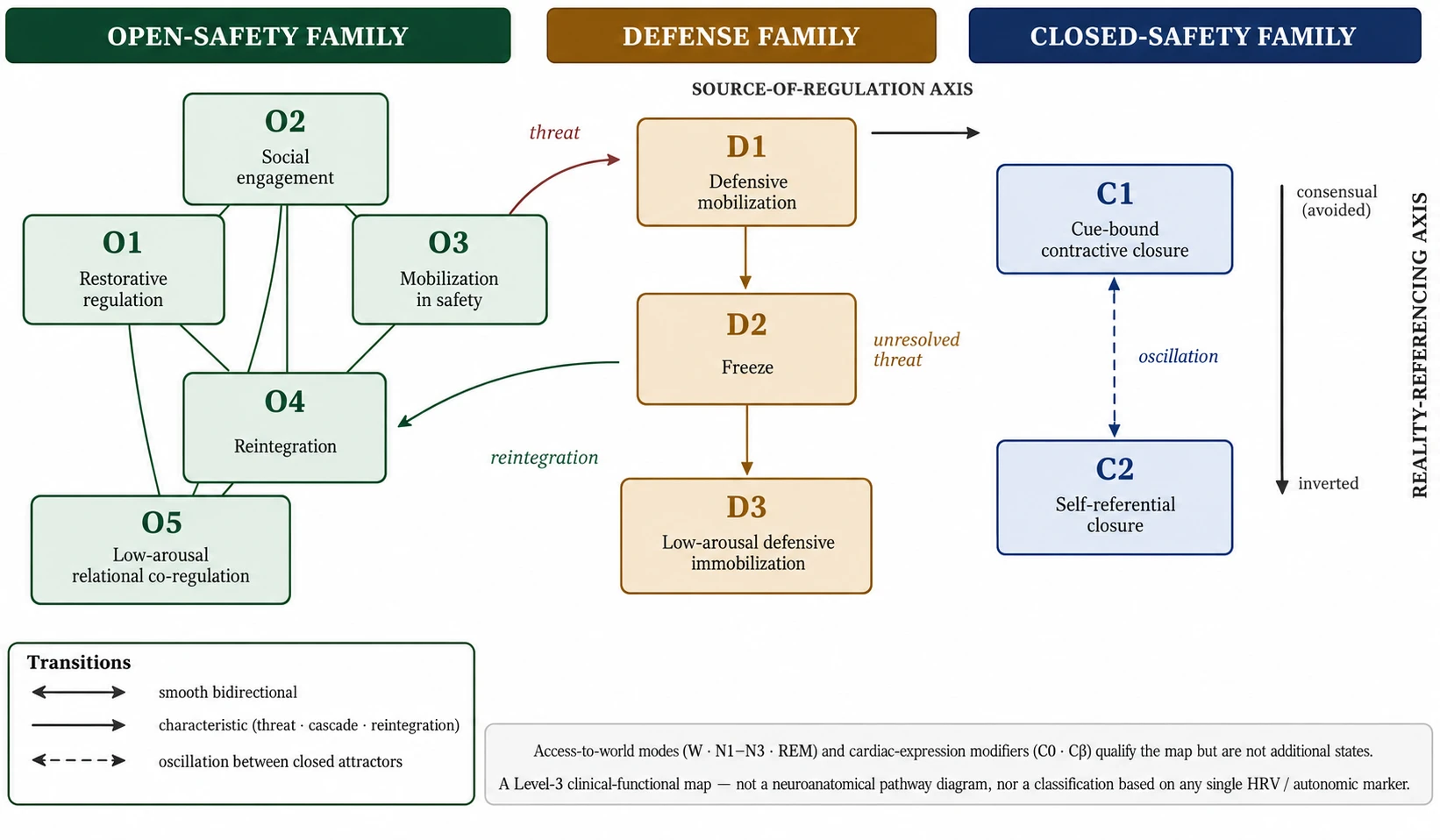
Figure 2. Ten-state clinical-functional map of regulatory regimes. The open-safety family (O1–O5) permits smooth, bidirectional transitions among restorative regulation (O1), social engagement (O2), mobilization in safety (O3), reintegration (O4), and low-arousal relational co-regulation (O5). O5 is a low-arousal relational consolidation state connected to O1, O2, and O4. Under threat, the organism may leave the open-safety cycle and enter the defense family (D1–D3), progressing from defensive mobilization (D1) through freeze (D2) toward low-arousal defensive immobilization (D3) when threat remains unresolved. Exit from defense occurs through reintegration (O4). The closed-safety family (C1–C2) lies outside the engagement–defense cycle: it is entered along the source-of-regulation axis and differentiated by the reality-referencing axis (cue-bound contractive closure, C1, keeps consensual reality as the avoided reference; self-referential closure, C2, refers reality inward). Access-to-world modes and cardiac-expression layers qualify the map but are not additional states. The figure is a Level-3 clinical-functional map, not a neuroanatomical pathway diagram or a classification based on any single HRV/autonomic marker.
4.2 The Five Open-Safety States
The five open-safety states share secure safety appraisal, consensual reality-referencing, preserved or recovering integration, and the capacity to open toward the shared world. They differ by arousal, activity, and the form of social availability: solitary availability, active engagement, mobilization in safety, reintegration, and low-arousal relational co-regulation.
The family corresponds approximately to what the theory grouped under “ventral vagal” function; Section 3’s translation preserves the grouping as clinical-functional without anatomical commitment. The five are differentiated by arousal and by their configuration of social availability and integration. All five share secure safety appraisal, coherent internal integration, and consensual reality-referencing.
4.2.1 O1: Restorative regulation. The low-arousal, internally-anchored, socially available state in which the organism is at rest while open to contact – calm with retained alertness, smooth respiration, low motor activity. It is often accompanied by low-arousal cardiorespiratory patterns, but it is defined clinically by retained availability, flexibility, and integration. On the axes – safety secure, arousal low, flexibility high, social availability available-on-demand, source internal and human-mediated, internal integration coherent, reality-referencing consensual. Its distinguishing feature, which the classical map could not specify, is that low arousal is combined with coherent integration and consensual reality-referencing: the organism is at rest and remains reachable and reality-anchored. It can be mimicked at the level of HRV signature (low HR, low RMSSD, low movement) by low-arousal defensive immobilization, and – most consequentially in the present version – by sealed inversion. That state may share with O1 not only behavioral quiet but a favorable autonomic profile, while differing fundamentally on social availability, source, and reality-referencing (Sections 4.3.3, 4.5, 6.6). The discrimination is among the most consequential in the ontology, because the states require opposite responses.
4.2.2 O2: Social engagement. The moderate-arousal, relationally anchored, fully available state of active contact: sustained eye contact, prosodic vocalization, facial responsiveness, and the smooth turn-taking that is the behavioral signature of intersubjective regulation (Aureli et al., 2022; Carozza & Leong, 2021; Feldman, 2007; Trevarthen & Bullowa, 1979; Tronick, 1989). On the axes – safety secure, arousal moderate, flexibility high, social availability full and active, source human-mediated through co-regulation, internal integration coherent, reality-referencing consensual. The defining feature is the active engagement of the source-of-regulation axis: the organism regulates through and with another. Clinically, this is the state in which therapy does its work – trauma-focused, attachment-based, and somatic interventions all operate by re-establishing access to social engagement where it had become unavailable. O2 is constitutively dependent on a regulating other, and the long-term capacity to access it depends on a developmental history in which that other was reliably present. Where that history is disrupted – by neglect, abuse, chronic illness, or substitution of the caregiver by a closed regulatory source (Section 6) – access becomes fragile, and the organism shifts toward states in which regulation does not depend on contact.
4.2.3 O3: Mobilization in safety. The high-arousal engagement state of active mobilization – play, work, sport, exploration – under preserved safety: elevated heart rate, increased respiration, focused attention, motor engagement, but, unlike defensive mobilization, in a context appraised as safe and under voluntary modulation. On the axes – safety secure, arousal high, flexibility preserved, social availability task-modulated but accessible, source internal and human-mediated, internal integration coherent, reality-referencing consensual. The defining feature is the combination of high arousal with preserved safety appraisal, which the three-state map struggled to accommodate. It is the state of play, focused work, and flow (Csikszentmihalyi, 1990; P. Lehrer et al., 2020; Vezenkov, 2026); its preservation in trauma populations is a marker of regulatory recovery. Its relationship to D1 is a central clinical concern: the two share high arousal but diverge on safety, flexibility, and social availability, and a system conditioned by repeated threat will, under mild stress, transition into D1 along trajectories the well-regulated organism would have traversed into O3.
4.2.4 O4: Reintegration. The transitional engagement state in which the organism moves out of a defense or withdrawal state back toward restorative regulation, social engagement, or mobilization in safety: gradual return of social availability, softening of defensive postures, resumption of prosody and eye contact, and a subjective texture that may include relief, vulnerability, grief, or fatigue. Reintegration is specified as a state because it has a recurrent profile, not merely because it lies between states. On the axes – safety becoming secure but not yet stable, arousal variable and decreasing, flexibility recovering, social availability increasing but vulnerable, source principally human-mediated, internal integration reassembling, reality-referencing returning to consensual. It is the only engagement state whose axis values are themselves in motion, and its specification as a state rather than a transitional event is a central clinical innovation: it draws attention to a phase often unattended, specifies what is required to support it (slowed pacing, sustained co-regulatory contact, protection from premature demand), and reframes the therapeutic project not as the elimination of defensive states but as the development of the capacity to return from them. Clinically, most substantive trauma work is done here. Its successful traversal consolidates therapeutic gain; its failure makes defensive and closed states more deeply attractor-like over time.
4.2.5 O5: Low-arousal relational co-regulation. The low-arousal, relationally open, human-mediated restorative state in which the organism is settled and quiet while remaining maximally reachable through a present or internalized other. It is the configuration of post-discharge resolution after safe intimacy (Section 4.8.2), of quiet caregiving contact and feeding, of settled affectionate proximity and the onset of shared rest – calm with retained reachability, low motor demand, soft prosody and contact. On the axes – safety secure; arousal low; flexibility preserved; social availability open and relationally active despite low arousal; source of regulation human-mediated through co-regulatory contact, including internalized relational safety in the absence of a present other; internal integration coherent; reality-referencing consensual. Its defining feature is the combination the rest of the open-safety family cannot represent: low arousal held together with high relational availability. O1 is available on demand but not relationally engaged; O2 is engaged but at moderate arousal and under action demand; O5 is the cell between them – quiet and open at once (Carter et al., 2020). On the state-versus-subtype criterion of Section 4.1, it is a state and not a subregion of O1: a distinct axial profile, a characteristic transition structure (entered through dyadic settling; exiting to O1 when contact closes, to O2 when arousal and engagement rise, or into sleep), and a distinct intervention logic (the capacity to be simultaneously quiet and reachable with another is frequently the last regulatory capacity to recover in trauma, and is more diagnostic of recovery than solitary down regulation). It occupies the positive pole of the "quiet body" problem: where low-arousal defensive immobilization (D3) is a quiet body that is not a reachable person, deep sleep is a quiet body that is safely unreachable, and the closed-safety states (C1 and C2) are quiet bodies sealed from contact, O5 is the quiet body that is maximally reachable – the clearest low-arousal expression of open safety.
Its transition structure is distinctive. It often follows reintegration (O4), when defensive activation has softened into contact; it may follow erotic mobilization and consummatory discharge; it may arise in caregiver-infant regulation; and it may precede solitary rest, sleep, active engagement, or renewed mobilization in safety. Clinically, it is a consolidation state: the task is not to increase arousal or demand immediate verbal processing, but to protect low-demand human contact long enough for the organism to internalize relational safety. Premature demand may move the system into defensive mobilization, freeze, or collapse; premature withdrawal of the human source may return it to solitary regulation or to closed-source substitution.
4.3 The Defense States (D1, D2, D3)
The next three states are defense states under threat, without a substituted regulatory source and without inversion of the reality referent. They share reduced flexibility relative to the open-safety states, asymmetric exit trajectories, and the recruitment of defensive rather than constructive resources. They are differentiated by arousal and by the configuration of integration and social availability, and they retain consensual reality-referencing – the world is appraised as threatening, but it remains the reference. The closed-safety states are treated separately (Sections 4.4–4.5).
4.3.1 D1: Defensive mobilization. The high-arousal defense state in which the organism is mobilized to address a threat appraisal: motor readiness or active fight/flight, attention narrowed to threat-relevant stimuli, and reduced access to regulatory and social capacities. On the axes – safety threatened, arousal high, flexibility reduced, social availability suspended or reduced, source autonomous, internal integration narrowed to the defensive task, reality-referencing consensual but threat-saturated. It corresponds approximately to “fight/flight.” It is adaptive when threat is real, present, and addressable by mobilization, and pathological when chronically recruited where mobilization does not resolve the threat appraisal (Lin & Peper, 2009; Manolova & Vezenkov, 2025g; Peper & Harvey, 2018; van der Kolk, 2014; Vezenkov, 2026; Vezenkov & Manolova, 2025c, 2026). Exit runs through reintegration; where resolution is impossible, the state tends to persist as chronic hyperarousal or to collapse into a lower-arousal defense.
4.3.2 D2: Freeze. The high-arousal defense state in which the organism is immobilized despite high autonomic activation – the simultaneous engagement of activation and motor inhibition sometimes described as tonic immobility (Davis, 2025; Kolacz et al., 2025; Levin et al., 2021; Manolova & Vezenkov, 2025e, 2025g; Schauer & Elbert, 2010; Vezenkov & Manolova, 2025b; Volchan et al., 2017). On the axes – safety threatened, often catastrophically; arousal high and locked; flexibility markedly reduced; social availability suspended; source autonomous; internal integration beginning to fragment under the dual activation; reality-referencing consensual. Clinically it is the state of the assault victim who cannot move, the child witnessing violence who cannot speak – the state in which trauma is most reliably encoded as un-processed sensorimotor memory (Levine, 1997; Levine et al., 2018; Payne et al., 2015; Perry, 2006, 2009, 2014; van der Kolk, 2014; Vezenkov & Manolova, 2025c, 2026). Exit passes through one of two pathways: under favorable conditions freeze releases into mobilization (then resolving through reintegration) with the somatic discharge the trauma literature documents (Bell et al., 2019; Levine, 1997; Manolova & Vezenkov, 2025g; Payne et al., 2015); under unfavorable conditions it collapses downward into D3.
4.3.3 D3: Low-arousal defensive immobilization. The low-arousal defense state in which the organism has withdrawn into a quasi-collapse: withdrawn social availability and structural fragmentation of body, emotion, cognition, and narrative. It may present with reduced heart rate, flattened or rigid respiratory variability, and low movement, but it is defined by threatened safety appraisal, withdrawn social availability, a collapsed source of regulation, and fragmentation – not by its autonomic signature. It corresponds approximately to “dorsal-vagal shutdown” and to what the trauma literature calls dissociation, collapse, shutdown, or numbing (Levine, 1997; Perry, 2009, 2014; Schauer & Elbert, 2010; van der Kolk, 2014; Vezenkov & Manolova, 2025d, 2025c). On the axes – safety threatened, often catastrophically and without prospect of resolution; arousal low; flexibility severely reduced; social availability structurally withdrawn; source collapsed-internal; internal integration fragmented; reality-referencing consensual but threat-saturated. This is the state the classical map was structurally unable to separate from restorative regulation, because the two often share an HRV signature of low HR, low RMSSD, and low movement (Grossman, 2023; Grossman et al., 2026; Vezenkov, 2026). The seven-axis specification makes the discrimination explicit, and it also separates D3 from sealed inversion (C2): D3 is autonomically depressed or collapsed under unresolved threat and remains consensually referenced, whereas C2 may be autonomically stable or even favorable under a sealed appraisal of safety and is anchored in an inverted referent. Clinically D3 is the state of chronic dissociation, depressive shutdown after unresolved trauma, and catatonic-like withdrawal – most prone to misdiagnosis as depression, fatigue, or autistic withdrawal, and, most consequentially here, as restorative regulation by HRV-based monitoring. Its exit is the most asymmetric in the defense family, requiring sustained co-regulatory contact, slow pacing, protection from demand, and gradual re-engagement of body, breath, and orientation.
4.4 C1: Cue-bound Contractive Closure
The first of the two closed-safety states is cue-bound contractive closure (C1), a contractive, closed-sensory homeostasis in which the organism stabilizes through an artificial, cue-dependent, or highly predictable sensory source while consensual reality remains the avoided reference. The system is closed, but it is not inverted: the shared world is still recognized as real, although it is experienced as excessive, dysregulating, or unsafe, and is withdrawn from in favor of the predictable source.
On the axes – safety functionally appraised as secure but on a closed object (the artificial source appraised as safe, the shared world as demanding, unpredictable, or threatening); arousal variable but typically moderate-to-low under source availability and dysregulated on its withdrawal; flexibility reduced; social availability withdrawn from the human world while oriented to the artificial source; source artificial and cue-dependent (the defining axis); internal integration shallow or narrowed; reality-referencing consensual but avoided. Within this state fall screen-calming, screen addiction, and screen trauma; sensory dominance; cue-dependent regulation; compulsive repetition; and surrogate regulation more generally (Section 6.2). The defining clinical signature is that the artificial source can regulate the organism while the shared human world cannot, and that removal of the source produces acute dysregulation – withdrawal, agitation, craving, search for the dose – because the reference is still the avoided shared world, to which the organism cannot yet return (Manolova & Vezenkov, 2025g, 2025e, 2025b; Petrova et al., 2025; Vezenkov & Manolova, 2025c, 2025e, 2025d, 2025f, 2025b, 2026).
C1 differs from low-arousal defensive immobilization on source (substituted rather than collapsed) and on entry (along the source-of-regulation axis rather than through threat collapse); it differs from restorative regulation on social availability, flexibility, source, and the avoidance that structures its safety; and it differs from C2 on the reality-referencing axis, which is the burden of the next section. The narrower operational hypothesis of screen induction is preserved for this state and requires four conditions – temporal precedence of intensive screen-mediated regulation; worsening under continued artificial-source dependence; partial or full improvement after supported withdrawal with cultivation of human-mediated alternatives; and recurrence on reintroduction – but it characterizes one well-developed pathway into C1, not an unconditional etiology.
4.5 C2: Self-referential Closure
The second of the two closed-safety states, and the principal new specification of the present version, is self-referential closure (C2), a sealed inversion in which the operational criterion of reality has migrated inward. Internally generated sensory, affective, symbolic, or relational regularities become the primary world-reference, while the shared human world is treated as intrusive, noisy, unreal, or secondary. The state may present in psychotic-like or ASD-like forms (Section 6.6), but it is defined functionally rather than diagnostically.
On the axes – safety appraised as secure within the sealed configuration (illusory-safe); arousal variable, often low; flexibility reduced and decreasingly responsive to standard relational probes; social availability withdrawn, with at most intermittent windows of contingent reciprocity; source internally generated and self-referential (the defining axis distinguishing it from C1); internal integration internally coherent – the configuration is ordered and consistent from within, which is precisely why it is stable; reality-referencing inverted – internally anchored and consensually decoupled (the defining axis distinguishing it from every other state). The combination of internal coherence with consensual decoupling is what no single integration axis could represent and what the reality-referencing axis is introduced to capture.
Three properties justify its specification as a distinct state. First, it is a distinct attractor: where C1 is destabilized by removal of the artificial source, C2 may remain stable in the absence of any external source, because the regulatory reference is now internal and self-sustaining. Second, it carries a distinct and clinically central autonomic prediction: at depth, the autonomic plane may be stable or even favorable while shared-world access is minimal – the closed-safety autonomic–relational dissociation, whose mechanism is derived in Section 6.6 and whose test is Prediction 8. Third, it has a distinct intervention logic: not detox, since there is no external source to remove, but the re-anchoring of the reality referent and the restoration of shared-world access (Section 7.2).
A defining caution accompanies this state and is stated here rather than only in the safeguards. The good or normal autonomic indices that may accompany deep C2 are not part of its definition. C2 is defined by the axial profile – self-referential source, internal coherence with inverted reality-referencing, withdrawn social availability – of which minimal shared-world access is the clinical expression. The favorable autonomic signature is a Level 2 prediction that follows from this profile, exposed to refutation at Level 2 (Section 8), not a Level 3 diagnostic criterion. This keeps the definition within the model’s methodological discipline and within the range its evidence can bear.
4.6 Summary: The Ten-state Map and the Quiet-looking Configurations
Table 3 maps each state onto the seven axes. Table 4.2 then isolates the discrimination that motivates much of the paper – among the configurations that may all present as behaviorally quiet or low in motor output, but that mean different things, now including O5 and the non-state quiet signals (deep sleep and the β-blocked cardiac readout).
Table 4.1. The ten-state ontology – profile on the seven axes
| State | Safety | Arousal | Flexibility | Social availability | Source of regulation | Internal integration | Reality-referencing |
| Restorative regulation (O1) | Secure | Low | High | Available on demand | Internal / human | Coherent | Consensual |
| Social engagement (O2) | Secure | Moderate | High | Full, active | Human-mediated | Coherent | Consensual |
| Mobilization in safety (O3) | Secure | High | Preserved | Task-modulated | Internal / human | Coherent | Consensual |
| Reintegration (O4) | Becoming secure | Decreasing | Recovering | Increasing, vulnerable | Human-mediated | Reassembling | Returning to consensual |
| Low-arousal relational co-regulation (O5) | Secure | Low | High / softly preserved | Active, low-demand, relationally present | Human-mediated (co-regulatory) | Coherent, affectively embodied | Consensual / shared |
| Defensive mobilization (D1) | Threatened | High | Reduced | Suspended | Autonomous | Narrowed | Consensual, threat-saturated |
| Freeze (D2) | Threatened (acute) | High / locked | Markedly reduced | Suspended | Autonomous | Beginning fragmentation | Consensual |
| Low-arousal defensive immobilization (D3) | Threatened (catastrophic) | Low | Severely reduced | Structurally withdrawn | Collapsed internal | Fragmented | Consensual, threat-saturated |
| Cue-bound contractive closure (C1) | Illusory-safe (on a closed object) | Variable, mod–low | Reduced | Withdrawn to artificial source | Artificial / cue-dependent | Shallow / narrowed | Consensual but avoided |
| Self-referential closure (C2) | Illusory-safe (sealed) | Variable, often low | Reduced | Withdrawn; intermittent windows | Internally generated / self-referential | Internally coherent | Inverted (internally anchored) |
Table 4.2. Quiet-looking configurations – decisive discriminators and readout validity
| Configuration | Why it may look quiet | What decides the classification |
| O1 – restorative regulation | low arousal, low movement, stable physiology | reachable, flexible, shared-world anchored |
| O5 – low-arousal relational co-regulation | low arousal, calm contact, bonded rest | active human-mediated co-regulation; reachable |
| D3 – low-arousal defensive immobilization | low arousal, stillness, low responsiveness | threat/collapse, withdrawal, fragmentation |
| C1 – Cue-bound contractive closure | quiet through artificial/cue-dependent source | source dependence; destabilizes off-source |
| C2 – Self-referential closure | quiet or even stable, but sealed | impaired shared-world access; inward reality-reference |
| N3 sleep (access mode) | low HR, low movement, offline restoration | not awake; social availability physiologically suspended |
| [state] + Cβ (readout modifier) | quiet cardiac channel under β-blockade | medication-constrained readout; non-cardiac axes decide |
Note. A β-blocked cardiac profile can co-present with any quiet-looking configuration. It does not define an eleventh state; it reduces or alters the discriminative value of the cardiac channel. Classification therefore shifts to the remaining axes, context, medication status and dose timing, respiration, movement, behavioral availability, subjective report, and responsiveness to human-mediated co-regulation. (Section 4.8.4).
The five vignettes below render Table 4.2 in the clinic: five presentations that a naive observer – or a wearable – could log as the same low-arousal, low-movement "calm," and that the model separates not on the autonomic plane but on source, integration, and reality-referencing.
O1 – restorative regulation (quiet and reachable). A child sits quietly after a full day, breathing slowly, not seeking stimulation; a wearable would record low heart rate, low movement, and a favorable HRV profile. When a parent enters and speaks, she looks up, answers, and re-settles — available on demand, flexible, anchored in the shared room. The quiet is restoration: secure safety, low arousal, high flexibility, on-demand availability, human/internal source, coherent integration, consensual reality-referencing. Nothing in the low autonomic signal defines the state; what defines it is that she remains reachable and reality-anchored while at rest.
O5 – low-arousal relational co-regulation (quiet and maximally reachable). The same child, half an hour earlier, lies against a caregiver during a story — low arousal, soft contact, minimal motor demand, and a wearable profile indistinguishable from O1. What separates them is not physiology but source and engagement: here regulation is actively human-mediated through present contact, and she is maximally reachable rather than merely reachable on demand. Low arousal is held together with open, relationally active availability — the one combination the rest of the open-safety family cannot represent. Clinically this is often the last capacity to return in trauma recovery: quiet and open to another at the same time.
D3 – low-arousal defensive immobilization (quiet because collapsed). An adolescent seen after prolonged, unresolved abuse sits motionless, gaze down, minimally responsive; heart rate and movement are low, and a monitor might read the profile as "calm" or "recovered." But approach does not open her — voice and gaze are not taken up, posture stays braced-then-slack, and body, affect, and narrative are fragmented. Safety is appraised as catastrophic without exit, the source of regulation has collapsed inward, and availability is structurally withdrawn. The low arousal is not rest but shutdown under threat that has found no resolution. The error the model warns against is reading the quiet signal as rest and withdrawing the sustained co-regulatory contact the state requires.
C1 – Cue-bound contractive closure (quiet through an artificial source). A young child is calm, absorbed, and still — but only while the tablet runs. The caregiver reports that "only the screen calms": face, voice, and touch no longer settle him, while light, sound, and predictable input reliably do. Remove the device and the quiet collapses into agitation, searching, and craving for the dose. The shared world is still recognized as real but experienced as excessive and avoided in favor of the reliable source. The defining axis is not arousal but source — artificial and cue-dependent — and the diagnostic signature is destabilization off-source: illusory-safe on a closed object, withdrawn from the human world, consensual reality-referencing preserved but avoided.
C2 – Self-referential closure (quiet and sealed). A child with an ASD-like presentation is, at depth, bodily settled: good resting heart rate, low motor expenditure, stable rhythm, sometimes a favorable HRV profile — a monitor would read health. Yet the shared human world enters only in narrow inclusion windows of seconds; between them he is oriented to a private sensory and object order that has become the operative reality, while face, voice, and joint attention are treated as intrusive or secondary. The configuration is internally coherent, which is why it is stable and why it cannot be reached by argument. This is the autonomic–relational dissociation in its sharpest form: here a good somatic profile is a reason to assess shared-world access directly, not to infer recovery (Section 6.6). "ASD-like" here names a functional configuration, not a diagnosis, and the same profile may be congenital, traumatic, neurodevelopmental, screen-amplified, or mixed.
These five states can all appear, to an observer relying on behavioral quiet or autonomic signature, as variants of "calm." They are not. O1 is quiet because it is restored and reachable; O5 because it is bonded and reachable through present contact; D3 because it has collapsed; C1 because it is regulated by an artificial source; C2 because reality has migrated inward and the system is sealed. The decisive discriminations are not on the autonomic plane but on the source, internal-integration, and reality-referencing axes, together with the organism's responsiveness to human-mediated co-regulation (Section 8). This five-way discrimination, and in particular the fact that O1 and C2 may look autonomically similar while diverging completely on the decisive axes, is among the model's most consequential clinical claims. The discrimination now spans two states that look quiet for opposite reasons (O1 and O5 versus D3, C1 and C2) and two quiet signals that are not states at all (deep sleep and the β-blocked readout); none is separable on the autonomic plane.
Three observations close the section. First, the states are not equally weighted across populations: engagement states predominate in health, defense states in clinical trauma populations, and the closed-safety states are increasingly observed in developmentally screen-exposed and reality-inverting presentations. Second, the map is open to extension: future observation may justify further states, splits, or axis reorganization, and future neuroscience may revise the substrate of any state without abolishing the state. Third, it is a map of regulatory regimes, not of persons: the same individual moves through many states over normal life, and the clinically relevant question is which patterns of recruitment, transition, and stabilization characterize an individual over time.
4.7 The Dynamics of Transitions, Access Modes, and Readout Layers
The general form is compositional rather than additive. A clinical configuration is a regulatory state – the seven-axis position – qualified by two orthogonal layers and punctuated by transient events:
regulatory state × access-to-world layer × cardiac-expression layer
The access-to-world layer records whether the organism is wakefully online to the shared world or in a biologically gated offline mode. Its values include waking access (W), sleep-transition states (N1/N2), deep restorative offline sleep (N3), REM internally generated simulation (R), and awakening/re-entry (A). Sleep therefore does not add four new states. N3 is a physiological restorative offline mode, not O1; REM is a normative internally generated simulation, not C2.
The cardiac-expression layer records how faithfully the cardiac channel can express state-related change. Its values include unconstrained cardiac expression (C0), pharmacologically constrained expression (Cβ, e.g. beta-adrenergic blockade), disease-constrained expression, training-adapted expression, rhythm-contaminated expression, and device-constrained expression. These are readout modifiers, not states.
Neither access mode nor cardiac-expression layer enters the state count. They record whether the state is online to the world and whether the autonomic signature can be trusted as a window onto it.
Because the model is a map of regimes rather than of persons, its clinical content lies less in the states themselves than in the structure of transitions among them. Four properties of that structure organize the clinical logic of Section 7.
First, transitions are asymmetric. Movement among the open-safety states (O1–O5) is generally smooth and bidirectional, although O4 and O5 have special roles. O4 is the reintegrative bridge after defense or intense activation; O5 is a low-arousal consolidation state in which open safety is stabilized through low-demand co-regulation. Movement out of the defense and withdrawal states (D1, D2 and D3) requires co-regulatory support, slowed pacing, and protection from demand – conditions the states cannot generate. The asymmetry is steepest for D3, and steeper still for C2, whose exit requires re-establishing the shared world as a regulatory reference rather than merely recovering access to it.
Second, the common exit pathway from the defense states runs through reintegration (O4), which is why O4 is specified as a state in its own right (Section 4.2.4): interventions that bypass it tend to drive the system back into defense.
Third, the defense states have a characteristic collapse pattern under unresolved threat: an unsustainable high-arousal defense (D1) tends to persist as chronic hyperarousal or to descend, through freeze (D2), into low-arousal defensive immobilization (D3).
Fourth, the closed-safety states sit outside the engagement-and-defense cycle, are entered along the source-of-regulation axis, and have three distinct exit logics across the closed and collapsed states. D3 is exited by co-regulatory release and reintegration after threat resolution. C1 is exited by source restoration – detox combined with cultivation of a human-mediated source, since removing the artificial source addresses the entry condition but not the regulatory vacuum it exposes (Ivanova et al., 2025; Manolova & Vezenkov, 2025a, 2025g; Stefanova et al., 2025). C2 is exited neither by reintegration nor by detox, but by re-anchoring of the reality referent and restoration of shared-world access. A characteristic transition signature links the two closed states: in the region between them the organism oscillates – alternating between contractive closure with the world still referenced (C1) and sealed inversion in which it is not (C2). This oscillation, observable as an alternation of reachable and unreachable periods, is the clinical marker of a system poised between the two closed attractors (Section 6.4).
Section 4.8 applies these two layers to the three phenomena most often mistaken for states.
4.8 Boundary Conditions: Access Modes, and Readout Modifiers
The boundary cases below apply the two layers of Section 4.7 to three phenomena that are often mistaken for states: sleep modifies access to the shared world; sexual consummation functions as a transition protocol; β-blockade modifies the cardiac readout. None is a regulatory state.
4.8.1 Sleep as a protected offline access mode. Sleep is a protected offline mode that periodically gates wakeful access to social availability, action, and shared reality. State labels apply only under W. Two category errors follow if this is ignored. Deep sleep is not O1: N3 may be restorative but is not reachable in the ordinary wakeful sense – a sleep analogue of restoration, not restorative regulation. REM is not C2: REM contains an internally generated world, but one that is physiologically bracketed, cyclic, reversible, and re-anchored on waking; C2 is a wakeful sealed inversion whose inward reference is unbounded and self-sustaining. REM is thus a benign reversible analogue of inversion and sharpens the binding parameter of the reality-referencing axis (Section 4.1). There is empirical warrant for treating sleep phases as distinct autonomic-behavioral modes without elevating them to states: quiet sleep differs from active sleep in RSA amplitude, heart period, and heart-period variability, and RSA–heart-period coupling falls toward zero in early sleep (Porges et al., 1999) – Level-2 observations that confirm real structure but cannot establish phase-as-state. Sleep requires no third safety: it is neither open safety (no waking reciprocity) nor closed safety (not cue-dependent, artificial-source-sustained, or self-referential), but protected offline regulation; the access mode preserves the two-safeties thesis.
4.8.2 Sexual behavior as an erotic-regulatory trajectory. Healthy partnered sexuality is not a new state but a trajectory through the open-safety family – chiefly O2, O3 and O5. Erotic build-up and intercourse are high-arousal co-regulation under safety, with preserved reciprocity, consent, social availability, and shared-world anchoring; they are among the clearest demonstrations that arousal and safety are orthogonal, high arousal becoming defensive only when organized by threat. We designate healthy erotic mobilization a subtype, O3E (erotic mobilization in open safety), not a further state. The same behavior may be organized by different states: coerced or fear-organized sexuality belongs to D1 or D2; compliance without internal consent to D2 or D3; numb or depersonalized sexuality to D3; compulsive pornography-mediated arousal to C1 once the source has become artificial and cue-dependent; and a persistent wakeful sexuality organized by internally generated fantasy with impaired shared-world access may be a C2 variant. The healthy cycle resolves into O5: O3E → consummatory discharge → O4 → O5 → O1 or O2. Pathological cycles fail to reintegrate — C1 → discharge → brief relief → renewed C1 craving loop, or D2/D3 → discharge without integration → shame, numbness, collapse, or withdrawal (a fall into D3).
4.8.3 Orgasm as a consummatory discharge event. Orgasm and ejaculation are not identical; the decisive event for the model is not seminal emission but the threshold of autonomic-sensorimotor discharge and the subsequent reorganization of state. Orgasm is too brief to be a macro-state and too specific to be subsumed under O3. It is a consummatory discharge event: a transient, reversible, reflex-like peak in which arousal reaches threshold, flexibility narrows, voluntary control is briefly reduced, and reality-referencing contracts without becoming pathologically inverted. Under safety this remains consensual, reversible, and integrated – distinct from D3 (loss of control as collapse under threat) and from C2 (internal reference as stable criterion of reality). Its clinical meaning is fixed by the state that precedes and the state that follows it.
4.8.4 Cardiac-readout modifiers: β-blockade and the quiet-heart fallacy. A further boundary case tests the ontology not from within endogenous physiology, as sleep does, nor through a discharge protocol, as orgasm does, but through pharmacological constraint of the measurement channel itself. β-adrenergic blockade may lower resting heart rate, blunt chronotropic reactivity, and alter HRV/RSA indices in ways that are not determined by the organism's regulatory state. The effect is not a new state; it is a Level-2 cardiac-readout modifier.
A beta-blocked individual may occupy any of the ten regulatory states – restored and reachable (O1), socially engaged (O2), mobilized in safety (O3), reintegrating (O4), defensively mobilized (D1), frozen (D2), collapsed (D3), cue-dependently closed (C1), sealed (C2), or bonded in low-arousal co-regulation (O5) – while the cardiac channel reports a narrowed or pharmacologically altered profile. The correct classification is therefore not a new state but [state]-Cβ.
The case exposes a prior step in the model's central caution. The earlier warning was that a quiet body is not necessarily a reachable person. β-blockade adds the more basic warning that a quiet heart is not necessarily a quiet body. A low-rate or low-reactivity cardiac profile may reflect restorative regulation, defensive collapse, sleep, closed-safety regulation, bonded co-regulation, athletic bradycardia, illness, or medication, and cannot be inverted into a state assignment.
The precise direction of change in HRV/RSA under β-blockade is not the load-bearing claim. β-adrenergic activity can substantially alter RSA magnitude; cardio-selective blockade has in some studies increased RSA amplitude, while under pronounced bradycardia RSA may attenuate through a floor effect; the effects are population-, dose-, respiration-, disease-, and baseline-dependent (Grossman & Taylor, 2007). The ontological point is simpler and survives in either direction: once the cardiac effector is pharmacologically constrained, the discriminative value of the cardiac channel is reduced and state assignment must rest on the remaining axes – safety appraisal, arousal, flexibility, social availability, source of regulation, internal integration, reality-referencing – together with context, behavior, respiration, movement, electrodermal activity where available, and subjective report.
In notation the case is Cβ. Thus O1-W-Cβ denotes wakeful restorative regulation under β-blocked cardiac expression; D3-W-Cβ low-arousal defensive immobilization under the same constraint; O5-W-Cβ low-arousal relational co-regulation under a medication-constrained channel; N3-Cβ deep restorative offline sleep under β-blockade. The medication does not decide the state; it marks the cardiac channel as partially uninterpretable for state discrimination. (This is an interpretive caution, not clinical guidance: a low rate or low variability accompanied by dizziness, syncope, marked fatigue, dyspnea, chest pain, or very low blood pressure is a matter for medical evaluation, not autonomic classification.)
5. Two Forms of Safety, Two Forms of Closure
The structural innovations – how letting go of unitary constructs reveals functionally distinct configurations
Section 4 identified the orthogonality of the source-of-regulation axis and introduced the reality-referencing axis. This section draws out two consequences the classical map was structurally unable to articulate. The first is the distinction between two forms of safety – human and closed. “Human” here means relational, reciprocal, and shared-world referenced, not morally superior or species-essential. The second, new to the present version, is that closed safety is not a single configuration but has two functionally distinct realizations – contractive closure and sealed inversion – which the reality-referencing axis is required to separate. The title is preserved: there remain two safeties, and no third is introduced. What is added is the recognition that the closed safety has two states (Figure 3).
5.1 Open safety: The Configuration That Opens the Organism
By open safety we mean the configuration in which the appraisal of secure conditions opens the organism to the world. It is the regulatory ground of the open-safety family (O1–O5) (Section 4.2). Its defining feature is developmental and integrative: the organism is wakefully available, able to engage in language, eye contact, play, joint attention, learning, curiosity, reciprocity, and the tolerance of unpredictability that human functioning requires; its capacities are expanding rather than contracting, its regulation structured around contact with a shared world rather than its avoidance.
O5 is the clearest low-arousal expression of open safety. It shows that open safety is not exhausted by active social engagement or by solitary calm. The organism may be quiet and still while actively regulated through a human source. This is the positive counterpart to the model’s caution that a quiet body is not necessarily a reachable person: in O5 the body is quiet precisely because the person is reachable and held within low-demand co-regulation.
Mechanistically, open safety is human-mediated. It arises through co-regulation – the responsive contingency of face, voice, gaze, touch, and rhythm that defines the regulatory ground of infant development and of adult therapeutic alliance (Kolacz et al., 2019, 2020, 2025; Kolacz & Porges, 2024; Porges, 2007a; Schore, 2003). It depends on the availability of a regulating other, and its long-term capacity rests on a history in which that other was reliably available; where that history is disrupted, access becomes fragile and the organism shifts toward states in which regulation does not depend on contact.
Open safety is not confined to the literal presence of another person. In mature regulation it includes internalized relational safety – the capacity to remain open, flexible, and integrated in the absence of the regulating other, because prior co-regulation has been internalized (Levine, 1997; Perry, 2014; Schore, 2003; Siegel, 2012; van der Kolk, 2014). It is on this basis that regulation through nature, animals, music, rhythmic or embodied practice, and self-regulation can belong to the open-safety family: what places a configuration there is not human proximity as such but its functional signature – openness to reciprocity, reality-testing, flexibility, and integration anchored in a shared world. A configuration that opens the organism along these axes is open (relational) safety even without a person present; a configuration that closes it is not open safety even when another person is in the room.
Open safety is not a guarantee of comfort or a particular affective tone. Patients in open safety can be sad, in pain, challenged, or undertaking demanding work. The defining feature is not the absence of difficulty but the preservation of access – the organism remains reachable, regulatable, reality-anchored, and in motion through the engagement states. Any account that reduces open safety to autonomic signature alone (low HR, high HRV) mis-characterizes what is definitional: the engagement of the regulatory source and the preservation of a consensual reality reference. This is the hinge of the present version, and it is the basis of the governing caution of Section 6.6: a quiet body is not the same as a reachable person.
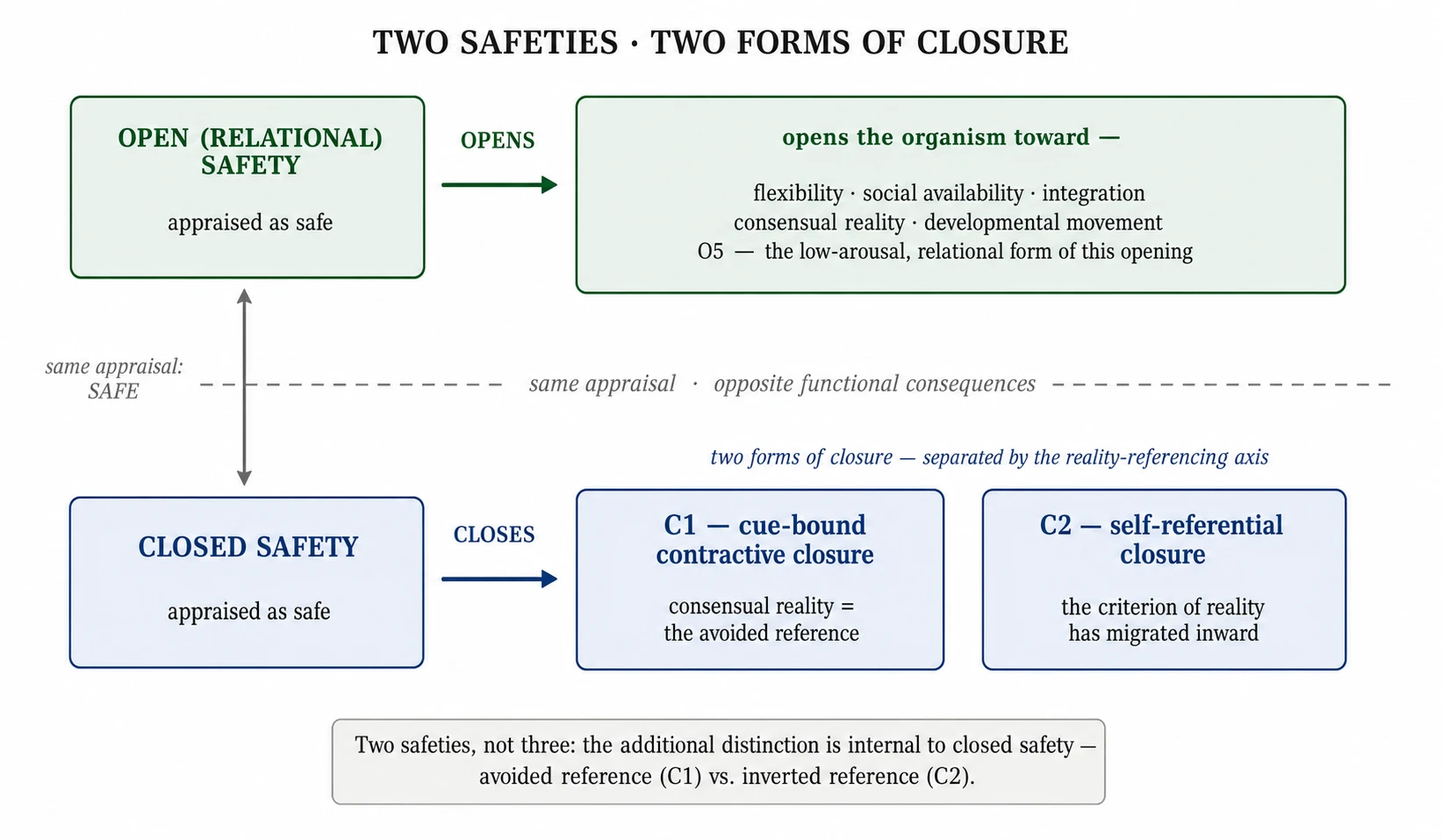
Figure 3. Two safeties and two forms of closure. Both open and closed safety are appraised as safe, but they have opposite functional consequences. Open (relational) safety opens the organism toward flexibility, social availability, integration, consensual reality, and developmental movement; O5 specifies the low-arousal, relational form of this opening. Closed safety closes the organism and is realized in two distinct forms: cue-bound contractive closure (C1), in which the organism withdraws toward an artificial, cue-dependent source while consensual reality remains the avoided reference; and self-referential closure (C2), in which the operational criterion of reality has migrated inward. The figure therefore preserves the claim that there are two safeties, not three: the additional distinction is internal to closed safety and separates avoided reference from inverted reference.
5.2 Closed Safety: The Configuration That Closes the Organism
By closed (illusory) safety – for which, when characterizing its phenomenological texture, we also use intrauterine-like safety (metaphorically) – we mean the configuration in which the appraisal of secure conditions closes the organism from the world. It is the regulatory ground of the closed-safety states (C1 and C2). Its defining feature is structurally contractive or sealing: the organism experiences a closed source as safe and the shared human world as demanding, unpredictable, or threatening, and reduces complexity, the demand for response, and the need for reciprocity to a minimum. It is often experienced subjectively as ultra-security.
The clinical cost is substantial. The capacities open safety supports – language, joint attention, reciprocity, adaptive flexibility — atrophy under sustained closed safety, particularly when stabilized in developmentally critical periods (Section 6). Capacities contract rather than expand; regulation is structured around the avoidance or replacement of contact; developmental possibilities narrow within the closed envelope.
A clarification of “illusory” forestalls a moralizing reading. Closed safety is not subjectively unreal, and the term is not a judgment of the patient. The appraisal of safety is genuine; the configuration is often experienced as the only available safety; and an observer who relies on the patient’s report of safety, or on autonomic correlates of safety alone, will encounter it as genuinely safe by those criteria. “Illusory” refers to its functional consequence – a safety appraisal structurally decoupled from the conditions genuine safety requires: preserved social availability, capacity for engagement, developmental movement, and an intact relation to a shared reality.
5.3 The Second Distinction: Two Forms of Closure
The present version adds a distinction internal to closed safety. Closed safety is realized in two functionally distinct states, which the reality-referencing axis separates. In contractive closure (C1) the organism withdraws toward a predictable, artificial, cue-dependent source, but consensual reality remains the avoided reference – the shared world is still recognized as real, merely as too much, too unpredictable, or too unsafe. In sealed inversion (C2) the criterion of reality has itself migrated inward – internally generated regularities become the operative world, and the shared human world is treated as noise, intrusion, or secondary. The distinction can be put in a sentence:
The critical distinction is no longer only between stress and recovery, nor even between open safety and closed safety. It is also between contractive closure, in which reality remains the avoided reference, and sealed inversion, in which the criterion of reality has migrated inward.
This distinction is the structural reason the model moves from eight states to ten. It also has a direct clinical consequence carried into Section 7: contractive closure is addressed by source restoration – removing the artificial source and cultivating a human-mediated one – whereas sealed inversion is not, because there is no external source to remove; it is addressed by re-anchoring the reality referent. To treat the two with the same protocol – most commonly, to apply detox logic to a sealed-inversion presentation – is a predictable clinical error.
5.4 Why Polyvagal Theory Could Not Specify These Distinctions
Neither distinction could be specified within classical polyvagal theory, for structural reasons. Across its formulations (Porges, 1995, 2001, 2007a, 2021, 2025c), the theory’s treatment of safety has been unitary: safety is the appraisal condition under which the “ventral vagal” system is recruited, and the three-state map is parameterized by safety as a single variable. This follows from the anatomical commitments. Once safety is tied to a single substrate, it must function as a single variable, because the substrate cannot be in two states at once; there is no anatomical room for two functionally opposite configurations of safety appraisal, nor for two distinct realizations of closure, nor for a reality-referencing dimension orthogonal to safety. Once the anatomical reduction is set aside – once the account operates at Level 3 with Level 2 signals as auxiliary – the unitary treatment is no longer required, and the distinctions become specifiable. A clinical implication follows directly: interventions designed on the unitary model cannot distinguish, in their effects, movement toward open safety from stabilization in closed safety, nor contractive closure from sealed inversion. An intervention that produces “calm” – reduced HR, reduced movement, reduced distress — may be moving the patient toward open safety, stabilizing them in contractive closure, or confirming a sealed inversion, and the unitary model has no way to discriminate.
5.5 Clinical Implications
Three implications orient the remainder of the paper. First, not every “safety” heals, and not every “stability” is recovery: interventions that produce comfort, autonomic quietude, or behavioral calm may move the patient toward open safety or stabilize them in one of the two closed states, and good autonomic indices may mark recovery, successful contractive closure, or sealed inversion. The source, social-availability, and reality-referencing axes provide the operational basis for discrimination, and the multimodal discipline of Section 2 the methodological frame. Second, the project is the cultivation of open safety and shared-world access, not the suppression of closed safety: suppression of a closed source, without simultaneous cultivation of human-mediated alternatives, leaves the organism without regulatory ground – and in sealed inversion there may be no external source to suppress at all. Third, clinical language must be calibrated to the distinctions: terms the theory used univocally - “co-regulation,” “safety cues,” “downregulation,” “regulated” – refer here to operations that may serve human or closed safety, and to states that may be quiet without being reachable; clinical communication should specify which is intended. The distinctions are implicit in much of the trauma, attachment, and developmental literatures and are articulated in adjacent registers in the Nootism and UTAF formulations (Manolova et al., 2025; Manolova & Vezenkov, 2025g, 2025e; Vezenkov & Manolova, 2025b, 2025e, 2026); the present contribution is their explicit articulation, their placement within a ten-state ontology, and their operational specification.
6. Closed Safety and the Two Closed-State Attractors
Unpacking C1 and C2 – from the artificial-source trajectory to sealed inversion, with the autonomic–relational dissociation between them
C1 and C2 were specified in Sections 4.4–4.5 by their axial profiles. This section unpacks them: why closed safety is two states rather than one (Section 6.1); the contractive state and its best-developed pathway, the screen trajectory (Section 6.2); self-referential closure (Section 6.3); the transition signatures between them (Section 6.4); inclusion windows as the measure of transition accessibility (Section 6.5); the presentation variants of C2 (Section 6.6); and the methodological safeguards under which the whole is to be read (Section 6.7). The overall structure is shown in Figure 4.
6.1 Why Closed Safety Is Not a Single State
Closed safety has two realizations because the organism can close itself to the shared world in two structurally different ways. It can withdraw toward a predictable external source while still treating the shared world as the real-but-avoided reference; or it can migrate the criterion of reality inward, so that the shared world is no longer the reference at all. These are not two depths of the same configuration but two attractors with different sources, different reality-referencing, different transition structures, and different exit logics (Section 4.7). The clearest evidence that they are distinct is behavioral and prognostic: a contractive closure presentation destabilizes when its artificial source is removed, whereas a sealed-inversion presentation may remain stable in the absence of any external source, because its regulatory reference is now internal. A single closed state cannot represent both behaviors at once; two states can.
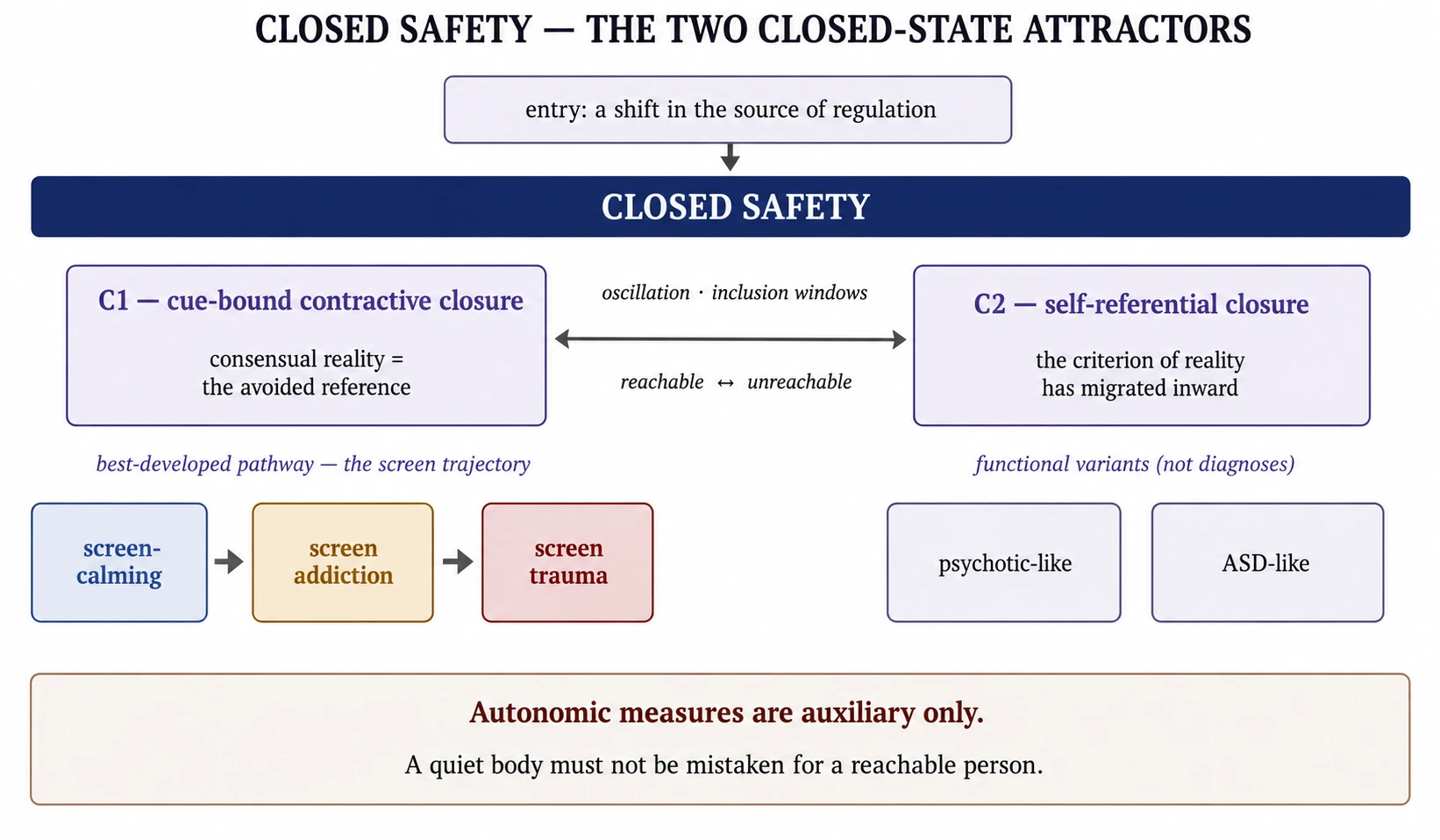
Figure 4. Closed safety and the two closed-state attractors. Closed safety comprises two functionally distinct attractors following a shift in the source of regulation. In cue-bound contractive closure (C1), the organism withdraws toward an artificial or cue-dependent source while consensual reality remains the avoided reference; its best-developed pathway is the screen trajectory from screen-calming through screen addiction to screen trauma. In self-referential closure (C2), the operational criterion of reality has migrated inward; psychotic-like and ASD-like presentations are treated as functional variants of this state rather than as diagnostic categories. The region between C1 and C2 may present as oscillation between reachable and unreachable periods. Across both states, autonomic measures are auxiliary only: a quiet body must not be mistaken for a reachable person.
O5 is the low-arousal open-safety contrast case for the closed states. C1 may be quiet because an artificial source has reduced unpredictability; C2 may be quiet because the world-reference has migrated inward; O5 is quiet because shared-world contact has become sufficiently safe to require no defensive effort.
6.2 C1: Cue-bound Contractive Closure and the Screen Trajectory
The contractive state is reached, in the current epidemiological context most often, through the screen trajectory – the best-developed pathway and the one whose intervention protocol is most fully specified. It comprises three sub-configurations of increasing depth.
Screen-calming. Not yet addiction: compulsive seeking and cue-dependent stabilization are not yet established. What is established is the first substitution of the regulatory source – the organism (most often an infant or young child, but in the current context also adolescents and adults) has begun to be calmed by light, sound, rhythm, and predictable input rather than by face, voice, gaze, touch, and contingent response. The clinical signature is the increasingly reliable observation that “only the screen calms.” At this stage flexibility is preserved and social availability recoverable when the source is removed under favorable conditions; the substitution is preferential rather than structural. Recognized early and reversed – by sustained restoration of human-mediated regulation, by limiting artificial-source availability under co-regulatory conditions, and by support for the caregiver–child relationship – the trajectory typically returns to the open-safety family without lasting anchors. What the screen offers is not “calm” in the sense of restorative regulation but closed safety, a closing rather than opening configuration that resembles O1 on arousal and behavioral quiet but differs on source, social availability, and reality-referencing (Manolova & Vezenkov, 2025e; Vezenkov & Manolova, 2026).
Screen addiction as state addiction. The central claim is that screen addiction is best understood not as a behavioral addiction to a device or content but as an addiction to a regulatory state – state addiction (Manolova & Vezenkov, 2025g; Vezenkov & Manolova, 2026). The object of compulsive seeking is not the screen, game, or content but the configuration those proximate objects reliably produce: sensory dominance, cue-dependent regulation, compulsive repetition, and withdrawal from reciprocity. The distinction from classical behavioral addiction (Dong & Potenza, 2014; Grant et al., 2010; Manolova & Vezenkov, 2025f; M. Potenza, 2013; M. N. Potenza, 2018; Vezenkov & Manolova, 2025a) matters in three respects: the object is the regulatory configuration, not the behavior; the negative consequences are developmental and regulatory rather than social, financial, or occupational; and the clinical hierarchy follows from the state-addiction formulation – the work is not suppression of a behavior but restoration of an alternative regulatory configuration.
Screen trauma and developmental anchors. The transition to screen trauma is marked by developmental anchors that persist after withdrawal: at the screen-addiction stage, removal produces acute dysregulation but leaves no structural trace once dysregulation resolves; at the screen-trauma stage, withdrawal no longer resolves the configuration. The diagnostic indicators (Vezenkov et al., 2026; Vezenkov & Manolova, 2025f, 2025e, 2025d, 2026) include persistent screen-induced visual and cortical reflexes after sustained withdrawal; vestibular and postural distortions persisting outside the artificial context; synesthesia-like sensory loops; cortical fragmentation patterns on qEEG; and developmental regressions in language, joint attention, and social availability that do not resolve with detox alone. Their presence after withdrawal is the operational criterion for the transition. Where the screen-trauma configuration begins to reorganize the criterion of reality itself – where the private sensory order becomes the operative world rather than a preferred refuge – the trajectory has crossed from C1 into C2, and the clinical picture changes accordingly (Section 6.4).
6.3 C2: Self-referential Closure
The sealed state is the configuration in which the criterion of reality has migrated inward. It is not adequately described as “deeper contractive closure,” because the defect is not greater withdrawal along the same line but a change in what counts as the world. Two features distinguish it sharply from C1. First, the source of regulation is no longer an external artificial object but the internally generated field itself, which is why removal of any external source does not dissolve the state. Second, the configuration is internally coherent – ordered and consistent from within – which is both why it is stable and why it cannot be reached by argument or by appeals to the shared world that the organism no longer takes as the reference.
The functional misbinding of inner and outer takes two opposed forms, which structure the presentation variants of Section 6.6. In one, the inner leaks outward – internal meanings, fears, images, voices, or associations acquire the force of external reality, and the shared world is rewritten through them. In the other, the outer fails to enter – the external human world is not bound as a shared relational reality but reduced to sensory or object structure, and a private order takes its place. Both are sealed inversions in the sense that the operative reality is internally referenced; they differ in the direction of the misbinding. The relationship of these functional configurations to the classical nosology of psychotic-spectrum and autism-spectrum conditions is an open research question; the model’s dialogue with the polyvagal reading of autism (Porges, 2025a) is conducted at the functional level and carries no etiological commitment.
6.4 Transition Signatures Between C1 and C2
The region between the two closed states is marked by a characteristic transition signature: oscillation. The organism alternates between contractive closure, in which the shared world is still the avoided reference, and sealed inversion, in which it is not – observable clinically as an alternation between periods when the patient is reachable and periods when the patient is qualitatively elsewhere, internally preoccupied, and disconnected from the consensual world. This oscillation is what earlier formulations described as a “psychotic-like alternation of inclusion and exclusion”; it is reinterpreted here not as a level on a single descent but as the signature of a system poised between two closed attractors, capable of resolving toward either. A dysregulatory presentation that remains broadly reachable, with poor control of entry and exit but with the shared world intact as a reference, is best understood as an early transitional pattern at the entrance to the closed-safety region rather than as a closed state in its own right; it is the point from which the system may move toward contractive closure, toward sealed inversion, or back toward engagement.
6.5 Inclusion Windows as Transition Accessibility
The single most important clinical variable in the closed-safety region, and especially in C2, is the inclusion window – an observable interval during which the patient responds contingently to human voice, gaze, gesture, touch, joint attention, or reciprocal play and communication. In the present version the inclusion window is not a level on a developmental axis but a measure of transition accessibility: how often, for how long, and under what conditions the sealed state can be exited toward social engagement (O2), mobilization in safety (O3), or reintegration (O4). Inclusion windows may last seconds to minutes and occur in contexts not immediately recognized as relational; their identification is a skilled task, and their systematic support and gradual extension are the central axis of intervention in C2 (Section 7.2). Their presence distinguishes the more accessible configurations from the most sealed, and their broadening, we predict, precedes stable developmental recovery (Section 8, Prediction 7).
6.6 Presentation Variants of C2 and the Autonomic–relational dissociation
C2 is one state with presentation variants, not several states. The variants differ on the direction of the inner/outer misbinding and on the depth of the inclusion window, while sharing the defining axial profile – self-referential source, internal coherence with consensual decoupling, low shared-world access. The model declines to make them separate states precisely because they share that profile, and it declines to map them onto nosological categories because the descriptors are functional, not diagnostic; the suffix “-like” is retained throughout.
Table 5. Presentation variants of C2
| Variant | Direction of misbinding | Inclusion windows | Clinical picture |
| Psychotic-like presentation | Inner leaks outward — internal meaning acquires external force | Intermittent | Private meanings, fears, images, voices, or associations experienced as external reality |
| ASD-like presentation, windows present | Outer fails to enter — private sensory/object order replaces relational world | Narrow but present (seconds to minutes) | The human world enters only in windows; sensory, rhythmic, or object order is more stable than the relational |
| ASD-like presentation, windows absent | Outer fails to enter, sealed | Absent or near-absent | Minimal windows of human inclusion; physical state may be good while shared-world access is minimal |
The closed-safety autonomic–relational dissociation. Across the deeper variants of C2, a clinically consequential paradox appears: the organism may show preserved, normal, or even favorable autonomic and somatic indices – good resting heart rate, low motor expenditure, stable respiration, good sleep or rhythm, low external reactivity, absence of visible physical illness, sometimes a favorable HRV profile – while remaining severely impaired in shared-world access. The mechanism requires no Level 1 commitment: once the operative world has been reduced to a controllable internal minimum, the organism is no longer in chronic threat-appraisal of its operative environment, and the autonomic load of unresolved threat falls away. The somatic stability is real; what is absent is the shared-world reference. This separates C2 sharply from D3, in which the autonomic plane is depressed under unresolved threat: D3 shows collapse on both the somatic and the relational side, whereas C2 may show somatic stability with relational and reality-referencing impairment. The paradox is the strongest expression of the model’s multimodal discipline: a child may appear bodily calm, even healthy, while being outside the shared human regulatory world, and in this configuration the better the autonomic profile, the more important it becomes to assess shared-world access directly rather than to infer recovery from the autonomic signal. The paradox is stated here as a clinical observation and is specified as a falsifiable Level 2 prediction in Section 8; it is not a definitional criterion of C2 (Section 4.5).
6.7 Methodological Safeguards
The claims of this section are bounded by safeguards that are integral to the formulation, not concessions to potential critics, and they must remain firm.
First, the model does not claim that all autism-spectrum presentations are C2, nor that all psychotic-spectrum presentations are C2. The claim is restricted to clinical subgroups whose presentation, history, and trajectory are best understood within the framework; “ASD-like” and “psychotic-like” capture functional configurations, not nosological assignments, and the relationship of these subgroups to the broader clinical populations is an open research question.
Second, the model does not claim that screen exposure causes schizophrenia or autism. The screen trajectory is one pathway into the contractive state (C1); C2 may be congenital, traumatic, neurodevelopmental, screen-amplified, or mixed, and the ontology describes a functional configuration, not a single cause.
Third, good autonomic indices are not pathological in themselves. They become clinically significant only in combination with low social availability, inverted reality-referencing, and a self-referential source. The paradox of Section 6.6 is a warning against over-reading the autonomic signal, not a claim that autonomic stability is itself a sign of pathology.
Fourth, C2 is not an anatomically demonstrated vagal regime. It is a functional configuration of source, integration, and reality-referencing, articulated at Level 3 and exposed to refutation at that level.
Fifth, the use of “intrauterine-like safety,” the UTAF model (Manolova & Vezenkov, 2025), and related expressions is functional and integrative, not anatomical or literal.
Sixth, the model does not replace medical, neurological, psychiatric, or developmental diagnosis. It is a clinical-functional ontology of regulatory states, not a nosology and not a substitute for established diagnostic assessment.
These safeguards are protective in two directions: they protect the model from being read as a stronger empirical or nosological claim than the evidence supports, and they protect the patients to whom it is applied from inappropriate categorization or from being denied access to interventions appropriate under classical framings.
7. Clinical Application: Restoring Access to the Shared World
From architecture to the clinical logic of intervention
The model’s contribution to clinical practice is not the introduction of new interventions but the specification of a logic under which existing interventions – co-regulation, somatic work, attentional repair, relational restoration, breath, movement, attachment-based intervention – can be deployed with greater precision and at the appropriate stages. The ten-state ontology reframes the overall aim: clinical work is the restoration of access to a shared human world under open safety, not the suppression of a behavior or the production of a particular autonomic signal. The section is organized around five principles. A general note applies throughout: clinical application requires appropriate medical, developmental, and psychiatric assessment, and the model is not intended to replace diagnosis, emergency care, or established evidence-based treatment – a caution especially relevant for children, ASD-like presentations, and psychotic-like episodes.
7.1 Therapy as the Engineering of State Transitions
The first principle is that therapy is the engineering of transitions between regulatory states, not the activation of a specific anatomical substrate. “Engineering” is used here not as a mechanistic manipulation of the patient but as the clinical design of the conditions under which otherwise foreclosed transitions become possible – the deliberate, relationally attuned shaping of pacing, demand, and co-regulatory support so that a transition the patient cannot presently make becomes available. The term marks the departure from formulations that take “activating the ventral vagal” or “increasing vagal tone” as their explicit target – formulations that, in the translation of Section 3, repeat the theory’s anatomical commitments and inherit Grossman’s criticisms. The therapeutic project is the restoration of flexibility on Axis 3 – the recovery of the capacity to move between states under open safety – and, for the closed-safety states, the restoration of a consensual reality reference on Axis 7. The clinical question is not “what state is the patient in?” but “which transitions are available, which are foreclosed, and which can be opened?”
This has three practical consequences. First, the same intervention may be appropriate or inappropriate depending on current state and target transition: breathwork in social engagement is consolidation; breathwork in low-arousal defensive immobilization may be premature demand. Second, the unit of assessment shifts from state to transition, and from autonomic signal to shared-world access: clinical change is documented in the pattern of accessible transitions and in the recovery of reachability, not in the production of a target autonomic signal. Third, the hierarchy of intervention follows the asymmetric transition structure and the three distinct exit logics of Section 4.7.
7.2 Three Exit Logics and One Consolidation Logic: D3, C1, C2 and O5
The model’s sharpest clinical claim is that the three low-output configurations that the unitary map could not distinguish require three different interventions.
D3 (low-arousal defensive immobilization) – co-regulatory release and reintegration. The exit runs through sustained co-regulatory contact, slow pacing, protection from demand, and gradual re-engagement of body, breath, and orientation, resolving through reintegration (O4) as the threat appraisal is metabolized. The error to avoid is reading the low-arousal signature as rest and withdrawing the co-regulatory support the state requires.
C1 (Cue-bound contractive closure) – source restoration. The exit runs through detox from the artificial source combined with simultaneous cultivation of a human-mediated source, since removing the artificial source addresses the entry condition but exposes a regulatory vacuum the organism will fill from any available alternative. Where the configuration has reached screen trauma, detox is necessary but insufficient, and the developmental anchors require targeted work. The error to avoid is detox without cultivation of a human-mediated alternative.
C2 (Self-referential closure) – re-anchoring of the reality referent. The exit runs neither through reintegration nor through detox – there is no external source to remove – but through the gradual restoration of the shared human world as the reference. The therapeutic aim is not, first, behavior, but the return of the criterion of reality from the self-referential internal field toward the shared world. In practice this means: not confusing autonomic stability with recovery; seeking and protecting the minimal inclusion window of shared reality; working through face, voice, rhythm, object, space, and context rather than through complex verbal exchange the sealed state cannot yet take up; rebuilding correctability through safe, graduated prediction error; establishing shared attention before complex conversation; and, throughout, distinguishing a quiet body from a reachable person. The error to avoid – the predictable one – is applying detox logic to a sealed-inversion presentation, where there is no external source whose removal would help and where the work is the re-establishment of a shared reference the patient has ceased to hold.
O5 – bonded consolidation. O5 is not exited in the same sense as D3, C1, and C2; it is cultivated and protected. Its clinical role is consolidation of open safety after reintegration, after high-arousal mobilization in safety, or after repair of relational rupture. The intervention error is premature demand: turning low-demand bonded contact into performance, verbal processing, exposure, or social expectation before the organism has stabilized relational safety. In pediatric work, O5 is cultivated through caregiver-infant or caregiver-child co-regulation: face, voice, gaze, rhythm, touch, feeding, quiet play, and shared rest. In adult trauma work, it appears as the capacity to remain in low-arousal contact without dissociation, compliance, sexualization, shame, or withdrawal. It is one of the most important markers that open safety has become embodied rather than merely cognitively understood.
7.3 Pediatric Specifics: Family Co-Regulation as a Condition, Not an Addition
For pediatric populations, family co-regulation is a condition of the intervention, not an addition. This follows from the developmental specification of open safety (Section 5.1) and of the closed-safety trajectories (Section 6): the caregiver is, for the developing patient, the principal source of human-mediated regulation, and the family system is the environment in which the regulatory contest between human and closed sources is decided. Three components must run in parallel: intervention with the patient through the appropriate exit logic; intervention with the caregiver through psychoeducation about the regulatory contest, support for the caregiver’s own regulatory capacities, and explicit cultivation of co-regulatory practices; and intervention with the family environment through systematic reduction of closed-source availability under conditions where human-mediated regulation is in place to fill the gap. Work with caregivers is the cultivation of conditions under which human-mediated regulation can compete, not the assignment of blame (Alexandrov et al., 2025; Manolova et al., 2025; Manolova & Vezenkov, 2025d, 2025c; Pashina et al., 2025; Petrov et al., 2025).
7.4 The Adult Trauma–Addiction Loop
For adults in whom a closed-safety regime is coupled with the trauma–addiction loop of the UTAF model (Manolova & Vezenkov, 2025g, 2025e; Vezenkov & Manolova, 2026), the application differs from the pediatric case. The structural difference is developmental: adults have completed the trajectory in which human-mediated regulation would be cultivated as a baseline, and the loop typically reflects the long-term consequences of disrupted developmental regulation rather than ongoing developmental disruption. UTAF’s structural insight, adopted at Level 3 (Section 6), is that the configuration is layered – each layer of addictive functioning corresponds to a distinct regime, and the layers stabilize one another. The clinical work is the systematic dismantling of the layered configuration from the outermost layer inward, with capacities cultivated in pace with removal. The model proposes not a new modality but a staging logic within which existing modalities can be deployed at the appropriate stages.
7.5 HRV, Wearables, and the Operational Discipline
The application requires a specific operational discipline in the use of HRV and wearable monitoring, resting on four principles, sharpened by the quiet-looking-configurations discrimination.
Principle 1: HRV measures capacity and variability, not state. RMSSD, HF-HRV, RSA, and related indices describe cardiorespiratory regulation across time and carry information about regulatory capacity, but they are not measures of state at a given moment. The same index value can be consistent with multiple states, and state assignment requires convergence of HRV with respiration, movement, electrodermal signal (where available), behavioral observation, context, and subjective state (Berntson et al., 1991; Grossman & Taylor, 2007; Laborde et al., 2017; Quintana & Heathers, 2014).
Principle 2: The same – or a better – autonomic profile can signify opposite clinical configurations. The most consequential instances are the shared low-arousal signature of O1 and D3, and the further case in which C2 presents with a favorable autonomic profile while shared-world access is severely impaired (Section 6.6). Reading a good autonomic signal as recovery in such a patient is the central iatrogenic error the model is designed to prevent. The discrimination requires the multimodal convergence of Principle 1 together with direct assessment of reality-referencing and of responsiveness to human-mediated co-regulation.
Principle 3: Never read autonomic stability as recovery without assessing shared-world access. A favorable autonomic signal – low or stable HR, low movement, behavioral quiet, good HRV – is by itself ambiguous among restorative regulation, low-arousal defensive immobilization, contractive closure, and sealed inversion. The discrimination requires contextual and relational information the signal alone does not provide.
Principle 4: Interpret the cardiac channel only after assessing channel validity. HRV and heart-rate outputs should not be read as state evidence until the validity of the cardiac channel has been checked. β-blockers, antiarrhythmics, pacemakers, arrhythmias, conduction disease, acute illness, endurance-training bradycardia, and major sleep-stage effects may all reduce the state-discriminative value of HR/HRV (Section 4.8.4). Where the channel is constrained, wearable recovery or stress scores describe a constrained cardiovascular channel, not a regulatory state, and classification weight shifts to the non-cardiac axes, context, and responsiveness to human-mediated co-regulation. Channel status should therefore be documented before the signal is read – medication class, dose and timing, cardiovascular diagnosis, rhythm status, symptoms, and device or signal quality (Rule 3, Section 2.3) – and a constrained profile recorded as [state]-Cβ, not as a state in its own right (Section 4.8.4).
The Low-Arousal Defensive State Index (LADSI) (Vezenkov, 2026) is a proposed multimodal operationalization of part of this discipline. A closing note on the wearable industry: its typical inference – that high HRV and low movement signify “recovery” or “ventral vagal activation” – is a univariate inference from a multivariate reality, inheriting both the theory’s anatomical commitments and its unitary treatment of safety (Sections 5.3–5.4). The discipline here is incompatible with that inference, and the industry’s clinical interpretations may require revision as multimodal state classification becomes more precise.
Interpretive caution, not clinical guidance: low heart rate or low variability accompanied by dizziness, syncope, marked fatigue, dyspnea, chest pain, or very low blood pressure requires medical evaluation rather than autonomic-state classification.
8. Falsifiable Predictions
Seven clinical-functional predictions and the discipline required to test them* A framework that operates at Level 3 and makes no Level 1 anatomical claims must, to function as more than a heuristic, generate Level 3 predictions specific enough to be tested and risky enough to be wrong. Seven such predictions follow from the architecture – one for each major claim that Table 9.1 exposes to refutation. Each is formulated as a Level 3 statement (with, in Group B, the associated Level 2 signature treated as auxiliary evidence) and specifies what would support and what would refute it. Under Rule 5, the predictions are refuted by evidence at the level of the claim, and not by a single Level 2 signal alone. The seven are grouped into three families: measurement and classification, state discrimination among the quiet-looking configurations, and trajectory.
8.1 Group A – Measurement and Classification Predictions
Prediction 1: Open safety and closed safety produce distinct multimodal profiles. While sharing some autonomic correlates of "safety" appraisal, the two are distinguishable by convergence across the seven axes: open safety shows preserved social availability under engagement probes, coherent internal integration, consensual reality-referencing, and responsiveness to co-regulation; closed safety shows withdrawn social availability under the same probes, cue-dependent or self-referential regulation, and unresponsiveness to human-mediated co-regulation. The divergence is sharpest where the autonomic signature is least informative: in O1, human voice, face, gaze, and joint attention increase accessibility; in C2, the same signals neither open the system nor destabilize it, because the human world is not the operative reality reference, even where autonomic indices appear comparably good. Refuted if patients classified as in closed safety show the same response to human-mediated co-regulation as those in open safety, and if multimodal classifiers cannot distinguish the two beyond chance.
Prediction 2: LADSI discriminates the five quiet-looking configurations better than univariate HRV indices. LADSI, combining HRV with respiration, electrodermal signal, movement, and context, will discriminate O1, O5, D3, C1, and C2 – all of which may share an HRV signature of low HR, low RMSSD, low movement – better than any single HRV index on matched clinical samples. *Refuted if* LADSI does not outperform univariate indices under AUC, sensitivity/specificity, calibration, and cross-validated classification accuracy. Prediction 3: Cardiac-channel masking under β-blockade. Under β-adrenergic blockade, state-related differences in heart rate and HRV/RSA indices are attenuated or distorted relative to the same individual off blockade or to matched non-blocked participants, while multimodal classification incorporating respiration, movement, electrodermal activity, behavior, context, subjective report, social availability, and reality-referencing continues to distinguish regulatory states.
Refuted if β-blockade does not reduce or distort the state-discriminative value of the cardiac channel under controlled conditions, or if multimodal assessment cannot distinguish engaged, bonded, defensive, collapsed, and closed configurations beyond chance when the cardiac channel is constrained.
8.2 Group B – State-Discrimination Predictions
Prediction 4: C2 shows autonomic–relational dissociation. Deep C2 configurations will show preserved, normal, or favorable autonomic indices (RMSSD, RSA, resting HR, indices of physical health) while showing severely reduced reciprocal function and shared-world access; and these indices will be *better* than those observed in D3 under comparable behavioral stillness.
Refuted if deep C2 configurations do not dissociate autonomic stability from relational impairment, or if their autonomic indices are not distinguishable from, or are worse than, those of D3 at matched stillness.
Prediction 5: C1 destabilizes when the artificial source is removed; C2 may remain stable. Removal of the artificial source in C1 produces withdrawal, agitation, craving, or search for the source; C2 may remain stable in the absence of any external source, because the regulatory reference is internal.
Refuted if C1 and C2 presentations show the same response to removal of external sources. Prediction 6: Low-arousal relational co-regulation is distinguishable from solitary restoration and active engagement. Low-arousal human-mediated bonded regulation (O5) will show a multimodal profile distinct from both O1 and O2. It will share low arousal with O1 but differ by active low-demand relational regulation; it will share human-mediated social availability with O2 but differ by low arousal, reduced demand, and quiet embodied contact.
Refuted if blinded multimodal assessment cannot distinguish low-arousal bonded co-regulation from solitary restorative regulation or moderate-arousal social engagement beyond chance, or if the distinction carries no differential transition or intervention implications.
8.3 Group C – Trajectory Prediction
Prediction 7: Inclusion-window expansion precedes stable functional recovery in C2. The first marker of recovery will be the broadening of inclusion windows – the time and contexts in which the patient remains in shared reality with another – not, directly, language, schooling, or social behavior, which recover subsequently.
Refuted if stable functional recovery is observed without prior broadening of inclusion windows, or if window broadening does not predict subsequent functional gains.
Table 6. The seven falsifiable predictions
| # | Group | Prediction | Conditions of refutation |
| 1 | A – Measurement | Open and closed safety produce distinct multimodal profiles and diverge under human co-regulation | Indistinguishable response to co-regulation; classifiers fail beyond chance |
| 2 | A – Measurement | LADSI discriminates the five quiet-looking configurations better than univariate HRV | LADSI does not outperform single HRV indices |
| 3 | A – Measurement | β-blockade masks state-related cardiac differences, while multimodal classification still separates states | β-blockade does not attenuate or distort cardiac state-discriminability under controlled conditions; or multimodal assessment cannot separate engaged, bonded, defensive, collapsed, and closed configurations beyond chance when the cardiac channel is constrained |
| 4 | B – Discrimination | C2 shows autonomic–relational dissociation, better autonomic indices than D3 | No dissociation; C2 indices not better than D3 at matched stillness |
| 5 | B – Discrimination | C1 destabilizes off-source; C2 may remain stable | Same response to removal of external sources |
| 6 | B – Discrimination | O5 differs from O1 and O2 | Multimodal coders cannot distinguish bonded low-arousal co-regulation from solitary rest or active engagement |
| 7 | C – Trajectory | Inclusion-window expansion precedes functional recovery | Recovery without prior window broadening |
8.4 Methodological Requirements for Testing the Predictions
The predictions are formulated under three constraints. First, they are Level 3 predictions requiring Level 3 evidence (Rule 5): the multimodal convergence of Rule 4 is operative throughout, a constraint made sharper by Group B, whose predictions concern precisely the cases in which autonomic signals mislead. Second, the clinical separation of patient groups at intake is itself a substantive task, so the Group A measurement work is logically prior to the Group B and C tests.
Third, the predictions admit refutation: a framework whose predictions cannot be refuted is, in the standard sense (Popper, 1959, 2002), not scientific, and the Level 1 silence of Section 2.2 provides no retreat from Level 3 refutation. The empirical program is substantial – longitudinal cohorts with multimodal monitoring, validated intake instruments, intervention trials at matched intensity, and methodological development of multimodal classifiers for the five-quiet-states discrimination – and the present paper undertakes the theoretical specification rather than the program itself.
Minimal empirical program: blinded multimodal state coding; repeated measures; pre-registered inclusion-window criteria; matched severity groups; longitudinal follow-up; at least one independent replication site.
9. Claim Status, Operational Definitions, and Limitations
Three closing instruments that bound the model’s claims
This section makes explicit the evidentiary status of the model’s principal claims, the operational definitions of its central terms, and the limitations of the present paper.
9.1 Status of the Major Claims
The methodological discipline (Section 2) and the literature-based claim about HRV are the most secure; the ten-state ontology and the two-safeties distinction are theoretical proposals with clinical motivation; the two-closures distinction, self-referential closure, and the autonomic–relational dissociation are clinical hypotheses drawn substantially from single-center observation and are the most exposed to refutation.
Table 7. Status of the major claims
| Claim | Status | Evidence base | What would refute it |
| RSA/HRV is not a direct state marker | Established / literature-based | Grossman & Taylor (2007); Berntson et al. (1991); HRV literature | Reliable single-moment state classification by HRV alone |
| Three-level claim discipline | Methodological proposal | Multi-level methodology of science | Incoherence or non-applicability in use |
| Ten-state ontology on seven axes | Theoretical Level 3 proposal | Clinical synthesis of trauma / autonomic literatures | Failure of multimodal differentiation among states (Prediction 2) |
| Human vs closed safety | Theoretical-clinical hypothesis | Trauma / addiction / screen observations | Indistinguishable multimodal profiles (Prediction 1) |
| Two closures: contractive (C1) vs sealed (C2) | Clinical hypothesis | Nootism / crossed-world observations | No source/referent differentiation; same response to source removal (Prediction 5) |
| Reality-referencing as a distinct axis | Theoretical proposal | Inverted-referent clinical observations | Internal integration and reality-referencing never dissociate |
| Closed-safety autonomic–relational dissociation | Clinical hypothesis (Level 2 prediction) | Crossed-world case observations | Autonomic stability never coexists with impaired shared-world access (Prediction 4) |
| Inclusion-window primacy in recovery | Clinical hypothesis | Nootism case observations | Functional recovery without prior window broadening (Prediction 7) |
| O5 (low-arousal relational co-regulation) | Theoretical-clinical hypothesis | Attachment, co-regulation, sexuality, caregiver-infant, and therapeutic alliance observations | Low-arousal high-availability profile never dissociates from O1 or O2 |
| Access-to-world layer | Operational scope layer | Sleep physiology and state/mode boundary analysis | Sleep phases behave as Level 3 waking regulatory states rather than access modes |
| Cardiac-expression layer | Operational measurement layer | HRV/RSA confound literature; medication and cardiovascular constraints | Cardiac expression remains equally state-discriminative under medication, rhythm, disease, and training constraints |
| Cardiac-readout modifier (β-blockade) | Methodological / Level-2 | Pharmacology of β-blockade; HRV literature | β-blockade does not reduce cardiac-channel state-discriminability (Prediction 3) |
9.2 Operational Definitions
Inclusion window: an observable interval during which the patient responds contingently to human voice, gaze, gesture, touch, joint attention, or reciprocal play and communication. Screen-trauma anchor: a persistent sensorimotor, autonomic, attentional, linguistic, or relational pattern that remains after sustained withdrawal of the artificial regulatory source. Open (relational) safety: a regulatory configuration in which social availability, flexibility, integration, and consensual reality-referencing increase in response to human-mediated cues, including internalized relational safety in the absence of a present other. Closed (illusory) safety: a configuration in which arousal may decrease but social availability and shared-world access do not improve, and regulation remains cue-dependent, artificial-source-dependent, or self-referential. Source of regulation: the agent or mechanism through which regulation is principally achieved – human-mediated, internally-mediated, autonomous, collapsed, artificial/cue-dependent, or internally-generated/self-referential. Internal integration: the internal coherence of body, affect, action, cognition, and narrative. Reality-referencing: whether the system remains anchored in a shared consensual reality or refers reality to an internally generated, self-referential field. Shared-world access: the degree to which the organism is behaviorally and referentially available to a consensual world shared with others; not an eighth axis but the joint clinical expression of social availability (Axis 4) and reality-referencing (Axis 7), operationalized through inclusion windows and responsiveness to human-mediated co-regulation. Cue-bound contractive closure (C1): a closed-safety state stabilized through an artificial, cue-dependent source while consensual reality remains the avoided reference. Self-referential closure (C2): a closed-safety state in which the operational criterion. of reality has migrated inward; presents in psychotic-like (inner-to-outer) or ASD-like (outer-to-private) forms, defined functionally. Closed-safety autonomic–relational dissociation: the predicted coexistence of preserved or favorable autonomic indices with impaired shared-world access in deep C2, treated as a Level 2 prediction, not a defining criterion. Screen-induced (operational): a configuration meeting four conditions – temporal precedence of intensive screen-mediated regulation; worsening under continued artificial-source dependence; partial or full improvement after supported withdrawal with cultivation of human-mediated alternatives; and recurrence on reintroduction – characterizing one pathway into C1. Low-arousal relational co-regulation (O5): a low-arousal open-safety state in which regulation is actively mediated through low-demand relational contact, with secure safety appraisal, preserved flexibility, active but quiet social availability, human-mediated source of regulation, coherent integration, and consensual reality-referencing. Access-to-world layer: an orthogonal layer indicating whether the organism is wakefully online to the shared world or in a biologically gated offline mode such as N1, N2, N3, REM, or awakening. Cardiac-expression layer: an orthogonal Level 2 readout layer indicating whether the cardiac channel is unconstrained or modified by medication, disease, rhythm disturbance, training adaptation, device constraints, or other factors. Cβ: beta-blocked or pharmacologically constrained cardiac expression; a modifier of the cardiac channel, not a regulatory state. Consummatory discharge event: a transient autonomic-sensorimotor discharge, paradigmatically orgasmic discharge, that punctuates a trajectory without constituting a macro-state.
9.3 Limitations
This paper is a theoretical specification rather than an empirical validation study. The ten-state ontology, the two-safeties and two-closures distinctions, the reality-referencing axis, and the closed-safety trajectories are clinical-functional proposals requiring prospective validation. The C1/C2 distinction, self-referential closure, and the autonomic–relational dissociation draw partly on clinical observations from our Center and should not be read as a definitive nosology or as a replacement for established diagnostic assessment; the model does not claim that all ASD or psychotic-spectrum presentations are C2, nor that screens cause schizophrenia or autism. HRV, qEEG, and autonomic measures are treated as auxiliary signals and as a source of falsifiable prediction, not as diagnostic markers, and the autonomic–relational dissociation in particular is a Level 2 prediction rather than a defining criterion; LADSI is a proposed rather than a validated instrument. The model makes no Level 1 anatomical claims and offers no neuroscientific account of the substrates of the states it specifies. The mechanisms by which states are acquired, consolidated, deepened, and transformed – a learning-systems layer – are deliberately reserved for a companion paper, so the present account describes the states but not their developmental engine. Future research must test whether the proposed states, transitions, and presentation variants can be reliably distinguished by multimodal assessment, whether internal integration and reality-referencing dissociate as predicted, and whether interventions designed around these distinctions produce superior outcomes to those designed under the unitary model.
The introduction of O5 should not be read as the claim that all post-coital relaxation, breastfeeding, co-sleeping, cuddling, or quiet proximity is automatically low-arousal relational co-regulation. These are candidate contexts. Classification requires the seven-axis profile: secure appraisal, low arousal, preserved flexibility, active low-demand social availability, human-mediated regulation, coherent integration, and consensual reality-referencing.
The cardiac-expression layer is not a medical classification and does not guide medication decisions. It is an interpretive safeguard for autonomic-state inference. Medication, rhythm status, cardiovascular disease, and symptoms must be documented when cardiac signals are used as evidence.
10. Conclusion
The reconstruction developed here makes four contributions.
First, it specifies a methodological discipline (Section 2) under which polyvagal theory's anatomical commitments can be set aside while its clinical map is preserved.
On this reading, the model takes no position on whether the critique or the reply ultimately prevails at the anatomical and psychophysiological levels, and it does not depend on the answer. The clinical map operates at the clinical-functional level, where that dispute does not, by itself, settle the clinical-functional claims; those claims remain fully exposed to empirical refutation at their own level.
Second, the model specifies a ten-state clinical-functional ontology (Section 4) on seven functional axes. It preserves the inherited map, distinguishes O1 from D3 on axes the three-state map could not articulate, and adds three original specifications: the open/closed safety distinction (Section 5); the reality-referencing axis (Section 4.1), which separates a system anchored in a shared world from one anchored in a self-referential field; and, on that axis, the differentiation of two closed-state attractors – Cue-bound contractive closure (C1), in which consensual reality remains the avoided reference, and self-referential closure (C2), in which the criterion of reality has migrated inward (Section 6). The result is a five-way discrimination among the states that may all present as quiet – restorative regulation, low-arousal relational co-regulation, defensive collapse, contractive closure, and sealed inversion – which the unitary map could not even state.
Third, and most consequentially, the reconstruction does not resolve the polyvagal debate by choosing a side. It changes the level of analysis, keeping each kind of claim answerable to its own kind of evidence: anatomical claims remain anatomical claims, psychophysiological markers remain auxiliary, and clinical-functional states require their own evidence.
Fourth, open safety is not merely autonomic quieting. It is regulation that preserves access to shared reality, reciprocal contact, and developmental movement. Closed safety may also quiet the body, but it does so by narrowing or sealing the world – contractively, with the world still the avoided reference, or by inversion, with the reference itself moved inside. The substantive questions the model now opens to the broader literature are to be settled empirically, at the level at which they are posed: how to discriminate regulatory configurations that share, or even invert, an autonomic signature; how to cultivate open safety and shared-world access as the ground of recovery; how to recognize contractive and inverted closed states; and how to engineer state transitions as the substance of therapeutic work.
The model's governing caution can now be stated in full: a quiet heart is not necessarily a quiet body, and a quiet body is not necessarily a reachable person. Each state makes the point from a different side. β-blockade shows that the cardiac channel may be quiet because it is pharmacologically constrained; D3, that the body may be quiet because it has collapsed; C2, that the body may be stable because the shared world has been sealed out. O5 supplies the positive counterpart: the body may be quiet because it is safely held in human co-regulation – reachable, world-anchored, and actively regulated through low-demand contact. The clinical task is to tell these quiet configurations apart, and to move the organism among them toward the one in which a quiet body is also a reachable person.
References
Alexandrov, I., Manolova, V., & Vezenkov, S. (2025). Infantile Behavior Patterns and Developmental Delays in Adolescents and Young Adults (Aged 12-29) with Screen Addiction. Nootism, 1(1), 79–82. https://doi.org/10.64441/nootism.2NCSC.8
Aureli, T., Presaghi, F., & Garito, M. C. (2022). Mother-infant co-regulation during infancy: Developmental changes and influencing factors. Infant Behavior & Development, 69, 101768. https://doi.org/10.1016/j.infbeh.2022.101768
Barrett, L. F., & Simmons, W. K. (2015). Interoceptive predictions in the brain. Nature Reviews. Neuroscience, 16(7), 419–429. https://doi.org/10.1038/nrn3950
Bell, A., Moss, D., & Kallmeyer, R. (2019). Healing the Neurophysiological Roots of Trauma: A Controlled Study Examining LORETA Z-Score Neurofeedback and HRV Biofeedback for Chronic PTSD. NeuroRegulation, 6(2), 54–70. https://doi.org/10.15540/nr.6.2.54
Berntson, G. G., Cacioppo, J. T., & Quigley, K. S. (1991). Autonomic determinism: The modes of autonomic control, the doctrine of autonomic space, and the laws of autonomic constraint. Psychological Review, 98(4), 459–487. https://doi.org/10.1037/0033-295x.98.4.459
Berntson, G. G., Cacioppo, J. T., & Quigley, K. S. (1993). Respiratory sinus arrhythmia: Autonomic origins, physiological mechanisms, and psychophysiological implications. Psychophysiology, 30(2), 183–196. https://doi.org/10.1111/j.1469-8986.1993.tb01731.x
Carozza, S., & Leong, V. (2021). The Role of Affectionate Caregiver Touch in Early Neurodevelopment and Parent–Infant Interactional Synchrony. Frontiers in Neuroscience, 14. https://doi.org/10.3389/fnins.2020.613378
Carter, C. S., Kenkel, W. M., MacLean, E. L., Wilson, S. R., Perkeybile, A. M., Yee, J. R., Ferris, C. F., Nazarloo, H. P., Porges, S. W., Davis, J. M., Connelly, J. J., & Kingsbury, M. A. (2020). Is Oxytocin “Nature’s Medicine”? Pharmacological Reviews, 72(4), 829–861. https://doi.org/10.1124/pr.120.019398
Critchley, H. D., & Garfinkel, S. N. (2018). The influence of physiological signals on cognition. Current Opinion in Behavioral Sciences, Emotion-Cognition Interactions, 19, 13–18. https://doi.org/10.1016/j.cobeha.2017.08.014
Csikszentmihalyi, M. (1990). Flow: The Psychology of Optimal Experience.
Davis, T. (2025). Cortisol Dysregulation and the Trauma Cycle in Intimate Partner Violence Survivors. Journal of Clinical Psychology and Neurology, 1–8. https://doi.org/10.61440/JCPN.2025.v3.39
Dong, G., & Potenza, M. N. (2014). A cognitive-behavioral model of Internet gaming disorder: Theoretical underpinnings and clinical implications. Journal of Psychiatric Research, 58, 7–11. https://doi.org/10.1016/j.jpsychires.2014.07.005
Feldman, R. (2007). Parent–infant synchrony and the construction of shared timing; physiological precursors, developmental outcomes, and risk conditions. Journal of Child Psychology and Psychiatry, 48(3–4), 329–354. https://doi.org/10.1111/j.1469-7610.2006.01701.x
Grant, J., Potenza, M., Weinstein, A., & Gorelick, D. (2010). Introduction to Behavioral Addictions. The American Journal of Drug and Alcohol Abuse, 36, 233–241. https://doi.org/10.3109/00952990.2010.491884
Grossman, P. (2023). Fundamental challenges and likely refutations of the five basic premises of the polyvagal theory. Biological Psychology, 180, 108589. https://doi.org/10.1016/j.biopsycho.2023.108589
Grossman, P., Ackland, G. L., Allen, A. M., Berntson, G. G., Booth, L. C., Burghardt, G. M., Buron, J., Dinets, V., Doody, J. S., Dutschmann, M., Farmer, D. G. S., Fisher, J. P., Gourine, V., Joyner, M. J., Karemaker, J. M., Khalsa, S. S., Lakatta, E. G., Leite, C. A. C., Macefield, G., … Zucker, I. H. (2026). Why the polyvagal theory is untenable. An international expert evaluation of the polyvagal theory and commentary upon Porges, S.W. (2025). Polyvagal theory: Current status, clinical applications, and future directions. Clin. Neuropsychiatry, 22(3), 169–184. https://doi.org/doi.org/10.36131/cnfioritieditore20260110
Grossman, P., & Taylor, E. W. (2007). Toward understanding respiratory sinus arrhythmia: Relations to cardiac vagal tone, evolution and biobehavioral functions. Biological Psychology, Special Issue of Biological Psychology on Cardiac Vagal Control, Emotion, Psychopathology, and Health., 74(2), 263–285. https://doi.org/10.1016/j.biopsycho.2005.11.014
Ivanova, V., Mitsova, S., Petrova, T., Manolova, V., & Vezenkov, S. (2025). Full Recovery of a 10-Year-Old Girl with Persistent Screen Addiction Since Age 2 and Autism Spectrum Disorder: Case Report. Nootism, 1, 17–26. https://doi.org/10.64441/nootism.1.3.3
Kolacz, J., Dale, L. P., Nix, E. J., Roath, O. K., Lewis, G. F., & Porges, S. W. (2020). Adversity History Predicts Self-Reported Autonomic Reactivity and Mental Health in US Residents During the COVID-19 Pandemic. Frontiers in Psychiatry, 11, 577728. https://doi.org/10.3389/fpsyt.2020.577728
Kolacz, J., Kovacic, K. K., & Porges, S. W. (2019). Traumatic stress and the autonomic brain‐gut connection in development: Polyvagal Theory as an integrative framework for psychosocial and gastrointestinal pathology. Developmental Psychobiology, 61(5), 796–809. https://doi.org/10.1002/dev.21852
Kolacz, J., & Porges, S. W. (2024). Social Co-regulation of the Autonomic Nervous System Between Infants and Their Caregivers. In J. D. Osofsky, H. E. Fitzgerald, M. Keren, & K. Puura (Eds.), WAIMH Handbook of Infant and Early Childhood Mental Health (pp. 169–183). Springer International Publishing. https://doi.org/10.1007/978-3-031-48627-2_11
Kolacz, J., Tabares, J. V., Roath, O. K., Rooney, E., Secor, A., Nix, E. J., Tomlinson, C. A., & Bryan, C. J. (2025). Dynamics of PTSD and autonomic symptoms in a longitudinal U.S. population-based sample. Psychological Trauma: Theory, Research, Practice, and Policy. https://doi.org/10.1037/tra0001918
Laborde, S., Mosley, E., & Thayer, J. F. (2017). Heart Rate Variability and Cardiac Vagal Tone in Psychophysiological Research – Recommendations for Experiment Planning, Data Analysis, and Data Reporting. Frontiers in Psychology, 8. https://doi.org/10.3389/fpsyg.2017.00213
Lehrer, P., Kaur, K., Sharma, A., Shah, K., Huseby, R., Bhavsar, J., Sgobba, P., & Zhang, Y. (2020). Heart Rate Variability Biofeedback Improves Emotional and Physical Health and Performance: A Systematic Review and Meta Analysis. Applied Psychophysiology and Biofeedback, 45(3), 109–129. https://doi.org/10.1007/s10484-020-09466-z
Lehrer, P. M., & Gevirtz, R. (2014). Heart rate variability biofeedback: How and why does it work? Frontiers in Psychology, 5. https://doi.org/10.3389/fpsyg.2014.00756
Levin, Y., Lev Bar-Or, R., Forer, R., Vaserman, M., Kor, A., & Lev-Ran, S. (2021). The association between type of trauma, level of exposure and addiction. Addictive Behaviors, 118, 106889. https://doi.org/10.1016/j.addbeh.2021.106889
Levine, P. (1997). Waking the tiger: Healing trauma (North Atlantic Books).
Levine, P., Blakeslee, A., & Sylvae, J. (2018). Reintegrating Fragmentation of the Primitive Self: Discussion of “Somatic Experiencing.” Psychoanalytic Dialogues, 28(5), 620–628. https://doi.org/10.1080/10481885.2018.1506216
Lin, I.-M., & Peper, E. (2009). Psychophysiological Patterns During Cell Phone Text Messaging: A Preliminary Study. Applied Psychophysiology and Biofeedback, 34(1), 53–57. https://doi.org/10.1007/s10484-009-9078-1
Manolova, V., Pashina, I., Mateev, M., & Vezenkov, S. (2025). Munchausen Syndrome by Proxy and Other Forms of Parental Abuse in Children with Screen Addiction and a Diagnosis of Autism (ASD) and/or ADHD. Nootism, 1(2), 11–30. https://doi.org/10.64441/nootism.1.2.2
Manolova, V., & Vezenkov, S. (2025a). A qEEG-Derived Screen Reactivity Index Quantifies Pre–Post Changes After a 40-Day Digital Detox Despite Persistent Screen Addiction: Single-Case Evidence With Concurrent HRV. Nootism, 1(6), 13–30. https://doi.org/10.64441/nootism.1.6.2
Manolova, V., & Vezenkov, S. (2025b). Are Screen-Induced Synesthesia and Screen-induced Cue-Dependent Behavior Contributing Factors in the Misdiagnosis of ASD Among Children with Screen Addiction? Nootism, 1, 11–16. https://doi.org/10.64441/nootism.1.3.2
Manolova, V., & Vezenkov, S. (2025c). Chronic Intimate Partner Violence, Autonomic Dysregulation, and Intergenerational Impact: A Case Study with HRV Analysis. Nootism, 1(5), 35–43. https://doi.org/10.64441/nootism.1.5.3
Manolova, V., & Vezenkov, S. (2025d). Parental Models: A Profile of the Dynamics in Children Dropping Out of Therapy Programs for Screen Addiction. Nootism, 1(1), 96–100. https://doi.org/10.64441/nootism.2NCSC.11
Manolova, V., & Vezenkov, S. (2025e). Screen Trauma – Specifics of the Disorder and Therapy in Adults and Children. Nootism, 1(1), 37–51. https://doi.org/10.64441/nootism.2NCSC.3
Manolova, V., & Vezenkov, S. (2025f). Screen-Mediated Developmental Deviation: A Historical-Cultural Theory of Autism’s Recognition and Rising Prevalence. Nootism, 1(6), 31–43. https://doi.org/10.64441/nootism.1.6.3
Manolova, V., & Vezenkov, S. (2025g). Unified Trauma-Addiction Functioning Model. Nootism, 1(4), 4–24. https://doi.org/10.64441/nootism.1.4.1
Pashina, I., Manolova, V., & Vezenkov, S. (2025). Parental Recovery as a Key Factor for the Recovery of Children with Screen Addiction – Biofeedback Therapy for Severe Disorders. Nootism, 1(1), 83–89. https://doi.org/10.64441/nootism.2NCSC.9
Payne, P., Levine, P., & Crane-Godreau, M. A. (2015). Somatic experiencing: Using interoception and proprioception as core elements of trauma therapy. Frontiers in Psychology, 6. https://doi.org/10.3389/fpsyg.2015.00093
Peper, E., & Harvey, R. (2018). Digital Addiction: Increased Loneliness, Anxiety, and Depression. NeuroRegulation, 5(1), 3–3. https://doi.org/10.15540/nr.5.1.3
Perry, B. D. (2006). Fear and learning: Trauma‐related factors in the adult education process. New Directions for Adult and Continuing Education, 2006(110), 21–27. https://doi.org/10.1002/ace.215
Perry, B. D. (2009). Examining Child Maltreatment Through a Neurodevelopmental Lens: Clinical Applications of the Neurosequential Model of Therapeutics. Journal of Loss and Trauma, 14(4), 240–255. https://doi.org/10.1080/15325020903004350
Perry, B. D. (2014). The Neurosequential Model of Therapeutics: Application of a developmentally sensitive and neurobiology-informed approach to clinical problem solving in maltreated children. In Infant and early childhood mental health: Core concepts and clinical practice (pp. 21–53). American Psychiatric Publishing, Inc.
Petrov, P., Manolova, V., & Vezenkov, S. (2025). Hidden Family Dynamics in a Case Study of a Child with Screen Addiction, Hyperactivity, and Language Deficits. Nootism, 1(1), 90–95. https://doi.org/10.64441/nootism.2NCSC.10
Petrova, S., Manolova, V., & Vezenkov, S. (2025). Reintroducing Screens: Severe Regression and Symptom Aggravation in Children with ASD/Screen Addiction. Nootism, 1(1), 59–65. https://doi.org/10.64441/nootism.2NCSC.5
Popper, K. R. (1959). The Logic of Scientific Discovery. Basic Books.
Popper, K. R. (2002). The Logic of Scientific Discovery. Psychology Press.
Porges, S. W. (1995). Orienting in a defensive world: Mammalian modifications of our evolutionary heritage. A Polyvagal Theory. Psychophysiology, 32(4), 301–318. https://doi.org/10.1111/j.1469-8986.1995.tb01213.x
Porges, S. W. (2001). The polyvagal theory: Phylogenetic substrates of a social nervous system. International Journal of Psychophysiology, 42(2), 123–146. https://doi.org/10.1016/S0167-8760(01)00162-3
Porges, S. W. (2003). Social engagement and attachment: A phylogenetic perspective. Annals of the New York Academy of Sciences, 1008, 31–47. https://doi.org/10.1196/annals.1301.004
Porges, S. W. (2007a). A phylogenetic journey through the vague and ambiguous Xth cranial nerve: A commentary on contemporary heart rate variability research. Biological Psychology, 74(2), 301–307. https://doi.org/10.1016/j.biopsycho.2006.08.007
Porges, S. W. (2007b). The polyvagal perspective. Biological Psychology, 74(2), 116–143. https://doi.org/10.1016/j.biopsycho.2006.06.009
Porges, S. W. (2009). The polyvagal theory: New insights into adaptive reactions of the autonomic nervous system. Cleveland Clinic Journal of Medicine, 76(4 suppl 2), S86–S90. https://doi.org/10.3949/ccjm.76.s2.17
Porges, S. W. (2021). Polyvagal Theory: A biobehavioral journey to sociality. Comprehensive Psychoneuroendocrinology, 7, 100069. https://doi.org/10.1016/j.cpnec.2021.100069
Porges, S. W. (2023). The vagal paradox: A polyvagal solution. Comprehensive Psychoneuroendocrinology, 16, 100200. https://doi.org/10.1016/j.cpnec.2023.100200
Porges, S. W. (2025a). Deconstructing Autism Through the Lens of the Polyvagal Theory: A foreword to Understanding Autism edited by Drs. Papaneophytou and Das. In Understanding Autism (pp. xxiii–xxx). Elsevier. https://doi.org/10.1016/B978-0-443-27366-7.09998-3
Porges, S. W. (2025b). Polyvagal theory: A journey from physiological observation to neural innervation and clinical insight. Frontiers in Behavioral Neuroscience, 19, 1659083. https://doi.org/10.3389/fnbeh.2025.1659083
Porges, S. W. (2025c). Polyvagal Theory: Current Status, Clinical Applications, and Future Directions. Clinical Neuropsychiatry, 22(3), 169–184. https://doi.org/10.36131/cnfioritieditore20250301
Porges, S. W. (2026). When A Critique Becomes Untenable: A Scholarly Response To Grossman Et Al.’S Evaluation Of Polyvagal Theory. Clinical Neuropsychiatry, 23(1), 113–128. https://doi.org/10.36131/cnfioritieditore20260111
Porges, S. W., Doussard‐Roosevelt, J. A., Stifter, C. A., McClenny, B. D., & Riniolo, T. C. (1999). Sleep state and vagal regulation of heart period patterns in the human newborn: An extension of the polyvagal theory. Psychophysiology, 36(1), 14–21. https://doi.org/10.1017/S004857729997035X
Potenza, M. (2013). Non-substance addictive behaviors in the context of DSM-5. Addictive Behaviors, 39. https://doi.org/10.1016/j.addbeh.2013.09.004
Potenza, M. N. (2018). Pornography in the current digital technology environment: An overview of a special issue on pornography. Sexual Addiction & Compulsivity, 25(4), 241–247. https://doi.org/10.1080/10720162.2019.1567411
Quigley, K. S., Kanoski, S., Grill, W. M., Barrett, L. F., & Tsakiris, M. (2021). Functions of Interoception: From Energy Regulation to Experience of the Self. Trends in Neurosciences, 44(1), 29–38. https://doi.org/10.1016/j.tins.2020.09.008
Quintana, D. S., & Heathers, J. A. J. (2014). Considerations in the assessment of heart rate variability in biobehavioral research. Frontiers in Psychology, 5, 805. https://doi.org/10.3389/fpsyg.2014.00805
Schauer, M., & Elbert, T. (2010). Dissociation Following Traumatic Stress. Zeitschrift Für Psychologie / Journal of Psychology, 218(2), 109–127. https://doi.org/10.1027/0044-3409/a000018
Schore, A. N. (2003). Affect Regulation & the Repair of the Self. WW Norton & Co.
Siegel, D. J. (2012). The Developing Mind: How Relationships and the Brain Interact to Shape Who We Are. Guilford Press.
Stefanova, M., Manolova, V., & Vezenkov, S. (2025). ADHD and Screen Addiction in Children Aged 3-9: Staged Recovery and Neurophysiological Markers. Nootism, 1(1), 66–73. https://doi.org/10.64441/nootism.2NCSC.6
Thayer, J. F., & Lane, R. D. (2009). Claude Bernard and the heart–brain connection: Further elaboration of a model of neurovisceral integration. Neuroscience & Biobehavioral Reviews, 33(2), 81–88. https://doi.org/10.1016/j.neubiorev.2008.08.004
Trevarthen, C., & Bullowa, M. (1979). Communication and cooperation in early infancy: A description of primary intersubjectivity. Before Speech (Cambridge), 321–347.
Tronick, E. (1989). Emotions and Emotional Communication in Infants. The American Psychologist, 44, 112–119. https://doi.org/10.1037//0003-066X.44.2.112
van der Kolk, B. A. (2014). The body keeps the score: Brain, mind, and body in the healing of trauma (pp. xvi, 443). Viking.
Vezenkov, S. (2026). The Missing Defensive State in Wearable and HRV-Based Stress Algorithms. A Trauma-Informed Critique of Polar and Kubios Interpretations. Nootism, 2, 4–16. https://doi.org/10.64441/nootism.2.2.1
Vezenkov, S., & Manolova, V. (2025a). Gaming and Gambling Addiction in Fathers as a Risk Factor for Early Screen Addiction in Children. Nootism, 1(2), 31–40. https://doi.org/10.64441/nootism.1.2.3
Vezenkov, S., & Manolova, V. (2025b). Neurobiology of Autism/Early Screen Addiction Recovery. Nootism, 1, 19–36. https://doi.org/10.64441/nootism.2NCSC.2
Vezenkov, S., & Manolova, V. (2025c). Screen Addiction – Biomarkers, Developmental Damage and Recovery. Nootism, 1(1), 6–18. https://doi.org/https://doi.org/10.64441/nootism.2NCSC.1
Vezenkov, S., & Manolova, V. (2025d). Screen-Induced Pathological Eye-Covering Reflex in Children with Early Screen Addiction. Nootism, 1(3), 5–10. https://doi.org/10.64441/nootism.1.3.1
Vezenkov, S., & Manolova, V. (2025e). Screen-Induced Pathological Vestibular Reflex: A Specific Marker of Early Screen Addiction. Nootism, 1(2), 5–10. https://doi.org/10.64441/nootism.1.2.1
Vezenkov, S., & Manolova, V. (2025f). Sensory Disintegration versus Sensory Deprivation: Vestibular-Visual Dynamics and Shared Behavioral Phenotypes in ASD and Early Blindness. Nootism, 1(6), 4–12. https://doi.org/10.64441/nootism.1.6.1
Vezenkov, S., & Manolova, V. (2026). Screen Addiction in Children and Adults: Biomarkers, Screen Trauma and Reversed Development. Nootism, 2(1), 4–45. https://doi.org/https://doi.org/10.64441/nootism.2.1.1
Vezenkov, S., Petrov, P., & Manolova, V. (2026). Screen Interaction, Not Screen Time: Multidimensional Framework, Global Policy Evidence, and Clinical Recommendations for Children with Screen Addiction and Screen Trauma. Nootism, 2, 17–63. https://doi.org/10.64441/nootism.2.2.2
Volchan, E., Rocha-Rego, V., Bastos, A. F., Oliveira, J. M., Franklin, C., Gleiser, S., Berger, W., Souza, G. G. L., Oliveira, L., David, I. A., Erthal, F. S., Pereira, M. G., & Figueira, I. (2017). Immobility reactions under threat: A contribution to human defensive cascade and PTSD. Neuroscience and Biobehavioral Reviews, 76(Pt A), 29–38. https://doi.org/10.1016/j.neubiorev.2017.01.025