


Stoyan R. Vezenkov and Violeta R. Manolova
Center for applied neuroscience Vezenkov, BG-1582 Sofia, e-mail: info@vezenkov.com
For citation: Vezenkov, S.R. and Manolova V.R. (2026) The Direction of Learning: A Clinical-Functional Model of Six Learning Systems in Regulatory-State Acquisition, Sleep-Supported Consolidation, and Transformation. Nootism 2 (4), 4-29, https://doi.org/10.64441/nootism.2.4.1
Abstract
Objective. Regulatory-state models classify the functional positions an organism occupies, but they do not specify how those positions are acquired, consolidated across sleep, deepened, and transformed. This paper supplies the learning-system layer reserved by the companion framework Two Safeties, Ten States (Vezenkov & Manolova, 2026) and adds sleep architecture as a cross-system biological condition that helps decide the fate of waking learning.
Approach. We adopt a three-level discipline: the six learning systems and ten regulatory states are clinical-functional constructs rather than neural modules, and psychophysiological and sleep measures remain auxiliary. State-dependent learning is used here in a strong, integrative sense — a moderation claim broader than state-dependent retrieval – in which regulatory state sets the content, salience, and developmental direction of learning. The waking relation is expressed as regulatory state × learning system = operative learning mode, extended offline as: waking [state × system] → sleep [architecture × developmental timing] → a more or less stable, integrated, generalized, weakened, or reorganized outcome.
Framework. Six nested, simultaneously available systems – LS-1 imprinting and tuning, LS0 mirroring and resonance, LS1 instrumental and procedural learning, LS2 associative and semantic learning, LS3 metacognition, and LS4 co-regulatory guidance — run across all ten states, with the state setting their direction. In open safety they build contact, competence, shared meaning, self-correction, and autonomy-returning guidance; in defense they narrow around survival; in closed safety they invert. Inversion is a reversal of function, not a loss of learning: the systems remain efficient while working toward closure. Two depths are distinguished – cue-bound dependence on an external surrogate (C1) and inward migration of the criterion of reality (C2) – with closed semantic consolidation (dark LS2) marking the threshold between them, while inverted LS4 organizes another person around the closure. Healthy and inverted LS4 are separated not by the strength of influence but by its direction: whether it returns autonomy or captures it. Sleep is not intrinsically corrective – its architecture can stabilize developmental, defensive, or closed learning alike – and, because it is redistributed across the lifespan, the model's developmental windows are also sleep-architecture windows.
Conclusion. The central hypothesis is two-stage: regulatory state biases the direction of waking learning, while age-appropriate sleep architecture helps shape its persistence, selectivity, and transformation. Clinically this yields a single principle – regulation precedes meaning – and a bottom-up order of repair in which source restoration is specific to C1, re-anchoring of the reality-referent to C2, and sufficient, continuous, appropriately timed sleep is foundational rather than incidental. The learning phenomena of LS-1 to LS2 and the broad role of sleep rest on established literatures; the inversion account, inverted LS4, the learning-system × sleep-microstructure mappings, and their alignment with developmental rubicons are advanced as explicit, falsifiable hypotheses. Every durable intervention can then be interrogated by two questions at once: what was learned, in which state, and what sleep architecture was available to transform it?
Keywords: learning systems; regulatory states; state-dependent learning; sleep architecture; memory consolidation; developmental windows; co-regulation; inversion; surrogate regulation; developmental engine
1. Introduction
Theories of learning are numerous and, for the most part, disconnected. Imprinting and attachment describe how the earliest expectations of a world are laid down (Ainsworth, Blehar, Waters, & Wall, 1978; Bowlby, 1969; Lorenz, 1935). Intersubjectivity and co-regulation describe how an infant comes to be regulated through and with another (Feldman, 2007; Trevarthen & Bullowa, 1979; Tronick, 1989). Classical and operant conditioning describe how action becomes bound to consequence (Pavlov, 1927; Skinner, 1938). Social-cognitive and semantic accounts describe the acquisition of meaning and a communicable model of the world (Bandura, 1977). Metacognition describes the monitoring and control of one’s own cognition (Flavell, 1979). Scaffolding and the zone of proximal development describe how a more capable other supports the emergence of a learner’s independent competence (Vygotsky, 1978). Each of these is well supported within its domain; none is integrated with the others, and none specifies the condition on which all of them depend.
That condition is the regulatory state of the organism. An organism does not learn the same way when it is safe, when it is defending, when it has collapsed, when it has been captured by an artificial source of regulation, and when its very criterion of reality has migrated inward. A substantial literature already documents that learning and memory are sensitive to internal state and context — state-dependent retrieval, mood-congruent memory, and context-dependent conditioning are well established (Bouton, 2004; Bower, 1981; Eich, 1980). What has not been articulated is a single clinical-functional framework in which the organism’s regulatory state, across development and defense, sets the developmental direction of every learning system at once. Learning is state-dependent in this stronger, integrative sense: the developmental and clinical consequences of a given learning operation cannot be read off the operation alone; they depend on the state in which it runs.
The companion paper, Two Safeties, Ten States (Vezenkov & Manolova, 2026), classified the states the organism occupies – a ten-state framework organized along seven functional axes and grouped into an open (relational) safety family, a defense family, and a closed-safety family. That paper deliberately confined itself to the classification of states and stated that it left to a companion paper the mechanisms by which states are acquired, consolidated, and transformed. The present paper occupies precisely that reserved position. It does not revise the ten-state framework; it supplies its developmental and learning-theoretic engine.
Thesis. The six learning systems are the developmental engine of the ten regulatory states. They are not a second taxonomy standing beside the states, to be added mechanically to them. They are the mechanisms through which the organism acquires its states, consolidates them, deepens them, and transforms them. Put compactly: the ten states say where the organism is; the six learning systems say how it arrived there, how it remains there, and how it can leave.
The relation between the two axes is captured by a single integrative formula, regulatory state × learning system = the operative learning mode. The formula is not a multiplication of two lists into a larger list. It places learning and state on two different axes: the state specifies the regulatory configuration in which a learning system is recruited, and the same system, recruited in different states, produces categorically different developmental outcomes. The remainder of the paper develops this claim. Section 2 states the methodological discipline the paper inherits from the companion paper. Section 3 defines the model’s key terms and its scope. Section 4 introduces the ten states insofar as they function as conditions of learning and anchors them in a reference table. Section 5 specifies the six learning systems and the architectural principles that govern them, and presents the integration matrix and the developmental-engine figure that are this paper’s central objects. Section 6 develops sleep architecture as the cross-system condition through which waking learning is stabilized, weakened, abstracted, or reorganized. Sections 7 through 9 walk the matrix through the three state families. Section 10 sets out the mechanisms of inversion as a developmental cascade. Section 11 offers two brief clinical illustrations. Section 12 develops inverted LS4 (dark LS4), the intersubjective pathology (Manolova & Vezenkov, 2025a; 2025b; Vezenkov&Manolova 2025a; 2025b). Section 13 sets out the therapeutic reversal (Vezenkov&Manolova 2026b). Section 14 gives falsifiable predictions and observable indicators. Section 15 states the limits of the account. Section 16 offers a single speculative macro-level extension that is not load-bearing for the core model.
Contribution and novelty. Beneath the architecture, the paper advances six claims that orient the reader to what is new:
- Learning systems are clinical-functional configurations, not neural modules. They are patterns of how experience is bound and updated, identifiable in development and in the consulting room, not proposed brain circuits.
- Regulatory states set the vector of learning – developmental, defensive, or closed. The state does not switch learning on or off; it sets the direction in which the learning systems run.
- Sleep is the shared offline phase of the learning systems. Waking state sets the direction and salience of learning; sleep architecture then helps shape which traces are stabilized, renormalized, integrated, generalized, or reorganized. Sleep is not intrinsically corrective — it can consolidate defensive and closed learning as readily as developmental learning — and it does not certify truth or adaptive value.
- Developmental windows are also sleep-architecture windows. The relative proportions and microstructure of active/REM sleep, NREM slow waves, spindles, and stage transitions change across ontogeny, so the model’s proposed developmental rubicons are to be tested against age-appropriate sleep organization rather than against fixed adult stage quotas.
- Inversion is not the loss of learning but the reversal of its function. In closed safety the systems remain efficient; what changes is the end toward which they work.
- Therapeutic change requires state restoration before meaning-level work can transform the system. Insight applied to an organism that has not regained regulatory access is unlikely to move it.
2. A Three-Level Discipline for Learning-System Claims
This paper makes a strong and unusual set of claims about learning. To keep them publishable rather than merely speculative, it adopts the same three-level discipline that organizes the companion paper, and it accepts the same constraints.
Level 1, anatomical, is left silent. The paper does not claim that the six learning systems are discrete neural pathways, modules, or circuits. In particular, and following the companion paper’s deliberate scope, it imports no autonomic anatomy: no ventral-vagal, sympathetic, or dorsal-vagal substrate is invoked to ground a learning system. The systems are not reified as brain parts. Where neuroscience is referenced, it is illustrative, not definitional. In the same spirit, mirroring (LS0) names a clinical-functional process of dyadic attunement and is not a claim about a mirror-neuron system; the term is functional, not anatomical.
Level 2, psychophysiological, is auxiliary for state and learning-system assignment. Heart-rate variability, waking EEG, interoception, behavior, and wearable outputs may corroborate a formulation, but no single signal defines one. Relations across levels are explicit, probabilistic bridge hypotheses; measures must be interpreted with signal quality, medication, respiration, movement, hypoxia, developmental stage, and context documented. Sleep staging is a special measurement case: formal N1/N2/N3/REM classification and microstructure require validated EEG or polysomnography. Consumer wearables may estimate timing or continuity but cannot, by themselves, establish stage-specific mechanisms.
Level 3, clinical-functional, carries the commitments. The learning systems are specified as clinical-functional configurations of learning – patterns of how the organism takes in, binds, and acts on information – identifiable in development and in the consulting room. This is the level at which the model is meant to be true, useful, and testable.
The mapping is many-to-many, not one-to-one. A regulatory state engages several learning systems at once; a learning system runs across states; and no sleep stage belongs uniquely to one system. NREM and REM processes cooperate, compete, and recur across the night. The matrices in Sections 5 and 6 therefore name characteristic interactions and candidate dependencies, not fixed correspondences such as LS1 = N2 or LS2 = N3.
State and learning mode are independently described. A regulatory state and a learning-system mode are conceptually separable and must be identified by different criteria. A state is assigned by its regulatory profile – source of regulation, social availability, arousal, flexibility, integration, and reality-referencing; a learning mode is assigned by how experience is encoded, repeated, interpreted, monitored, or transmitted. Their convergence is clinically expected and supports the formulation, but a state is never diagnosed from learning alone, nor a learning mode inferred from state alone. This independence rule guards the model against circularity: were either axis merely a relabeling of the other, the formula would have no content.
Falsifiability is structural. Each strong claim is paired with a condition that would count against it. The broad claim that sleep supports memory, plasticity, and affective functioning rests on established literatures; claims that a particular sleep microstructure preferentially supports a particular learning system are bridge hypotheses; and alignment between stage architecture and the model’s developmental rubicons is a new hypothesis. The inversion account, inverted LS4, and the macro-extension of Section 16 remain the most theoretical parts of the model.
Table 1. The confidence gradient across the model. Where each part of the framework stands on the established-to-speculative continuum, stated early so that the strength of each claim is visible from the outset.
| Domain | Confidence |
| LS-1 to LS2 phenomena | Established literatures |
| LS3 as metacognitive self-correction | Established; its integration into the model is an extension |
| LS4 as co-regulatory guidance | Plausible synthesis |
| Sleep architecture as a cross-system consolidation condition | Established broad literature; task- and stage-specific mechanisms remain active research |
| Learning-system × sleep-stage / microstructure mappings | Explicit Level-1/Level-2 to Level-3 bridge hypotheses |
| Developmental rubicons × age-specific sleep architecture | New longitudinal developmental hypothesis |
| Inversion of the systems (the dark forms) | Clinical-functional hypothesis |
| C1 → C2 via dark LS2 | Core developmental hypothesis |
| Inverted (dark) LS4 | Distinctive hypothesis |
| Dark LS5 (macro-extension) | Speculative extension |
3. Definitions and Scope
Because the model uses several terms in specific, sometimes unfamiliar senses, this section fixes their operational meaning before the argument proceeds. The definitions are clinical-functional, consistent with the Level-3 commitment of Section 2, and are intended to guard the model against avoidable misreadings.
- Learning system. A clinical-functional configuration of how the organism binds and updates experience — not a discrete neural module, circuit, or pathway.
- Regulatory state. The organism’s functional position along the seven axes of the companion paper’s ontology, considered here specifically as a condition of learning.
- Access-to-world layer. An orthogonal qualifier indicating whether the organism is wakefully online to the shared world or in a biologically gated offline mode: N1, N2, N3, REM, or awakening. These are not additional regulatory states; N3 is not O1, and REM’s internally generated simulation is not C2.
- Sleep architecture. The organization of sleep across stages, cycles, transitions, and microstructures – including slow-wave activity, slow oscillations, spindles, hippocampal ripples, REM density, and their temporal coupling – considered across a sleep period and across development.
- Sleep quality. Not duration alone, but age-appropriate quantity together with continuity, low fragmentation, coherent stage architecture and microstructure, circadian alignment, and freedom from repeated arousals, hypoxia, or other physiological disruption.
- Sleep-dependent consolidation. The family of offline operations by which newly encoded material may be stabilized, selectively weakened, integrated with prior knowledge, abstracted, generalized, or restructured. The term does not imply simple storage or indiscriminate strengthening.
- Developmental window / rubicon. A period in which the acquisition or reorganization of a learning capacity is unusually consequential. Rubicon is a term of this model for a threshold-like developmental transition, not a standard sleep-neuroscience category; any proposed alignment with sleep stages is a testable hypothesis.
- Shared-world access. The joint clinical expression of social availability and consensual reality-referencing, operationalized through inclusion windows and responsiveness to human-mediated co-regulation; it is not an eighth regulatory axis.
- The functional reversal of a learning system, so that it operates toward closure rather than toward development.
- An artificial, cue-dependent, or non-reciprocal source – for example a screen, substance, ritual, or relational configuration – that occupies a regulatory role normally served by internal or human-mediated regulation.
- Reality-referent. The operational criterion by which the organism tests what counts as real – whether the shared, consensual world or an internally generated model.
- Source restoration. The clinical task specific to C1: not the removal of the surrogate alone, but the rebuilding of a human-mediated regulator to occupy the regulatory slot the surrogate had filled.
- Re-anchoring. The clinical task specific to C2: the gradual restoration of shared-world access, so that the criterion of reality migrates back outward and the internal model again becomes corrigible by the shared world.
- Dark / inverted. Functional labels marking a developmental reversal, not moral judgments. “Dark” is used here as a clinical shorthand for an inverted configuration; it carries no evaluative or moral connotation.
Because the model’s claims are easy to over-read, it is worth stating explicitly what it does not assert. Table 2 pairs the most likely misreadings with the corresponding clarification.
Table 2. What the model does not claim. Common misreadings and the clarifications that bound the model’s actual commitments.
| Misreading | Clarification |
| The six systems are brain modules | They are clinical-functional learning configurations |
| HRV or physiology can diagnose a learning system | Level-2 signals are auxiliary only |
| All screen use produces C1 | Only when the screen functions as a regulatory surrogate |
| All inwardness is C2 | C2 requires the loss of shared-world corrigibility |
| “Dark” means morally bad | “Dark” means functionally inverted |
| LS4 is only for therapists | LS4 is any learned capacity to regulate another toward autonomy |
| Removing the surrogate is recovery | In C1, removal without source restoration may create a regulatory vacuum |
| N3, REM, or dreaming are additional regulatory states | They are access-to-world modes or experiences within sleep, orthogonal to the ten-state framework |
| Deep sleep simply prunes weak connections | Sleep combines selective renormalization and elimination with stabilization and new spine formation; effects depend on circuit, timing, and species |
| REM alone produces creativity or emotional intelligence | Associative restructuring also appears at N1 and across NREM–REM sequences; sleep supports components of emotion processing, not a unitary trait |
| The hippocampus is emptied into cortex overnight | Systems consolidation is a repeated hippocamp-neocortical dialogue that redistributes and transforms memory; it is not literal emptying |
| Total sleep time is a sufficient measure of quality | Continuity, stage architecture and microstructure, circadian alignment, arousals, hypoxia, and developmental fit also matter |
4. The Regulatory Stage: Ten States as Conditions of Learning
The companion paper specifies the ten states in full, along seven functional axes – safety appraisal, arousal, flexibility, social availability, source of regulation, internal integration, and reality-referencing. Orthogonally to the ten states, that paper also specifies two boundary layers that modify interpretation without adding to the state count: an access-to-world layer, which distinguishes wakeful access to the shared world from biologically gated offline modes (sleep-transition N1–N2, deep restorative N3, REM internally generated simulation, and awakening); and a cardiac-expression layer for physiological or pharmacological constraints on the autonomic readout. The access-to-world layer becomes load-bearing below, where the offline modes are shown to be the substrate on which state-dependent learning is consolidated. Here the ten states are introduced only as conditions of learning – the regulatory configurations within which the learning systems are recruited. Three of the seven axes do most of the work for the present purpose: the source of regulation (internal and human-mediated, autonomous, artificial, or self-referential), social availability (open, suspended, withdrawn), and reality-referencing (consensual, threat-saturated, avoided, or inverted).
Notation. States are labeled by regulatory family rather than by a single 1–10 sequence: O1–O5 for the open (relational) safety family, D1–D3 for the defense family, and C1–C2 for the closed-safety family. The family-coded scheme makes each state’s membership visible at a glance and removes the false impression of a single linear ordering that a 1–10 list can create. In these terms the two safeties of the companion paper are the open-safety pole (O) and the closed-safety pole (C), with defense (D) lying between them as the family that is neither safety. The states are also not all of the same logical type. O1, O2, O3, and the closures C1 and C2 are relatively stable regulatory regimes; O4 (reintegration) is a transitional bridge whose axis values are in motion rather than an attractor of the same kind; and O5 is specifically a dyadic, co-regulatory mode, sustained by a present and reciprocating other rather than by solitary self-regulation. The present paper treats all ten uniformly as conditions of learning, but this distinction matters wherever a transitional or dyadic configuration is mistaken for a stable one.
The open-safety family (states O1–O5) is the open organism. These are the states in which learning can build toward shared reality and autonomy. O1 is solitary restorative regulation: quiet, reachable, reality-anchored. O2 is active social engagement: regulation through and with a living other. O3 is mobilization in safety: high arousal under preserved safety – play, work, sport, flow – and the state of practice and mastery. O4 is reintegration: the transitional bridge by which the organism returns from defense, and the state in which most substantive trauma work is done. O5 is low-arousal relational co-regulation: low arousal held together with high relational availability – the quiet body that is maximally reachable, and frequently the last regulatory capacity to recover in trauma.
The defense family (states D1, D2, and D3) is the narrowed organism. D1 is defensive mobilization (fight or flight), attention narrowed to threat. D2 is freeze: high activation locked against motor inhibition, a clinically important pathway through which trauma is often encoded as unintegrated sensorimotor memory rather than as integrated narrative. D3 is low-arousal defensive immobilization: collapse, dissociation, shutdown (Vezenkov 2026). In all three the organism still takes in information, but learning loses its developmental function and is organized around survival.
The closed-safety family (states C1 and C2) is the closed organism, at two depths. C1, cue-bound contractive closure, stabilizes the organism through an artificial, cue-dependent source – screen, substance, ritual – while consensual reality remains recognized but avoided; removal of the source produces acute dysregulation. C2, self-referential closure, is deeper: the operational criterion of reality has migrated inward, internally generated regularities have become the primary world-reference, and the shared world is treated as intrusive or unreal. C1 is a dependence on an external source; C2 is a migration of the reality-referent itself.
A caution carried over from the companion paper governs the entire account: a quiet heart is not necessarily a quiet body, and a quiet body is not necessarily a reachable person. O1 and O5 are quiet because the organism is restored and reachable; D3 is quiet because it has collapsed; C1 is quiet because an artificial source has reduced unpredictability; C2 may present with a favorable autonomic profile while shared-world access is minimal. N3 is a quiet body that is physiologically and safely offline, not a regulatory state. Here reachable is used in a specific functional sense – available for reciprocal contact and correction by a present other – and not as a demand for maximal social openness, eye contact, or verbal fluency, which may be constitutionally low, or effortful, in people who nonetheless retain full relational capacity. For a theory of learning this is decisive: an apparent re-regulation may be a closure rather than a return to safety, and a learning intervention that mistakes the one for the other will deepen the configuration it intends to heal.
Table 3. The ten regulatory states as conditions of learning. A reference anchor for readers approaching this paper independently of the companion paper. States are grouped by family; the three axes shown are those most relevant to learning.
| Regulatory state | Family | Source of regulation | Reality-referencing | Learning consequence |
| O1 – restorative regulation | Open safety | Internal, self-regulated | Consensual | Restorative, reachable, reality-anchored baseline; waking access remains available |
| O2 – active social engagement | Open safety | Human-mediated (living other) | Consensual | Living-mirror learning (LS0); regulation through contact |
| O3 – mobilization in safety | Open safety | Human-mediated; autonomous | Consensual | Play, practice, skill, mastery (LS1) |
| O4 – reintegration | Open safety | Transitional, human-mediated | Returning to consensual | Reintegrative metacognition (LS3); the bridge for trauma work |
| O5 — low-arousal relational co-regulation | Open safety | Human-mediated, reciprocal | Consensual | Foundational relational encoding and safety learning (LS-1/LS0); deepest repair |
| D1 — defensive mobilization | Defense | Threat-driven; action available | Threat-saturated | Fast, narrow survival conditioning |
| D2 — freeze | Defense | Threat-driven; action blocked | Threat-saturated | Unintegrated sensorimotor encoding; arrested (not severed) instrumental loop |
| D3 – low-arousal defensive immobilization | Defense | Threat-driven; shutdown | Threat-saturated / offline | Fragmented, state-bound learning; not physiologic sleep |
| C1 – cue-bound contractive closure | Closed safety | Artificial, cue-dependent (screen / substance / ritual); non-reciprocal | Consensual but avoided | Surrogate mirroring (dark LS0); compulsion (LS1) |
| C2 – self-referential closure | Closed safety | Self-referential, internal | Inverted (internal referent) | Sealed semantic web (dark LS2); pseudo-insight (dark LS3) |
5. The Six Learning Systems as Developmental Engine
Architectural principles. Four principles govern the systems before any single one is described. First, nesting: later systems presuppose and build on earlier ones – mirroring presupposes an imprinted background of safety, meaning presupposes procedural and associative ground, metacognition presupposes something to reflect on. Second, simultaneity rather than linear succession: a system, once acquired, does not switch off when the next appears; development adds layers that run concurrently rather than replacing what came before, so that an adult is learning at all six levels at once. Third, a unified template: each system is described by a core question it answers, its healthy function, what it consolidates developmentally, how it inverts under closed safety, the established literature it draws on, and its status on the established-to-speculative gradient. Fourth, wake–sleep completion: each system has waking acquisition and offline transformation phases. No account of a learning system is developmentally complete without considering sleep quantity, continuity, timing, and architecture; however, no system maps one-to-one onto a sleep stage, and not every form of consolidation is exclusively sleep-dependent.
Conceptually, the six systems can be read as successive layers of a single predictive architecture: the organism is a system that builds and corrects a model of its world, and each learning system operates on that model at a different level and by a different mechanism (Clark, 2013; Friston, 2010). The systems also run on characteristically different time scales (Table 5), which is part of why they cannot be collapsed onto a single level. What follows specifies the six layers and the regulatory states with which each is most characteristically engaged. Figure 1 shows the organizing claim in a single view. The systems also share a common offline dependency – the sleep-supported consolidation of their waking encoding – which Section 6 develops as a cross-system condition rather than a substrate unique to any one system.
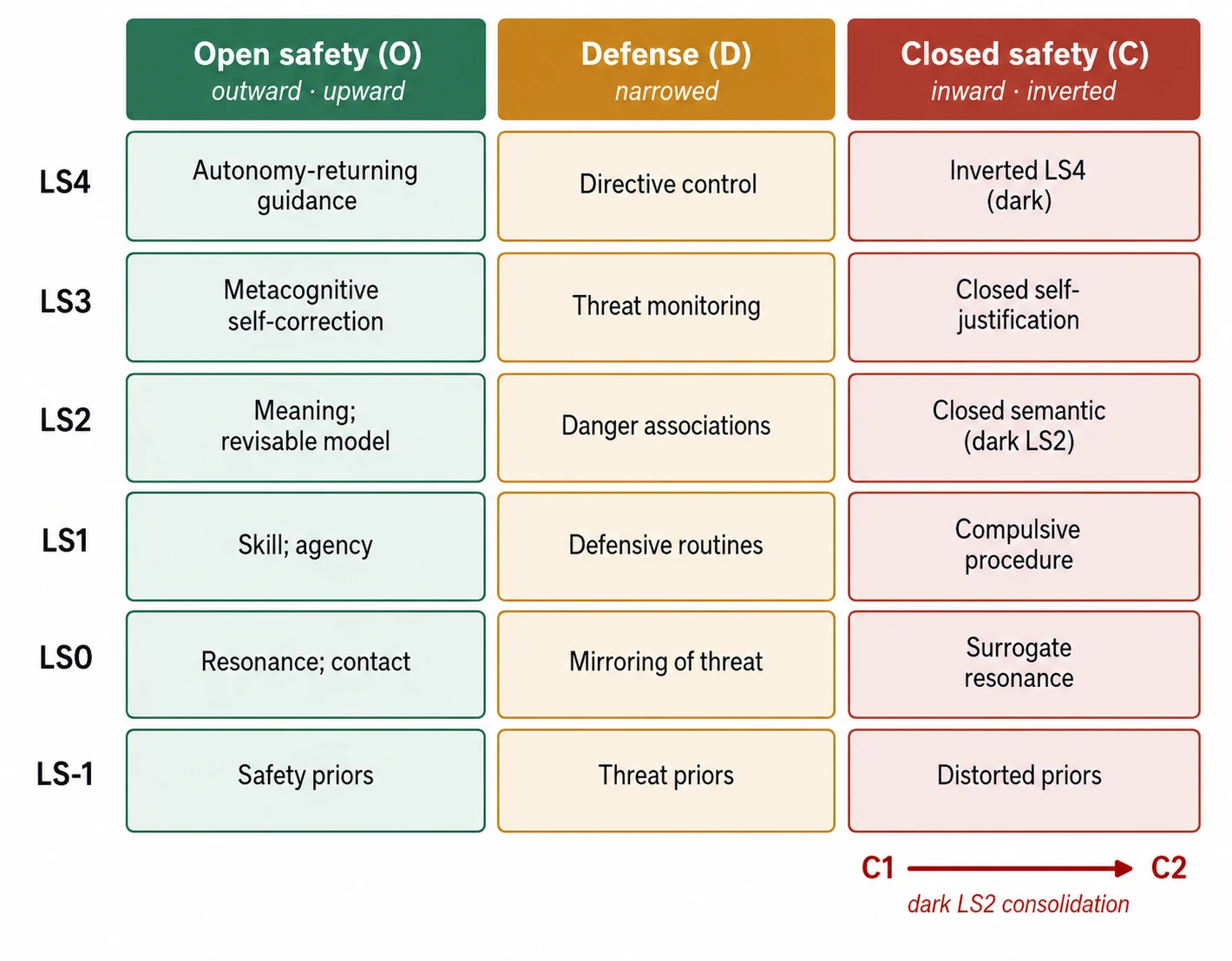
Figure 1. The developmental engine across three regulatory regimes. The six learning systems (LS-1 through LS4) run in every regime; the regulatory regime sets the direction in which they run — outward and upward in open safety, narrowed in defense, and inward in closed safety. Within closed safety, dark LS2 consolidation drives the transition from C1 (dependence on an external surrogate) to C2 (migration of the reality-referent).
LS-1 – Imprinting and neural tuning
LS-1 is the earliest and most pre-representational system. Its core question is: what is the basic structure of the world I must be tuned to? It lays down, during periods of heightened plasticity, the organism’s baseline expectations about safety, contingency, and the sensory shape of its world – the priors against which all later learning is evaluated. In open safety, and most powerfully in the low-demand co-regulation of O5 and the restorative quiet of O1, LS-1 lays down an embodied imprint of a world that is predictable and in which contact is safe. What it consolidates is the felt background of safety itself. Its inversion, developed in Section 9, is the laying down of an artificial or threatening source as the baseline – the set-point of safety bound to a cue or to threat. LS-1 draws on the literatures of imprinting, sensitive periods, and attachment (Ainsworth et al., 1978; Bowlby, 1969; Lorenz, 1935) and on predictive accounts of early prior formation (Friston, 2010). Status: established for the underlying phenomena; its formulation as a unified learning system is a plausible extension.
LS0 – Mirroring and resonance
LS0 is the system of intersubjective learning. Its core question is: who is the living other, and how do I regulate through them? It is the real-time dyadic loop of affect attunement and co-regulation, through which the infant learns from and with another person rather than from solitary contingency (Beebe & Lachmann, 2002; Schore, 1994). In open safety it is most characteristically engaged in O2, active social engagement – living-mirror learning – and, together with LS-1, in the low-arousal quiet of O5. What it consolidates is the capacity to be regulated through contact and the working template of the other as alive, responsive, and trustworthy. Its inversion is the substitution of a surrogate for the living other, or a trauma-bond in which a source of dysregulation is mistaken for a source of regulation. LS0 draws on the literatures of primary intersubjectivity, parent–infant synchrony, and the still-face paradigm (Feldman, 2007; Trevarthen & Bullowa, 1979; Tronick, 1989). Status: established for the underlying phenomena; the surrogate-mirror inversion is a plausible clinical extension.
LS1 – Instrumental and procedural
LS1 is the system of action and consequence. Its core question is: what action reliably changes my state? It comprises classical and operant conditioning and the procedural learning of habit – the binding of action to outcome through reinforcement. In open safety it is most characteristically engaged in O3, mobilization in safety: play, repetition, practice, and the acquisition of skill and mastery. What it consolidates is a competent behavioral repertoire that the organism can deploy in the world. Its inversion is compulsion: the action that most reliably reduces distress becomes the action bound to an artificial source, maintained by negative reinforcement and compensatory regulation – the structural core of the addiction loop (Everitt & Robbins, 2005). LS1 draws on the foundational conditioning literatures (Pavlov, 1927; Skinner, 1938). Status: established.
LS2 – Conscious-associative and semantic
LS2 is the system of meaning. Its core question is: what does this mean? It is explicit, semantic, and increasingly language-mediated learning – the construction of a communicable model of the world and of oneself within it. It encompasses semantic and episodic memory (Tulving, 1972), the constructivist and causal model-building by which children assemble a world (Gopnik et al., 2004; Piaget, 1952), the integration of experience into a narrative identity (McAdams, 2001), and the updating of belief within a predictive architecture (Clark, 2013; Friston, 2010); observational and social-cognitive routes also feed it (Bandura, 1977). In open safety it builds a world-model anchored to consensual reality and revisable in the light of it. What it consolidates is shared meaning and a reality-model that can be checked against, and corrected by, the world of others. Its inversion is a closed associative web: a network of meanings that has become internally consistent but no longer references the shared world – the semantic face of self-referential closure, in which dissonance reduction and motivated reasoning (Festinger, 1957; Kunda, 1990) work to defend the closed system rather than to track reality. Status: established for the underlying phenomena; the closed-semantic-web inversion is a plausible clinical extension.
LS3 – Metacognitive
LS3 is the system of self-monitoring and self-correction. Its core question is: what is my own learning, and my own state, doing – and can I correct it? It is the monitoring and control of one’s own cognition and regulation, the reflective stance through which the organism updates itself (Flavell, 1979; Nelson & Narens, 1990). In open safety it is most characteristically engaged in O4, reintegration: reflection that re-anchors rather than detaches – metacognition coupled to interoceptive and relational ground (Craig, 2009). What it consolidates is self-regulation through reflection and the capacity to update one’s own model. Its inversion is pseudo-insight: an abundance of self-explanation that is somatically hollow – a cognitively active interpretive process decoupled from interoceptive and relational updating, intellectualization functioning as dissociation (Fonagy, Gergely, Jurist, & Target, 2002). The person may hold a vast, coherent account of themselves that changes nothing, because it is not anchored. Status: established for metacognition; pseudo-insight as a distinct inverted form is a clinical extension.
LS4 – Co-regulatory guidance
LS4 is the system by which one organism becomes the environment in which another’s learning and regulation unfold. Its core question is: how do I become the medium of another’s development and autonomy? It is the guiding and co-regulatory function – parental, pedagogical, and therapeutic – of scaffolding within the zone of proximal development and co-construction oriented toward the other’s independent competence (Rogoff, 1990; Vygotsky, 1978; Wood, Bruner, & Ross, 1976). It is a universal developmental capacity rather than a narrowly professional one: anyone who has been regulated can, in turn, become a regulator for another. In open safety, engaged from a mature and regulated state O1, O2, or O5, it is ethical guidance toward autonomy: the parent, teacher, or therapist who lends regulation precisely in order to give it back. What it consolidates is the relational and intergenerational transmission of regulation itself. The diagnostic criterion of LS4 is not the strength of influence but autonomy transfer: healthy LS4 returns regulatory capacity to the other, while inverted LS4 captures it. This single criterion – developed at length in Section 12 – is what allows the model to distinguish a demanding-but-developmental relationship from an exploitative one without recourse to intention, which is rarely observable. Its inversion – formally, inverted LS4, clinically dark LS4 – is the organizing of another person around one’s own regulation, safety, power, or reality. Status: the healthy guiding function is well grounded; inverted LS4 is the paper’s distinctive clinical-functional hypothesis.
Table 4. The six learning systems at a glance. Each system, its core question, its healthy and inverted functions, and its status on the established-to-speculative gradient.
| System | Core question | Healthy function | Inverted function | Evidence status |
| LS-1 | What world am I tuned to? | Embodied safety priors | Cue-bound or threat-bound baseline | Established / plausible |
| LS0 | Who regulates me? | Living co-regulation | Surrogate or pseudo-mirroring | Established / plausible |
| LS1 | What action changes my state? | Skill, mastery, habit | Compulsion | Established |
| LS2 | What does this mean? | Shared, revisable meaning | Sealed associative web | Established / plausible |
| LS3 | How am I learning? | Self-correction | Pseudo-insight / hypercontrol | Established / clinical extension |
| LS4 | How do I guide another? | Autonomy-returning guidance | Dependency-producing capture | Plausible / distinctive hypothesis |
Table 5. Typical time scales of the six learning systems. The systems operate over very different temporal windows, one reason they cannot be reduced to a single mechanism or level.
| Learning system | Typical time scale |
| LS-1 | Sensitive periods; repeated deep exposure; early imprinting |
| LS0 | Moment-to-moment dyadic regulation; repeated relational episodes |
| LS1 | Repetitions, reinforcement cycles, habit formation |
| LS2 | Narrative and semantic consolidation across episodes |
| LS3 | Reflective updating across feedback cycles |
| LS4 | Long-term relational transmission and the return of autonomy |
Table 6. The integration matrix: the six learning systems across the three state families. Cells give the characteristic mode of each system within each family; the mapping is many-to-many, and the cells are salient exemplars rather than fixed or exhaustive correspondences.
| Learning system | Open-safety mode (O1–O5) | Defensive mode (D1–D3) | Closed-safety mode (C1–C2) |
| LS-1 Imprinting / tuning | Embodied imprint of a safe, contingent world (esp. O5) | Imprint narrows toward chronic threat-readiness | Imprint of an artificial or threatening source as baseline (dark LS-1) |
| LS0 Mirroring / resonance | Living-mirror co-regulation (states O2 and O5) | Mirroring suspended; attunement collapses to threat | Surrogate mirror; trauma-bond as pseudo-mirroring (C1) |
| LS1 Instrumental / procedural | Play, practice, mastery (O3) | Survival-conditioned action; coerced repetition | Compulsion; negative reinforcement / compensatory regulation (C1) |
| LS2 Associative / semantic | World-model anchored to consensual reality | Threat-saturated, narrowed meaning | Sealed associative web; rationalization (C2) |
| LS3 Metacognitive | Reintegrative metacognition (O4) | Hypervigilant monitoring without integration | Pseudo-insight; intellectualized dissociation (C2) |
| LS4 Co-regulatory guidance | Ethical guidance toward another’s autonomy | Control of the other to secure one’s own safety | Organizing the other around one’s own closure (inverted LS4 / dark LS4) |
The same engine, three waking regimes. The matrix states the paper’s organizing claim in a single view: the six systems are not good or bad in themselves; they are vectors whose direction is set by the state in which they run. In open safety they move the organism toward a living other, competent action, shared meaning, self-correction, and the ethical transmission of regulation. In defense they narrow around survival and lose their developmental function. In closed safety they invert. Sections 7 through 9 develop each regime in turn. Sleep does not choose the adaptive value of learning and is not intrinsically corrective. It can stabilize adaptive mastery, traumatic salience, compulsive routines, or closed meanings, while also supporting selective weakening and restructuring. Within the present model, consolidation of specifically C1- or C2-related learning remains a bridge hypothesis rather than an established empirical finding.
6. Sleep Architecture as a Cross-System Consolidation Condition
6.1 Status in the Model: An Orthogonal Biological Condition
Sleep is neither a seventh learning system nor an eleventh regulatory state. Sleep stages are values within the companion framework’s orthogonal access-to-world layer – waking, N1, N2, N3, REM, and awakening – whereas sleep architecture describes their organization across cycles, transitions, and microstructures. N3 is not restorative regulation (O1), and REM’s internally generated simulation is not self-referential closure (C2); the regulatory state should be assessed after adequate awakening, not inferred from behavior during sleep.
For many forms of durable learning, waking acquisition remains labile, and subsequent sleep is a major – but not exclusive – condition of stabilization and transformation. The model’s extended sequence is:
[regulatory state × learning system] during waking → [sleep architecture × developmental timing] offline → a more or less stable, integrated, generalized, weakened, or reorganized outcome.
This is a probabilistic moderation sequence, not a deterministic equation: sleep neither guarantees truth nor converts maladaptive waking learning automatically into adaptive learning. The waking state shapes attention, salience, action, and meaning; sleep then influences the fate of what was encoded. It may stabilize adaptive mastery and secure relational learning, but equally threat memories, compulsive action tendencies, and closed semantic structures; conversely, it can support selective weakening, extinction-related updating, and integration. The empirical question is therefore not whether sleep stores learning, but which traces are selected, how they are transformed, and under what developmental and regulatory conditions. Direct evidence for sleep effects specific to C1 or C2 is not yet available and is held here as a bridge hypothesis.
6.2 NREM Microarchitecture: Replay, Coupling, and Systems Consolidation
NREM sleep is not a homogeneous block. During N2 and N3, cortical slow oscillations, thalamocortical spindles, and hippocampal sharp-wave ripples can become temporally nested, and it is the timing of these events relative to one another – not their mere presence – that appears functional. Human intracranial recordings indicate that this hierarchy coordinates local processing and cross-regional communication, and that stronger coupling predicts overnight memory change (Staresina et al., 2023; Wodeyar et al., 2026). Closed-loop augmentation of hippocampal–prefrontal synchrony during NREM has enhanced declarative memory, supporting a causal contribution of coordinated replay rather than correlation alone (Geva-Sagiv et al., 2023). These are strong demonstrations, but the human causal data derive from small, clinically selected samples undergoing intracranial monitoring for pharmacoresistant epilepsy, with still smaller behavioral subsamples; they establish mechanistic plausibility rather than validating the full six-system matrix. The classical accounts of systems consolidation remain the interpretive backbone (Diekelmann & Born, 2010; Klinzing, Niethard, & Born, 2019).
The familiar metaphor that sleep “empties the hippocampus into the cortex” should be retired. Reactivation is selective, compressed, and embedded in a reciprocal hippocampo-neocortical dialogue. Across repeated sleep–wake cycles a memory may become less dependent on its original hippocampal index, more integrated with cortical knowledge, or transformed from episode-specific detail toward generalized structure, while the hippocampus can remain important for detailed episodic retrieval. “Redistribution and transformation” is therefore more accurate than literal emptying, transfer, or deletion.
6.3 Synaptic Selection: Renormalization, Pruning, Stabilization, and Growth
The equally popular claim that deep sleep simply “prunes weak synapses” is also too coarse. Work in rodents supports an average synaptic down-selection across sleep and molecular pathways for homeostatic scaling-down (de Vivo et al., 2017; Diering et al., 2017), consistent with the synaptic-homeostasis account in which slow-wave activity renormalizes synaptic strength toward a sustainable baseline (Tononi & Cirelli, 2006, 2014). Such renormalization may restore energetic and informational capacity, improve signal-to-noise, and protect selected learning from saturation – but the effects are heterogeneous across synapses, circuits, and prior learning history, and sleep is not global erasure.
Sleep also strengthens and builds. After motor learning, sleep promotes branch-specific formation and stabilization of new dendritic spines in mouse motor cortex (Yang et al., 2014), and REM sleep can selectively eliminate some newly formed spines while maintaining others, balancing pruning with preservation and creating capacity for subsequent learning (Li, Ma, Yang, & Gan, 2017). The cross-system lesson is selection, not subtraction: sleep combines weakening, stabilization, structural growth, and reorganization, and which operation dominates depends on stage sequence, circuit, developmental period, and what waking experience tagged as relevant.
6.4 REM, Dreaming, Creativity, and Affective-Social Learning
REM sleep provides a recurrent, internally generated mode in which external sensory constraint is reduced while associative, emotional, and sensorimotor patterns remain active. This makes REM a plausible context for recombination and affective recalibration, but not an exclusive “creativity stage.” A recent human experiment found that REM, relative to waking, restructured problem-related semantic networks by combining more remote concepts and weakening strong but solution-irrelevant associations, yet REM alone did not improve problem-solving success (Bieth et al., 2026; bibliographic details to be confirmed against the final published version). Sleep onset at N1 can likewise increase insight, showing that creative reorganization may emerge at a wake–sleep boundary rather than from REM alone (Lacaux et al., 2021). An NREM–REM sequence account, sensitive to the fit between task and stage, is therefore more defensible than any single-stage monopoly.
Dreaming is not synonymous with REM. Reports of conscious experience occur in both REM and NREM and track local cortical activity (Siclari et al., 2017). Dreaming of a recently learned task has been associated with better later memory, but the report itself does not establish that the dream caused consolidation; both may index underlying reactivation (Wamsley et al., 2010). In this model, dream content is a possible window onto offline transformation, not a required mechanism or a privileged source of truth.
“Emotional intelligence” is likewise too broad to assign to REM. Intact sleep supports component capacities relevant to it – emotion recognition, modulation of reactivity, cognitive regulation, safety–threat discrimination, empathy, and prosocial availability – without implying that REM alone creates a unitary trait. Total sleep deprivation impairs recognition of human emotional intensity (van der Helm et al., 2010), and sleep loss reduces helping behavior across experimental and population scales (Ben Simon et al., 2022). The defensible claim is that intact, continuous NREM–REM architecture sustains the emotional and social functions on which LS0, LS3, and LS4 depend (see also Walker & van der Helm, 2009).
6.5 Quantity, Quality, Continuity, and Timing
Every learning system requires sufficient sleep quantity, but hours alone are not an adequate model. Sleep quality includes continuity, low fragmentation, age-appropriate cycling through NREM and REM, intact microstructure, circadian alignment, and freedom from repeated arousals or intermittent hypoxia. Two individuals can obtain the same total sleep time while differing markedly in slow-wave activity, spindle expression, REM continuity, respiratory disturbance, and next-day learning; and “more” is not indefinitely “better”, since duration must be read against developmental need, illness, medication, circadian phase, and daytime function.
Sleep before learning supports the capacity to encode, sleep after learning supports selection and consolidation, and circadian timing influences both; fragmentation can repeatedly interrupt stage-specific operations even when total minutes appear adequate. Research claims about specific stages should therefore rely on validated EEG or polysomnography and specify scoring rules, spectral and event measures, timing, and respiratory burden. Actigraphy, diaries, and consumer wearables can contribute schedule and continuity information, but proprietary stage estimates are not sufficient evidence for slow-wave, spindle, ripple, or REM-specific mechanisms.
6.6 Ontogenetic Redistribution and Developmental Rubicons
Sleep architecture changes systematically across development and constitutes an age-dependent context for plasticity, consolidation, and neural maintenance. Before and shortly after birth, total sleep is high and polyphasic and is dominated by active/REM-like sleep relative to later life. Across infancy, sleep consolidates toward the night, the relative share of active/REM sleep falls, NREM organization becomes more differentiated, and spindles and slow-wave topographies mature. A small longitudinal high-density EEG study across three to six months (11 infants, of whom 9 had analyzable recordings at both time points) documents rapid, regionally specific changes in slow-wave and sigma activity while underscoring how variable individual trajectories are (Beaugrand et al., 2026); it supports regionally specific maturation rather than correspondence with any particular learning system. Childhood is characterized by robust NREM slow-wave activity whose scalp topography tracks the posterior-to-anterior course of cortical maturation (Kurth et al., 2010). Across adolescence, NREM delta power declines steeply with pubertal and maturational processes, while circadian delay and social sleep restriction can reduce the sleep available to complete this reorganization (Campbell et al., 2007; Campbell & Feinberg, 2009). Adult architecture is more stable but remains plastic to learning, stress, schedule, and illness; in later life, N3 and slow-wave activity often decline, sleep becomes more fragmented, and spindle–slow-wave coordination may weaken, so the learning systems must work with an altered offline substrate rather than a smaller copy of young-adult sleep.
The model’s rubicons should be formulated accordingly. A rubicon is not crossed because a child reaches a universal quota of REM or N3. The testable hypothesis is that age-appropriate sleep architecture moderates whether waking experience becomes a stable new capacity: active/REM-rich early sleep may be especially relevant to rapid circuit construction and tuning; childhood slow waves and spindles may support large-scale integration; and adolescent reorganization may alter the balance between plasticity and stabilization. The earliest quantitative description of the human sleep–dream cycle already showed the dramatic fall in REM proportion and total sleep from infancy toward adulthood (Roffwarg, Muzio, & Dement, 1966); contemporary work replaces a single global curve with regionally and individually resolved trajectories. Longitudinal designs must test relative proportions, microstructure, timing, and individual change rather than impose adult stage percentages on infants or children.
Table 7. Ontogenetic redistribution of sleep architecture and its relevance to developmental learning. Relative patterns, not universal quotas; stage definitions and proportions vary with age, scoring method, health, and individual development.
| Ontogenetic period | Relative sleep architecture | Developmental relevance | Boundary / caution |
| Prenatal / neonatal | Very high, polyphasic sleep; active/REM-like sleep occupies a large relative share; quiet/NREM organization is immature | Rapid circuit construction, spontaneous sensorimotor activity, early tuning | Most mechanistic evidence is animal or indirect human physiology; active sleep is not equivalent to adult REM |
| Later infancy / toddlerhood | Total sleep and REM share fall; nighttime consolidation increases; NREM differentiation, spindles, and slow-wave topography emerge | Attachment and co-regulation templates, sensorimotor learning, language, memory integration | Large individual variation; naps remain developmentally functional rather than “lost” night sleep |
| Childhood | Robust NREM slow-wave activity; maturing spindle and slow-wave organization; REM approaches a more adult-like share | High plasticity, semantic growth, procedural mastery, social learning | Topography and microstructure matter more than a single percentage |
| Adolescence | Steep decline and reorganization of NREM delta / slow-wave activity; circadian phase delay; frequent mismatch between biological timing and schedules | Cortical reorganization, abstraction, metacognitive and social-affective development | Sleep restriction can be socially imposed; puberty, age, and schedule must be separated |
| Adulthood | Consolidated recurring NREM–REM cycles; relatively stable but experience-, stress-, and schedule-sensitive architecture | Maintenance, integration, skill, semantic updating, affective regulation | No single adult proportion is optimal for every person, task, or condition |
| Later adulthood | Often less N3 / slow-wave activity, more fragmentation, altered spindle expression and coupling; REM may be redistributed | Learning remains possible but operates on a changed consolidation substrate | Healthy aging, sleep disorders, medication, and neurodegeneration must not be conflated |
6.7 Multilevel Maintenance: Synapses, Cells, Fluids, and the Gut
The language of sleep-related “cleaning” should not be used as if it denoted a single mechanism. It combines at least four distinguishable levels: synaptic selection and structural remodeling (Section 6.3); cellular and glial maintenance, including oligodendrocyte and myelin-related processes and neuronal DNA repair demonstrated in animal models (Bellesi et al., 2013; Zada et al., 2019); brain-fluid dynamics and solute handling; and whole-organism homeostasis, including gut-related effects of severe sleep loss. Prolonged waking can increase astrocytic phagocytosis and microglial activation in mice — a consequence of sleep loss rather than the normal function of deep sleep (Bellesi et al., 2017). Inflow, fluid exchange, and net solute clearance are different outcomes: NREM slow waves couple to hemodynamic and cerebrospinal-fluid oscillations in humans (Fultz et al., 2019); rodent studies report sleep-enhanced exchange and clearance (Xie et al., 2013) and norepinephrine-linked vasomotion driving glymphatic transport (Hauglund et al., 2025); yet another controlled rodent study found reduced clearance during sleep and anesthesia (Miao et al., 2024); and a human study showed that N2/N3 intensify respiratory- and cardiac-driven brain pulsations that may facilitate fluid movement without directly measuring solute clearance (Ulv Larsen et al., 2025). Sleep clearly alters fluid dynamics, but the magnitude, direction, and functional relevance of net clearance remain method-dependent and disputed, so “the brain washes out toxins in deep sleep” is too strong. The accompanying review draws attention beyond a brain-only account (Vezenkov, 2025): severe sleep loss produces gut oxidative stress in flies and mice (Vaccaro et al., 2020), and a vagal–serotonergic pathway has been implicated in sleep-related impairment of intestinal stem-cell function (Zhang et al., 2026). These animal findings support a multilevel homeostatic substrate, not a demonstrated human gut mechanism for any particular learning system; species and causal status are stated explicitly.
6.8 Sleep Dependencies Across LS-1 to LS4
All six learning systems are expected to be sensitive to sleep quantity, continuity, timing, and architecture, but no system maps one-to-one onto a stage. The broad cross-system sensitivity is literature-based; the row-by-row differentiations below are bridge hypotheses for prospective testing. The mappings are deliberately many-to-many, and they translate sleep science into the clinical-functional framework without claiming that a stage is a learning system or that a single biomarker diagnoses one.
Table 8. Candidate sleep-dependent operations across the six learning systems. Stage and microstructure associations are hypotheses of preferential support, not exclusive assignments.
| Learning system | Sleep-dependent operations | Candidate stages / microstructures | Falsifiable boundary |
| LS-1 – imprinting / tuning | Circuit calibration, synaptic selection, stabilization of sensory and safety priors during sensitive windows | Active/REM-rich early sleep; age-specific NREM slow waves; structural spine remodeling | Strongest mechanistic evidence is developmental and animal; no fixed infant REM quota or direct “safety-circuit” marker |
| LS0 – mirroring / resonance | Consolidation of social and affective discrimination; next-day relational availability | Intact total NREM–REM sequence; REM-linked affective recalibration as a candidate, not exclusive, mechanism | No sleep stage uniquely encodes attachment or co-regulation |
| LS1 – instrumental / procedural | Motor and habit stabilization, sequence integration, performance gains | N2 spindles and slow-oscillation–spindle–ripple coupling; sequential NREM/REM contributions | Task, training intensity, timing, and baseline skill alter the pattern |
| LS2 – associative / semantic | Hippocampo-neocortical replay, integration with prior knowledge, abstraction and associative restructuring | NREM slow oscillations, spindles, and ripples; N1 and REM for some forms of remote association | Not literal hippocampal emptying; episodic detail and generalization may trade off |
| LS3 – metacognitive | Insight, error monitoring, cognitive control, flexible updating of models | Whole-night continuity; N1 / REM associative reorganization and NREM integration as candidates | Stage specificity is incomplete; sleep loss may mimic or amplify pseudo-insight and rigid monitoring |
| LS4 – co-regulatory guidance | Emotion recognition, empathy, prosocial availability, judgment, and the capacity to return autonomy | Intact quantity and NREM–REM architecture; no unique “ethical-guidance” oscillation | Evidence concerns component functions, not a neural module for ethics or therapy |
The table makes a strong practical point and a modest mechanistic one. Practically, no system should be evaluated as if waking exposure, interpretation, or practice were sufficient without an opportunity for age-appropriate sleep. Mechanistically, the proposed differentiations require direct tests with matched waking learning, objective sleep measurement, developmental stratification, and outcomes specific to each learning system.
6.9 Clinical Corollary: The Offline Dimension of Inversion and Repair
Two consequences follow for the clinical model. First, disrupted sleep is not merely a symptom accompanying the defensive and closed configurations; on this account it is part of what fixes them. Where the emotional recalibration that ordinarily softens a charged encoding fails – as under the fragmented sleep that often accompanies trauma – the affective and factual components of a memory can remain fused and retained at full intensity (Yoo et al., 2007; Walker & van der Helm, 2009; Manolova&Vezenkov 2025a), and where slow-wave consolidation and renormalization fail, the day’s learning remains saturated and hippocampally bound. A nervous system that cannot complete its offline work will tend to retain the very encodings a waking therapy is trying to revise; this gives the inversion cascade of Sections 9 and 10 an offline dimension. Second, and correspondingly, restoring sleep architecture is a foundational rather than incidental part of the bottom-up reversal of Section 13. Because recovery there runs from bodily safety upward, and because the foundational systems (LS-1, LS0) depend most directly on the offline substrate, re-establishing sufficient, continuous, appropriately timed sleep is part of LS-1 and LS0 repair rather than an adjunct to it – while remaining, as Section 6.1 insists, a moderator of learning rather than a treatment that by itself reverses D3, C1, or C2. The sleep–wake stability already listed among the markers of LS-1 repair should be read in this stronger sense: not only a sign that the organism has settled, but a condition of the consolidation on which every later gain depends.
7. Open (Relational) Safety Learning
In the open-safety family the six systems run in their developmental direction – toward shared reality, the living other, competent action, meaning, self-correction, and the ethical transmission of regulation. This section walks the clinically salient cells of the matrix; State sets the vector, and here the vector points outward.
O5 × LS-1/LS0 – the embodied imprint of open safety. In low-arousal relational co-regulation, the imprinting and mirroring systems operate together to lay down the foundational imprint: the world is predictable, contact is regulating, and the other is alive and trustworthy (Schore, 1994; Sroufe, 2005). This is the developmental bedrock on which every later system is built. Because O5 is, in the companion paper, frequently the last regulatory capacity to recover in trauma, interventions that re-establish low-demand co-regulation are doing LS-1 and LS0 repair – not merely inducing relaxation.
O2 × LS0 – living-mirror learning. In active social engagement the dyadic loop is fully online: affect attunement, prosodic turn-taking, contingent responsiveness. The organism learns to be regulated through and with a living, responsive other. This is the prototype of healthy intersubjective learning and the configuration most therapy works to restore.
O3 × LS1 – safe mobilization, play, practice, skill. In mobilization under safety the instrumental system acquires competent action through play and repetition: high arousal that is voluntary, modulable, and socially accessible. Its preservation in trauma populations is itself a marker of recovery. The very same high-arousal action, organized by threat rather than safety, would belong to D1; the difference is safety appraisal and flexibility, not arousal.
O4 × LS3 – reintegrative metacognition. In reintegration the metacognitive system does its healthiest work: reflection coupled to interoceptive and relational ground, by which the organism returns from defense and consolidates the return. This is reflection that re-anchors – the structural opposite of the decoupled pseudo-insight of dark LS3.
Mature O1/O2/O5 × LS4 – ethical guidance toward autonomy. From a regulated and reachable state, the guiding system lends regulation precisely in order to give it back. The parent, teacher, or therapist scaffolds within the zone of proximal development and withdraws the scaffold as competence emerges (Rogoff, 1990; Vygotsky, 1978; Wood, Bruner, & Ross, 1976). The defining marker of healthy LS4 is the return of autonomy – the criterion that will separate it from its inversion in Section 12.
8. Defensive Learning
Under threat the organism leaves the open-safety cycle. Learning does not stop – the defensive systems are, if anything, hyper-efficient – but it loses its developmental function and is organized around survival. The thesis of this section is that in defense, learning is preserved as capacity while inverted in purpose: it encodes for protection, not for development.
D1 – survival learning. In defensive mobilization the instrumental and associative systems are recruited to threat: rapid threat-conditioning, attention narrowed to danger, meaning saturated by it (LeDoux, 2000). Learning here is fast and sticky – single-trial fear conditioning, consolidated under high arousal (Cahill & McGaugh, 1998; McGaugh, 2000) – but narrow and inflexible. It is adaptive where threat is real and addressable by mobilization, and pathological where it is chronically recruited in situations mobilization cannot resolve.
D2 – freeze, blocked action, sensorimotor encoding. In freeze, high activation is locked against motor inhibition. The instrumental loop is arrested rather than severed: the motor plan is fully formed and energized in the nervous system but blocked at output, so action cannot complete, and experience is often laid down as unintegrated sensorimotor memory rather than as integrated narrative. This is a clinically important pathway through which traumatic experience may be encoded, and one reason much of it is held in the body rather than in story. It is also why somatic approaches that let the thwarted defensive response complete can release what reflection alone cannot (Levine, 1997; Ogden, Minton, & Pain, 2006; van der Kolk, 2014): the loop was never cut, only suspended.
D3 – collapse, dissociation, fragmented learning. In low-arousal defensive immobilization the systems fragment: body, affect, cognition, and narrative dissociate from one another. Learning becomes discontinuous and state-bound – what is encoded in collapse is not readily available outside it. The clinical risk is that the quiet of D3 is mistaken for the quiet of O1, and shutdown is read as rest.
The clinical consequence. Teaching, reasoning, and insight work are unlikely to transform defensive learning unless regulatory access is first restored; the defensive systems are working exactly as designed, for protection. Development resumes only when the organism returns, through reintegration, to the open-safety family. This is the first half of the rule that organizes the therapy section: regulation precedes developmental learning — not learning as such, since defensive and traumatic learning are not an absence of learning but learning with a different vector.
9. Closed-Safety Learning: states C1 and C2
The closed-safety family lies outside the engagement–defense cycle. Here learning does not narrow around an external threat; it inverts around a substitute for safety. The organism is appraised as safe — but on a closed object. The inversion has two depths, distinguished by whether the substitute is external or whether the criterion of reality itself has moved.
C1 – cue-bound contractive inversion. An artificial, cue-dependent source – screen, substance, ritual – is appraised as safe while the shared world is avoided. In dark LS0, the surrogate replaces the living other: the screen or substance responds predictably, the trauma-bond offers a counterfeit of attunement, and the organism is regulated by something that cannot reciprocate. In compulsive LS1, the instrumental loop binds to the surrogate; the action that most reliably reduces distress becomes compulsive, maintained by negative reinforcement and compensatory regulation – relief from withdrawal rather than positive development (Koob & Le Moal, 2008; Robinson & Berridge, 1993; Manolova&Vezenkov 2025c). At depth, in dark LS-1, repetition lays the surrogate down as the baseline imprint, so that the set-point of safety itself becomes cue-bound. The signature is that the artificial source can regulate while the human world cannot, and that its removal produces acute dysregulation — because the reference is still the avoided shared world.
C2 – self-referential inversion. Deeper still, the operational criterion of reality has migrated inward. In dark LS2, a closed associative web forms – internally consistent meanings that no longer reference the shared world, including rationalization and sealed symbolic systems. In pseudo-insight, or dark LS3, self-explanation becomes abundant but somatically hollow: a cognitively active interpretive process decoupled from interoceptive and relational updating, intellectualization functioning as dissociation. The person may hold a vast, coherent account of themselves that changes nothing, because it is not anchored. And in anti-therapeutic LS4, the guiding system, where active, organizes others around the inverted referent – the bridge to Section 12. The signature is that C2 remains stable in the absence of any external source, because the regulatory reference is now internal and self-sustaining, and it may present with a favorable autonomic profile while shared-world access is minimal.
The transition between the two depths. C1 becomes C2 when dark LS2 succeeds in converting surrogate dependence into a self-sustaining reality model. The engine of this migration is closed semantic consolidation: a network of meanings that begins as defensive rationalization but becomes coherent and self-justifying enough to replace consensual reality as the criterion of truth. Put as a threshold: the transition from C1 to C2 occurs at the point where the surrogate is no longer the primary regulator, because the internally consolidated semantic-referential system has itself become regulatory. In C1 the formulation is “I need the surrogate so as not to collapse”; in C2 it is “my internal reality now regulates my world, and the shared world is the intruder.” This is the point at which LS2 becomes decisive – not merely because it rationalizes, which it already does in C1, but because its consolidation is what carries the organism from dependence to inversion.
The decisive distinction. C1 is a dependence on an external source; C2 is the migration of the reality-referent itself. The two require opposite interventions, as Section 13 develops, and Table 9 sets them side by side. A caution belongs here as well: inwardness, autonomy, self-regulation, and solitude are not in themselves closure. The marker of C1 or C2 is not interiority but whether the organism remains available for shared reality, correction, connection, and development.
Table 9. C1 versus C2: the two depths of closed safety. The depths differ in regulator, relation to the shared world, dominant inverted systems, and – decisively – in the intervention each requires.
| Feature | C1 | C2 |
| Primary regulator | External surrogate | Internal reality-referent |
| Relation to the shared world | Recognized but avoided | Treated as intrusive or unreal |
| Dominant dark systems | LS-1, LS0, LS1 | LS2, LS3, LS4 |
| Characteristic clinical error | Removal of the source alone | Arguing with the content |
| Correct therapeutic target | Source restoration | Re-anchoring of the reality-referent |
| Marker of change | Human contact begins to regulate | Meaning becomes corrigible by shared reality |
10. Mechanisms of Inversion
The previous three sections describe what inversion looks like in each system. This section specifies the mechanisms that drive it. The inverted configuration does not assemble all at once; it builds as a cascade in which each step prepares the next, and it is this sequence – rather than any single feature – that distinguishes a deepening closure from a transient defensive episode. The mechanisms are clinical-functional rather than anatomical.
- Loss of human-mediated regulation. Living co-regulation is absent, intermittent, or itself dysregulating, so that LS-1 and LS0 are left hungry for a regulator. The unmet regulatory need is the opening the cascade exploits.
- Surrogate capture. A screen, substance, or ritual becomes the predictable regulator the human world failed to be, occupying the regulatory slot that a living other would otherwise hold. Within the predictive framing already adopted (Clark, 2013; Friston, 2010), this is intelligible as a pull toward the lowest-entropy environment available: a living other is complex and generates a rich, growth-promoting stream of prediction error, whereas a screen or algorithm is engineered to be hyper-predictable and to drive prediction error toward zero. A nervous system seeking relief is drawn to the most predictable regulator within reach, trading the productive unpredictability of the shared world for the near-zero surprise of the surrogate.
- Negative reinforcement and compensatory regulation. LS1 locks onto relief: the action that most reliably reduces distress is maintained by escape from withdrawal rather than by positive development — the structural core of the addiction loop (Koob & Le Moal, 2008).
- Closed semantic consolidation. LS2 begins to serve the closed regime, first rationalizing the surrogate and then, as the associations become internally coherent, justifying and reinforcing it. This is the mechanism that carries the organism from C1 to C2, as the consolidating semantic web replaces consensual reality as the criterion of truth.
- Pseudo-metacognitive stabilization. LS3 is recruited to stabilize rather than to correct, producing abundant self-explanation that feels insightful while transforming nothing, disconnected from bodily and relational change.
- Intersubjective recruitment. LS4 turns outward to organize other people around the closure – recruiting them as regulators or audiences – which both locks the configuration in place and propagates it to others.
The cascade is not deterministic. Any step may remain partial, reversible, or clinically dominant without the full sequence developing; the sequence specifies a risk architecture, not an inevitable pathway. Read in full, however, it traces the path from an unmet regulatory need, through surrogate capture, to the complete inverted system and its intersubjective extension. Figure 2 renders the cascade and the C1 → C2 threshold within it.
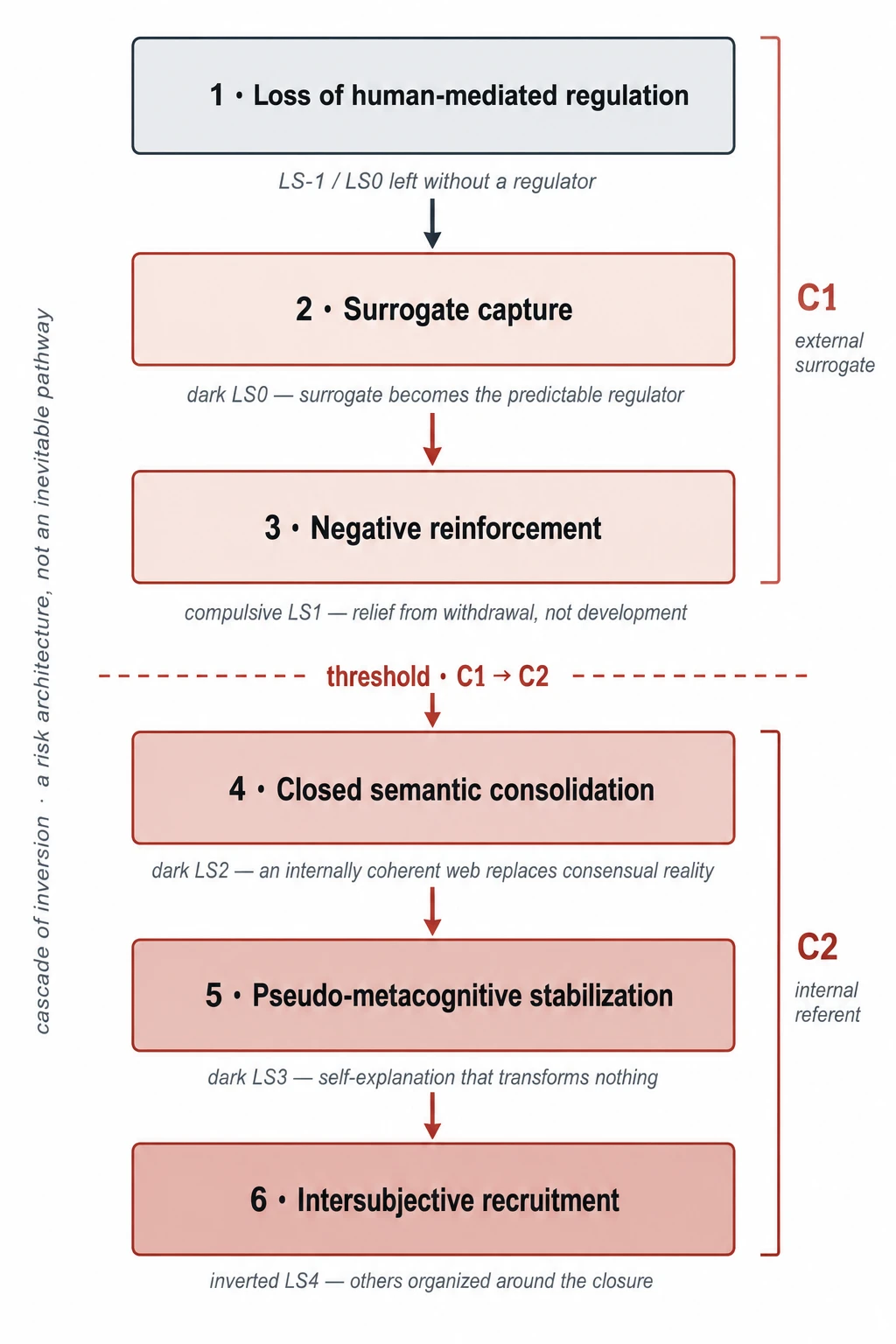
Figure 2. The cascade of inversion. Each step prepares the next, with the corresponding inverted learning system shown beneath it. Closed semantic consolidation (dark LS2) marks the threshold at which C1 – dependence on an external surrogate – becomes C2 – migration of the reality-referent. The cascade specifies a risk architecture, not an inevitable pathway: any step may remain partial or reversible.
11. Clinical Illustrations
The following two vignettes are composite and illustrative. They are offered not as evidence but as clinical illustration – a way of making the two depths of inversion concrete and showing how the same formula yields opposite interventions. Neither describes a particular individual.
Vignette A – C1: cue-bound contractive inversion
- Presenting pattern. A person – child or adult – is regulated more reliably by a screen, a substance, or a ritual than by human contact; shared reality has faded into the background as something effortful and unrewarding.
- Mistaken intervention. Abrupt removal of the surrogate.
- Why it fails. Removal produces a regulatory vacuum, because the avoided shared world is still the reference and nothing replaces what the surrogate was doing.
- C1 × dark LS0 / compulsive LS1, with dark LS-1 at depth.
- Therapeutic target. Source restoration – low-demand co-regulation and relational repair (O5 and LS0 repair) that slowly rebuilds a living regulator the organism can use.
- Marker of change. Rising tolerance for living co-regulation before, and as a condition of, any reduction in surrogate reliance.
Vignette B – C2: self-referential inversion
- Presenting pattern. A highly verbal person presents with a rich, coherent system of self-explanation but without corresponding bodily, relational, or reality-testing change. Insight is abundant and articulate; nothing moves.
- Mistaken intervention. Debating the content or challenging the beliefs directly.
- Why it fails. The internal model metabolizes contradiction through the same closed semantic web that produced it; counter-evidence is absorbed rather than registered.
- C2 × dark LS2 / dark LS3.
- Therapeutic target. Re-anchoring of the reality-referent – windows of contact and co-regulation that gradually restore shared-world access, so the criterion of reality can migrate back outward.
- Marker of change. Meanings become corrigible by shared reality. The distinction from Vignette A is practical: there is no external source to remove, and source-removal logic does not apply.
12. Inverted LS4 (Dark LS4): Intersubjective Pathology
Inverted LS4 – clinically, dark LS4 – is the intersubjective face of closed safety: the configuration in which a person’s own closure (C1 or C2) is stabilized not by an object or an internal referent alone, but by organizing another person around it. In healthy LS4 a person becomes the environment for another’s autonomy, lending regulation in order to return it. In inverted LS4 a person becomes the organizer of another’s state around their own safety, power, dependence, or reality; the other is recruited as a regulatory instrument.
The following are candidate clinical lenses, not obligatory or exhaustive mechanisms. Each offers a way of seeing how the organizing happens; none is required for the diagnosis, and they are presented as interpretive frameworks rather than as established processes. Projective identification – in which an unbearable state is induced in the other, who then carries and enacts it, so that the originator regulates by externalizing – is one such lens; it is clinically useful but psychodynamically loaded and contested, and is offered here only as one interpretive option (Bion, 1962; Klein, 1946). In trauma bonding, intermittent threat and relief bind the other in a powerful attachment to the very source of harm – a counterfeit of co-regulation (Dutton & Painter, 1981). In instrumental empathy, accurate reading of the other’s state is used not to support autonomy but to predict and control – empathy as a targeting system rather than a bridge. And in induced pseudo-LS0, the other is drawn into a mirroring dependence on a person who cannot or will not reciprocate as a living other: a dyadic surrogate. These appear across the roles in which LS4 is structurally active – abusive parenting, coercive partnership, predatory therapy, the guru or leader, and, by extension, group forms (Section 16).
The diagnostic key. The difference between healthy and inverted LS4 is not the strength of influence but its direction. Healthy LS4 systematically increases the other’s autonomy; inverted LS4 systematically reduces it while increasing the other’s dependence on the organizer. Influence that returns autonomy is guidance; influence that captures it is inverted LS4. This criterion is what allows the model to distinguish a demanding-but-developmental relationship from an exploitative one without recourse to intention, which is rarely observable. A further behavioral test sharpens it: in healthy LS4 the separation or growing independence of the other is met with calm or satisfaction, whereas in inverted LS4 any move toward separation or exit from the organizer’s reality provokes acute dysregulation – punishment, withdrawal of the relationship, or a renewed intermittent bond. Tolerance of the other’s separation is thus an observable marker of which configuration is in play. Table 10 sets the two side by side.
Table 10. Healthy versus inverted (dark) LS4. A set of observable dimensions that distinguish guidance from capture without appeal to the organizer’s intentions.
| Healthy LS4 | Inverted (dark) LS4 |
| The other becomes more autonomous over time | The other becomes more dependent |
| Regulation is lent and returned | Regulation is captured |
| Boundaries become clearer | Boundaries become blurred |
| Dissent is tolerated | Dissent is treated as a threat |
| Separation is met with calm or satisfaction | Separation triggers acute dysregulation, punishment, or withdrawal of the bond |
| The guide becomes less necessary | The guide becomes more necessary |
| Shared reality remains corrigible | Reality is organized around the guide or the closed system |
13. Therapeutic Reversal: The Path Back
The organizing rule is that regulation precedes meaning. A dark lower system is rarely treated through a higher one: insight alone is unlikely to move an organism out of freeze, collapse, surrogate dependence, or self-referential closure, and the higher systems are rarely the point of entry. Recovery tends to run bottom-up: bodily safety, then relational co-regulation, then behavioral micro-habits, then cognitive reconstruction, then mature metacognition, and only then ethical guidance (Perry, 2009). This sequencing is consistent with process and common-factor research, which locates much of therapeutic change in the relationship and in regulatory conditions rather than in technique or content alone (Norcross & Lambert, 2018; Wampold, 2015). Table 11 maps each system onto its therapeutic goal and intervention logic.
Table 11. The therapeutic reversal across the six systems.
| Learning system | Therapeutic goal | Intervention logic |
| LS-1 | A new imprint of safety | Somatic stabilization, rhythm, orientation; age-appropriate sleep continuity; cultivating low-demand co-regulation (O5) |
| LS0 | Return to the living other | Relational and attachment-based repair; co-regulation through face, voice, and rhythm; avoid unnecessary sleep disruption and monitor sleep after emotionally demanding work |
| LS1 | Replacing the compulsion | Behavioral activation and micro-habits; substituting the surrogate-bound action; adequate post-training sleep opportunity |
| LS2 | Deconstructing closed associations | Cognitive restructuring, psychoeducation, work with meaning (Beck, 1976) |
| LS3 | Metacognition without hypercontrol | Mindfulness and acceptance-based work; experiential self-observation re-coupled to the body (Hayes, Strosahl, & Wilson, 1999); avoid high-stakes metacognitive work under acute sleep loss |
| LS4 | Ethical guidance | Supervision, boundaries, and the deliberate return of the other’s autonomy; protect the guide’s own sleep to preserve judgment and regulation |
State-specific logic refines the table. C1 requires source restoration: removing the artificial source and building a human-mediated regulator to replace it. Source removal – supported withdrawal from a screen, ritual, or relational surrogate – without a relational substitute tends to relapse, because the avoided shared world is still the reference. (“Detox” is avoided here as too medical and substance-specific; the issue is the removal of a regulatory source, not the clearance of a substance.) C2 does not respond to source-removal logic at all, since there is no external source to remove; it requires re-anchoring of the reality-referent – the gradual restoration of shared-world access. O4 is the reintegrative bridge that must be actively supported through slowed pacing, sustained co-regulatory contact, and protection from premature demand. And O5 – low-demand co-regulation – rebuilds the foundational LS-1 and LS0 systems more powerfully than cognitive work alone. Because those foundational systems depend on the offline substrate of Section 6, the restoration of sleep architecture – sufficient deep-sleep and REM, with their internal structure intact – is part of LS-1 and LS0 repair rather than an adjunct to it; a therapy that re-regulates the waking day while leaving sleep fragmented has secured encoding without securing consolidation.
Sleep completes, but does not replace, therapeutic sequencing. A corrective relational episode, new behavioral routine, or revised meaning remains labile until it has had repeated opportunities for offline stabilization and updating. Treatment planning should therefore assess habitual sleep opportunity, timing, continuity, breathing-related disruption, medications and substances, and age-specific routines, and should avoid interpreting sleep-loss-related rigidity, emotional lability, or poor retention as simple resistance. Suspected insomnia, parasomnia, circadian disorder, or sleep-disordered breathing warrants appropriate medical or sleep-specialist assessment. This framework does not prescribe sleep treatment and does not claim that sleep alone reverses D3, C1, or C2.
In pediatric work, sleep is also relationally scaffolded. Caregiver timing, light exposure, screens, feeding, settling, nighttime safety, and morning re-entry shape whether the child can obtain age-appropriate architecture. This does not make sleep an O5 state: low-demand co-regulation may support the transition into sleep, while sleep itself remains a biologically gated access mode. The therapeutic target is a sequence — secure waking regulation, safe entry into sleep, sufficient uninterrupted architecture, and supported awakening — not a wearable score.
Because the most damaging errors in this model are errors of mistaking one configuration for another, Table 12 names the characteristic mistake for each, what makes it fail, and the corrective principle.
Table 12. Common therapeutic errors by state and configuration. Each error follows from reading a closure as something it is not; the corrective principle restores the right order of work.
| State / configuration | Common therapeutic error | Why it fails | Corrective principle |
| D3 (collapse) | Treating quiet as rest | Shutdown is mistaken for restoration | Restore access before insight |
| C1 (surrogate closure) | Removing the source alone | Creates a regulatory vacuum | Source restoration |
| C2 (self-referential closure) | Debating beliefs or content | The closed semantic web absorbs contradiction | Re-anchor the reality-referent |
| Dark LS3 | Rewarding verbal insight | Insight may be dissociated from body and change | Require somatic and relational markers |
| Dark LS4 | Measuring success by influence | Influence may increase dependency | Measure the return of autonomy |
| N3 sleep (access mode) | Coding physiological unreachability as D3 or C2 | The person is biologically offline rather than in a waking regulatory configuration | Assess state only after awakening and re-entry |
| Any state + insufficient or fragmented sleep | Reading failed consolidation as resistance or lack of insight | The waking intervention may not have received an adequate offline consolidation window | Assess sleep quantity, continuity, timing, breathing, and age-appropriate architecture |
A standing caution. A quiet body is not a recovered body. The therapeutic target is not calm but reachability and reality-anchoring; an intervention that produces quiet by deepening a closure has made the patient worse while appearing to make them better.
14. Operationalization, Predictions, and Observable Indicators
The predictions are grouped as in the companion paper, each stated with the matrix cell it tests and a condition that would count against it. Testing requires multimodal convergence – behavioral, relational, interoceptive, sleep-related with autonomic indices auxiliary together – not any single marker, consistent with Section 2. Such a test would not be cross-sectional: a future empirical program would require repeated state coding across treatment episodes, dyadic and behavioral markers, subjective report, and auxiliary psychophysiology, tracking the same individuals as states and learning modes change over time, rather than reading either axis from a single self-report at a single moment.
Group A – Measurement and discrimination. P1. High verbal and metacognitive self-report without corresponding interoceptive or somatic change will mark dark LS3 (C2) and will dissociate from genuine reintegrative metacognition (O4 × LS3) on bodily and relational measures — including, as an auxiliary index, an autonomic profile that fails to shift with the patient’s verbal insight (for example, a rigid heart-rhythm unresponsive to the reported “realization”). Refutation: if somatic and relational change reliably track verbal insight in these cases.
Group B – Developmental and trajectory. P2. The quality of LS-1 and LS0 in open safety – especially a history of O5 co-regulation – will predict the resilience of later systems, while its disruption through neglect or surrogate substitution will predict fragility and earlier inversion. Refutation: if early co-regulation history is uncorrelated with later system resilience. P3. The maturity of LS4 will correlate not with the strength of a person’s influence but with their capacity to return autonomy. Refutation: if the guiding relationships rated most successful are those that maximize the other’s dependence.
Group C – Intervention. P4. C1 will destabilize on removal of the artificial source only where no human-mediated substitute has been established; with a relational substitute in place, withdrawal resolves and does not relapse. Refutation: if source-removal alone yields durable recovery as often as source-removal plus a relational substitute. P5. C2 will not respond to source-removal logic but will respond to the gradual restoration of shared-world access. Refutation: if source-removal alone improves C2. P6. O5–based low-demand co-regulation will predict recovery of LS-1 and LS0 more strongly than purely cognitive (LS2/LS3) interventions. Refutation: if cognitive interventions restore the foundational systems as well as, or better than, co-regulation.
Group D – Inversion dynamics. P7. In cases transitioning from C1 to C2, the emergence of a self-consistent closed semantic system will temporally precede reduced dependence on the external surrogate and reduced corrigibility by shared-world feedback. Observably, the person’s self-description should grow increasingly dense, self-sufficient, and closed – a private, self-justifying idiom or logic – before they cease to be interested in others’ feedback at all. Refutation: if reduced surrogate dependence and reduced corrigibility appear before, or without, the consolidation of a closed semantic system.
Group E – Sleep architecture and developmental timing. P8. Objective sleep quantity, continuity, circadian alignment, and architecture will predict retention and transformation across all six learning systems beyond waking exposure, baseline performance, elapsed time, and regulatory state. Refutation: if sleep measures add no incremental prediction under adequately powered, preregistered designs.
P9. Fragmentation of task-relevant microstructure – for example, disruption of NREM slow-oscillation–spindle–ripple coupling after LS1/LS2 learning – will impair consolidation even when total sleep time is matched. Refutation: if architecture and microstructure never outperform duration alone.
P10. The relation between sleep architecture and learning-system outcomes will be moderated by ontogenetic period: active/REM-rich early sleep, childhood slow-wave/spindle organization, adolescent delta reorganization, and later-life fragmentation will show different predictive weights, and model-defined Rubicon crossings will be more likely when sleep is age-appropriate. Refutation: if longitudinal sleep change never moderates threshold-like developmental transitions beyond age, maturation, and waking experience.
P11. Waking regulatory state will predict the direction and content of learning, while sleep architecture predicts its persistence, selectivity, and transformation; sleep will not systematically convert maladaptive waking learning into adaptive learning. Refutation: if sleep effects are independent of what and how the waking organism encoded.
Table 13 turns these predictions toward the clinic, specifying observable markers and candidate measures for each repair target. The indices are meant to converge – behavioral, relational, and interoceptive together – rather than to be read in isolation, and the physiological measures listed are auxiliary Level-2 correlates only, never definitional of a learning system (Section 2).
Table 13. Observable indicators of repair across the six systems.
| Construct | Observable markers | Candidate measures (behavioral, relational, and auxiliary physiological) |
| LS-1 repair | Orientation, rhythm tolerance, sleep–wake stability, reduced startle | Clinical observation, caregiver report, interoceptive measures; where available, polysomnographic or actigraphic sleep-architecture indices (deep-sleep and REM proportion and continuity) |
| LS0 repair | Reciprocal availability through the person’s accessible channels; contingent response, prosody, turn-taking, and joint attention where developmentally appropriate | Dyadic coding; still-face-like paradigms; as auxiliary correlates, HRV / respiratory-sinus-arrhythmia synchrony between the dyad members |
| LS1 shift | Compulsion replaced by flexible micro-habits | Habit logs, behavioral-activation markers |
| LS2 re-anchoring | Meanings become corrigible by shared reality | Narrative coding, cognitive-flexibility measures |
| LS3 reintegration | Insight tracks body and behavior change | Discrepancy between verbal insight and somatic / relational markers; as an auxiliary index, waking high-theta (“cortical sleep”) qEEG during fluent verbal production |
| LS4 maturity | The other becomes more autonomous over time; tolerance of the other’s separation | Dependency / autonomy trajectory; supervision ratings |
| Cross-system sleep substrate | Age-appropriate duration and continuity; coherent stage cycles; low arousal / hypoxia burden; next-day retention, flexibility, and affective availability | Sleep diary and actigraphy for schedule/continuity; validated questionnaires; PSG/EEG for staging, slow-wave activity, spindles, coupling, and respiratory indices. Consumer stage scores are not confirmatory. |
15. Discussion and Limitations
The account is clinical-functional, not anatomical: the six systems are configurations of learning, not proven neural modules, and no autonomic anatomy is claimed. It is a developmental and therapeutic model, not a diagnostic system, and does not replace medical, psychiatric, or neurodevelopmental assessment. The confidence gradient (Table 1) runs from LS-1 through LS2, which rest on comparatively well-established work, through the more conceptual LS3 and LS4, to the inversion account, inverted (dark) LS4, and the macro-extension of Section 16, which are the most theoretical parts of the model. The broader framework connecting trauma, addiction, and functioning through inversion is plausible but not yet empirically validated. Table 14 records the status of the major claims.
Table 14. Status of the major claims and their conditions of refutation.
| Claim | Status | Condition that would count against it |
| The six systems as distinct learning configurations | Established (LS-1–LS2) to plausible (LS3–LS4) | If the proposed systems collapse onto one another or onto a single existing construct without remainder |
| State-dependence of learning (state × system) | Core hypothesis | If learning outcomes prove state-independent — the same intervention yielding the same developmental result regardless of state |
| C1 inversion (cue-bound contractive) | Plausible clinical hypothesis | If source-removal alone yields durable recovery without a relational substitute |
| C2 inversion (self-referential) | Most theoretical | If C2 presentations respond to source-removal logic, or never show the predicted favorable-autonomic / low-access dissociation |
| C1 → C2 transition via dark LS2 | Core developmental hypothesis | If reduced surrogate dependence and corrigibility appear before, or without, closed semantic consolidation (see P7) |
| Inverted (dark) LS4 (intersubjective pathology) | Distinctive hypothesis | If guiding relationships rated successful maximize rather than reduce the other’s dependence |
| Sleep-dependent consolidation as the engine’s offline substrate | Established mechanisms integrated as a foundation layer | If durable consolidation of any learning system proves independent of sleep-phase architecture (see P8) |
| Dark LS5 (macro-extension) | Speculative extension | Offered for discussion only; not load-bearing for the core model |
| Sleep architecture as a cross-system condition of durable learning | Literature-based general claim | If sleep quantity, continuity, timing, and architecture add no predictive value to retention or transformation beyond waking exposure and time (see P8) |
| Learning systems show partially differentiated sleep dependencies | Bridge hypothesis | If stage and microstructure measures never differentially moderate the six systems under matched waking acquisition (see P9) |
| Developmental Rubicons depend on age-appropriate sleep architecture | New developmental hypothesis | If longitudinal changes in sleep architecture do not moderate threshold-like learning transitions beyond age and waking experience (see P10) |
| Sleep-related brain-fluid clearance is a settled unitary mechanism | Not claimed; active, method-dependent controversy | Supporting and opposing findings must be reconciled across inflow, exchange, and efflux measures before a stronger claim is warranted |
Several cautions guard against over-extension. Not every calm body is a recovered body; not every closure is C2, much being the shallower C1 or simple defense; not every screen exposure produces a closed-safety state; and inwardness, autonomy, and solitude are not pathology. The model does not claim that every presentation marked by reduced shared-world access, low corrigibility by shared reality, an internally anchored reality-referent, or social availability without reciprocal updating is a closed-safety state — whether it arises in the context of addiction, psychosis-spectrum, neurodevelopmental, or screen-related presentations. It specifies one functional pathway among others, and functional resemblance is not identity. The discriminating question throughout is whether the organism remains available for shared reality, correction, connection, and development.
The sleep evidence has its own limits. Much cellular, synaptic, developmental, gut, and glymphatic work is performed in mice, flies, or zebrafish; translation to human learning systems cannot be assumed. Human stage studies are often correlational, small, or conducted in patients undergoing intracranial monitoring. Selective REM or NREM deprivation may introduce stress and fragmentation. Stage labels conceal microstructural diversity, and the same oscillation can have different functions by region, phase, age, and coupling. Dream reports do not prove causal memory processing. Glymphatic inflow, fluid exchange, and net solute clearance are different outcomes, with conflicting results. No one-to-one learning-system–stage mapping is claimed.
Sleep quality is also bidirectional with regulatory state and environment. Threat, pain, caregiving demands, artificial light, screens, substances, medication, breathing disorders, and circadian misalignment can fragment sleep; poor sleep can then narrow flexibility, social availability, attention, and reality testing. Causal studies must separate this feedback loop from the proposed post-encoding consolidation pathway. The model therefore treats sleep as necessary biological ground and a moderator of learning, not as a sufficient explanation of psychopathology or development.
The model’s central, testable wager is now two-stage. During waking, regulatory state biases the direction of learning; during sleep, age-appropriate architecture helps shape which traces are stabilized, weakened, integrated, generalized, or reorganized. The ten states describe waking regulatory positions, the six systems describe developmental learning operations, and sleep provides a recurrent biological context through which those operations may become durable history.
16. Conclusions
This paper set out to supply the developmental and learning-theoretic engine that the companion framework, Two Safeties, Ten States, reserved for a later account. Its central claim is that learning cannot be understood apart from the regulatory state in which it runs. The same six systems – imprinting and tuning (LS-1), mirroring and resonance (LS0), instrumental and procedural learning (LS1), associative and semantic learning (LS2), metacognition (LS3), and co-regulatory guidance (LS4) – operate continuously and simultaneously across every state, but the regulatory configuration in which they are recruited sets the direction in which they run. Expressed compactly as regulatory state × learning system = operative learning mode, the model treats state and learning not as two taxonomies to be added together but as two orthogonal axes whose product is the developmental outcome. In open safety the systems move outward and upward — toward a living other, competent action, shared meaning, self-correction, and the return of autonomy; in defense they narrow around survival; in closed safety they invert. The ten states say where the organism is; the six systems say how it arrived there, how it remains there, and how it can leave.
The account's most distinctive contribution is its treatment of inversion. Inversion is not a failure or absence of learning but a reversal of its function: in closed safety the systems remain efficient, and it is the end toward which they work that has changed. The model distinguishes two depths of closure – C1, in which an artificial, cue-dependent surrogate occupies the regulatory slot a living other would hold, and C2, in which the operational criterion of reality has itself migrated inward – and identifies closed semantic consolidation (dark LS2) as the mechanism that carries the organism across the threshold from the one to the other. Its sharpest claim is intersubjective: inverted LS4 (dark LS4), the organizing of another person around one's own closure, is distinguished from healthy guidance not by the strength of influence but by its direction – whether it returns autonomy to the other or captures it. This criterion of autonomy transfer allows demanding-but-developmental relationships to be told apart from exploitative ones without recourse to intention, which is rarely observable.
To this waking architecture the paper adds an offline dimension. Sleep architecture is neither a further learning system nor an additional regulatory state, but a cross-system biological condition through which the fate of waking learning is decided. The resulting hypothesis is explicitly two-stage: during waking, regulatory state biases the direction and salience of learning; during sleep, age-appropriate architecture helps shape which traces are stabilized, weakened, integrated, generalized, or reorganized. Sleep is not intrinsically corrective – it can consolidate defensive and closed learning as readily as developmental learning, and it certifies neither truth nor adaptive value. Because the proportions and microstructure of sleep change systematically across the lifespan, the model's proposed developmental windows are also sleep-architecture windows, to be tested against age-appropriate organization rather than fixed adult stage quotas.
These claims converge on a single therapeutic principle: regulation precedes meaning. A dark lower system is rarely reached through a higher one, and insight applied to an organism that has not regained regulatory access is unlikely to move it. Recovery therefore tends to run bottom-up – from bodily safety, through relational co-regulation, to behavioral, cognitive, metacognitive, and finally guiding work – and the correct intervention depends on the configuration: source restoration for C1, re-anchoring of the reality-referent for C2, and, throughout, the re-establishment of sufficient, continuous, appropriately timed sleep as a foundational rather than incidental part of repair. The recurring clinical error the model warns against is mistaking one quiet for another: an apparent re-regulation may be a closure, and an intervention that produces calm by deepening a closure has made the patient worse while appearing to make them better.
The framework remains, by its own discipline, a clinical-functional and developmental model rather than an anatomical or diagnostic one. Its foundations – the learning phenomena of LS-1 through LS2, and the broad role of sleep in memory, plasticity, and affective functioning – rest on established literatures, while its integrative core – the inversion account, inverted LS4, the learning-system × sleep-microstructure mappings, and the alignment of developmental rubicons with age-specific sleep architecture – is advanced as a set of explicit, falsifiable hypotheses awaiting prospective, longitudinal, and multimodal test. Its value, if it has one, is to make those tests askable: every durable intervention can now be interrogated by two questions at once – what was learned, and in which state? and what sleep architecture was available to transform it?
References
Ainsworth, M. D. S., Blehar, M. C., Waters, E., & Wall, S. (1978). Patterns of attachment: A psychological study of the strange situation. Erlbaum.
Bandura, A. (1977). Social learning theory. Prentice-Hall.
Bateman, A., & Fonagy, P. (2004). Psychotherapy for borderline personality disorder: Mentalization-based treatment. Oxford University Press.
Beaugrand, M., Jaramillo, V., Mühlematter, C., Schoch, S. F., Reicher, V., Markovic, A., & Kurth, S. (2026). Tracing infant sleep neurophysiology longitudinally from 3 to 6 months: EEG insights into brain development. npj Biological Timing and Sleep, 3, 9. https://doi.org/10.1038/s44323-026-00071-7
Beck, A. T. (1976). Cognitive therapy and the emotional disorders. International Universities Press.
Beebe, B., & Lachmann, F. M. (2002). Infant research and adult treatment: Co-constructing interactions. Analytic Press.
Bellesi, M., de Vivo, L., Chini, M., Gilli, F., Tononi, G., & Cirelli, C. (2017). Sleep loss promotes astrocytic phagocytosis and microglial activation in mouse cerebral cortex. Journal of Neuroscience, 37(21), 5263–5273. https://doi.org/10.1523/JNEUROSCI.3981-16.2017
Bellesi, M., Pfister-Genskow, M., Maret, S., Keles, S., Tononi, G., & Cirelli, C. (2013). Effects of sleep and wake on oligodendrocytes and their precursors. Journal of Neuroscience, 33(36), 14288–14300. https://doi.org/10.1523/JNEUROSCI.5102-12.2013
Ben Simon, E., Vallat, R., Rossi, A., & Walker, M. P. (2022). Sleep loss leads to the withdrawal of human helping across individuals, groups, and large-scale societies. PLOS Biology, 20(8), e3001733. https://doi.org/10.1371/journal.pbio.3001733
Bieth, T., Decat, N., Kenett, Y. N., et al. (2026). REM sleep favors the restructuring of problem-related semantic associations. Communications Biology. https://doi.org/10.1038/s42003-026-10354-1
Bion, W. R. (1962). Learning from experience. Heinemann.
Bouton, M. E. (2004). Context and behavioral processes in extinction. Learning & Memory, 11(5), 485–494.
Bower, G. H. (1981). Mood and memory. American Psychologist, 36(2), 129–148.
Bowlby, J. (1969). Attachment and loss, Vol. 1: Attachment. Basic Books.
Cahill, L., & McGaugh, J. L. (1998). Mechanisms of emotional arousal and lasting declarative memory. Trends in Neurosciences, 21(7), 294–299.
Campbell, I. G., & Feinberg, I. (2009). Longitudinal trajectories of non-rapid eye movement delta and theta EEG as indicators of adolescent brain maturation. Proceedings of the National Academy of Sciences, 106(13), 5177–5180.
Campbell, I. G., Higgins, L. M., Trinidad, J. M., Richardson, P., & Feinberg, I. (2007). The increase in longitudinally measured sleepiness across adolescence is related to the maturational decline in low-frequency EEG power. Sleep, 30(12), 1677–1687. https://doi.org/10.1093/sleep/30.12.1677
Cao, J., Herman, A. B., West, G. B., Poe, G., & Savage, V. M. (2020). Unraveling why we sleep: Quantitative analysis reveals abrupt transition from neural reorganization to repair in early development. Science Advances, 6(38), eaba0398.
Clark, A. (2013). Whatever next? Predictive brains, situated agents, and the future of cognitive science. Behavioral and Brain Sciences, 36(3), 181–204.
Craig, A. D. (2009). How do you feel — now? The anterior insula and human awareness. Nature Reviews Neuroscience, 10(1), 59–70.
de Vivo, L., Bellesi, M., Marshall, W., Bushong, E. A., Ellisman, M. H., Tononi, G., & Cirelli, C. (2017). Ultrastructural evidence for synaptic scaling across the wake/sleep cycle. Science, 355(6324), 507–510. https://doi.org/10.1126/science.aah5982
Diekelmann, S., & Born, J. (2010). The memory function of sleep. Nature Reviews Neuroscience, 11(2), 114–126.
Diering, G. H., Nirujogi, R. S., Roth, R. H., Worley, P. F., Pandey, A., & Huganir, R. L. (2017). Homer1a drives homeostatic scaling-down of excitatory synapses during sleep. Science, 355(6324), 511–515. https://doi.org/10.1126/science.aai8355
Dutton, D. G., & Painter, S. L. (1981). Traumatic bonding: The development of emotional attachments in battered women and other relationships of intermittent abuse. Victimology, 6(1–4), 139–155.
Eich, J. E. (1980). The cue-dependent nature of state-dependent retrieval. Memory & Cognition, 8(2), 157–173.
Everitt, B. J., & Robbins, T. W. (2005). Neural systems of reinforcement for drug addiction: From actions to habits to compulsion. Nature Neuroscience, 8(11), 1481–1489.
Feldman, R. (2007). Parent–infant synchrony and the construction of shared timing. Journal of Child Psychology and Psychiatry, 48(3–4), 329–354.
Festinger, L. (1957). A theory of cognitive dissonance. Stanford University Press.
Flavell, J. H. (1979). Metacognition and cognitive monitoring: A new area of cognitive–developmental inquiry. American Psychologist, 34(10), 906–911.
Fonagy, P., Gergely, G., Jurist, E. L., & Target, M. (2002). Affect regulation, mentalization, and the development of the self. Other Press.
Friston, K. (2010). The free-energy principle: A unified brain theory? Nature Reviews Neuroscience, 11(2), 127–138.
Fultz, N. E., Bonmassar, G., Setsompop, K., Stickgold, R. A., Rosen, B. R., Polimeni, J. R., & Lewis, L. D. (2019). Coupled electrophysiological, hemodynamic, and cerebrospinal fluid oscillations in human sleep. Science, 366(6465), 628–631. https://doi.org/10.1126/science.aax5440
Geva-Sagiv, M., Mankin, E. A., Eliashiv, D., Epstein, S., Cherry, N., Kalender, G., Tchemodanov, N., Nir, Y., & Fried, I. (2023). Augmenting hippocampal–prefrontal neuronal synchrony during sleep enhances memory consolidation in humans. Nature Neuroscience, 26, 1100–1110. https://doi.org/10.1038/s41593-023-01324-5
Gopnik, A., Glymour, C., Sobel, D. M., Schulz, L. E., Kushnir, T., & Danks, D. (2004). A theory of causal learning in children: Causal maps and Bayes nets. Psychological Review, 111(1), 3–32.
Hahn, M. A., Heib, D., Schabus, M., Hoedlmoser, K., & Helfrich, R. F. (2020). Slow oscillation–spindle coupling predicts enhanced memory formation from childhood to adolescence. eLife, 9, e53730.
Hauglund, N. L., Andersen, M., Tokarska, K., et al. (2025). Norepinephrine-mediated slow vasomotion drives glymphatic clearance during sleep. Cell, 188(3), 606–622.e17. https://doi.org/10.1016/j.cell.2024.11.027
Hayes, S. C., Strosahl, K. D., & Wilson, K. G. (1999). Acceptance and commitment therapy: An experiential approach to behavior change. Guilford Press.
Hofer, M. A. (1994). Hidden regulators in attachment, separation, and loss. Monographs of the Society for Research in Child Development, 59(2–3), 192–207.
Jiang-Xie, L.-F., Drieu, A., Bhasiin, K., Quintero, D., Smirnov, I., & Kipnis, J. (2024). Neuronal dynamics direct cerebrospinal fluid perfusion and brain clearance. Nature, 627(8002), 157–164.
Klein, M. (1946). Notes on some schizoid mechanisms. International Journal of Psycho-Analysis, 27, 99–110.
Klinzing, J. G., Niethard, N., & Born, J. (2019). Mechanisms of systems memory consolidation during sleep. Nature Neuroscience, 22(10), 1598–1610.
Koob, G. F., & Le Moal, M. (2008). Addiction and the brain antireward system. Annual Review of Psychology, 59, 29–53.
Kunda, Z. (1990). The case for motivated reasoning. Psychological Bulletin, 108(3), 480–498.
Kurth, S., Ringli, M., Geiger, A., LeBourgeois, M., Jenni, O. G., & Huber, R. (2010). Mapping of cortical activity in the first two decades of life: A high-density sleep electroencephalogram study. Journal of Neuroscience, 30(40), 13211–13219. https://doi.org/10.1523/JNEUROSCI.2532-10.2010
Lacaux, C., Andrillon, T., Bastoul, C., Idir, Y., Fonteix-Galet, A., Arnulf, I., & Oudiette, D. (2021). Sleep onset is a creative sweet spot. Science Advances, 7(50), eabj5866. https://doi.org/10.1126/sciadv.abj5866
Landmann, N., Kuhn, M., Piosczyk, H., Feige, B., Baglioni, C., Spiegelhalder, K., … Nissen, C. (2014). The reorganisation of memory during sleep. Sleep Medicine Reviews, 18(6), 531–541.
LeDoux, J. E. (2000). Emotion circuits in the brain. Annual Review of Neuroscience, 23, 155–184.
Levine, P. A. (1997). Waking the tiger: Healing trauma. North Atlantic Books.
Li, W., Ma, L., Yang, G., & Gan, W.-B. (2017). REM sleep selectively prunes and maintains new synapses in development and learning. Nature Neuroscience, 20(3), 427–437. https://doi.org/10.1038/nn.4479
Lifton, R. J. (1961). Thought reform and the psychology of totalism. Norton.
Lorenz, K. (1935). Der Kumpan in der Umwelt des Vogels. Journal für Ornithologie, 83, 137–213, 289–413.
Manolova, V.R. and Vezenkov, S.R. (2025a) Unified Trauma-Addiction Functioning Model. Nootism 1(4), 4-24, https://doi.org/10.64441/nootism.1.4.1
Manolova V.R. and Vezenkov S.R. (2025b) Screen Trauma – Specifics of the Disorder and Therapy in Adults and Children. Nootism 1(1), 37-51, ISSN 3033-1765 https://doi.org/10.64441/nootism.2NCSC.3
Manolova V.R. and Vezenkov S.R. (2025c) Are Screen-Induced Synesthesia and Screen-induced Cue-Dependent Behavior Contributing Factors in the Misdiagnosis of ASD Among Children with Screen Addiction? Nootism 1(3), 11-16, https://doi.org/10.64441/nootism.1.3.2
McAdams, D. P. (2001). The psychology of life stories. Review of General Psychology, 5(2), 100–122.
McGaugh, J. L. (2000). Memory — a century of consolidation. Science, 287(5451), 248–251.
Miao, A., Luo, T., Hsieh, B., Edge, C. J., Gridley, M., Wong, R. T. C., … Franks, N. P. (2024). Brain clearance is reduced during sleep and anesthesia. Nature Neuroscience, 27(6), 1046–1050.
Nelson, T. O., & Narens, L. (1990). Metamemory: A theoretical framework and new findings. In G. H. Bower (Ed.), The psychology of learning and motivation (Vol. 26, pp. 125–173). Academic Press.
Norcross, J. C., & Lambert, M. J. (2018). Psychotherapy relationships that work III. Psychotherapy, 55(4), 303–315.
Ogden, P., Minton, K., & Pain, C. (2006). Trauma and the body: A sensorimotor approach to psychotherapy. Norton.
Pavlov, I. P. (1927). Conditioned reflexes. Oxford University Press.
Perogamvros, L., & Schwartz, S. (2012). The roles of the reward system in sleep and dreaming. Neuroscience & Biobehavioral Reviews, 36(8), 1934–1951.
Perry, B. D. (2009). Examining child maltreatment through a neurodevelopmental lens: Clinical applications of the neurosequential model of therapeutics. Journal of Loss and Trauma, 14(4), 240–255.
Piaget, J. (1952). The origins of intelligence in children. International Universities Press.
Robinson, T. E., & Berridge, K. C. (1993). The neural basis of drug craving: An incentive-sensitization theory of addiction. Brain Research Reviews, 18(3), 247–291.
Roffwarg, H. P., Muzio, J. N., & Dement, W. C. (1966). Ontogenetic development of the human sleep-dream cycle. Science, 152(3722), 604–619.
Rogoff, B. (1990). Apprenticeship in thinking: Cognitive development in social context. Oxford University Press.
Schore, A. N. (1994). Affect regulation and the origin of the self: The neurobiology of emotional development. Erlbaum.
Shokri-Kojori, E., Wang, G.-J., Wiers, C. E., Demiral, S. B., Guo, M., Kim, S. W., … Volkow, N. D. (2018). β-Amyloid accumulation in the human brain after one night of sleep deprivation. Proceedings of the National Academy of Sciences, 115(17), 4483–4488.
Siclari, F., Baird, B., Perogamvros, L., Bernardi, G., LaRocque, J. J., Riedner, B., Boly, M., Postle, B. R., & Tononi, G. (2017). The neural correlates of dreaming. Nature Neuroscience, 20, 872–878. https://doi.org/10.1038/nn.4545
Skinner, B. F. (1938). The behavior of organisms. Appleton-Century-Crofts.
Sroufe, L. A. (2005). Attachment and development: A prospective, longitudinal study from birth to adulthood. Attachment & Human Development, 7(4), 349–367.
Staresina, B. P., Niediek, J., Borger, V., Surges, R., & Mormann, F. (2023). How coupled slow oscillations, spindles, and ripples coordinate neuronal processing and communication during human sleep. Nature Neuroscience, 26(8), 1429–1437.
Tononi, G., & Cirelli, C. (2006). Sleep function and synaptic homeostasis. Sleep Medicine Reviews, 10(1), 49–62.
Tononi, G., & Cirelli, C. (2014). Sleep and the price of plasticity: From synaptic and cellular homeostasis to memory consolidation and integration. Neuron, 81(1), 12–34.
Trevarthen, C., & Bullowa, M. (1979). Communication and cooperation in early infancy. In M. Bullowa (Ed.), Before speech. Cambridge University Press.
Tronick, E. Z. (1989). Emotions and emotional communication in infants. American Psychologist, 44(2), 112–119.
Tulving, E. (1972). Episodic and semantic memory. In E. Tulving & W. Donaldson (Eds.), Organization of memory (pp. 381–403). Academic Press.
Ulv Larsen, S. M., Holst, S. C., Olsen, A. S., Ozenne, B., Zilstorff, D. B., Brendstrup-Brix, K., et al. (2025). Sleep deprivation and sleep intensity exert distinct effects on cerebral vasomotion and brain pulsations driven by the respiratory and cardiac cycles. PLOS Biology, 23(11), e3003500. https://doi.org/10.1371/journal.pbio.3003500
Vaccaro, A., Kaplan Dor, Y., Nambara, K., Pollina, E. A., Lin, C., Greenberg, M. E., & Rogulja, D. (2020). Sleep loss can cause death through accumulation of reactive oxygen species in the gut. Cell, 181(6), 1307–1328.e15. https://doi.org/10.1016/j.cell.2020.04.049
van der Helm, E., Gujar, N., & Walker, M. P. (2010). Sleep deprivation impairs the accurate recognition of human emotions. Sleep, 33(3), 335–342. https://doi.org/10.1093/sleep/33.3.335
van der Helm, E., Yao, J., Dutt, S., Rao, V., Saletin, J. M., & Walker, M. P. (2011). REM sleep depotentiates amygdala activity to previous emotional experiences. Current Biology, 21(23), 2029–2032.
van der Kolk, B. A. (2014). The body keeps the score: Brain, mind, and body in the healing of trauma. Viking.
Vezenkov, S. R. (2025). Sleep, the nervous system, and the gut: An ancient alliance with modern consequences. Nootism, 1(5), 44–48. https://doi.org/10.64441/nootism.1.5.4
Vezenkov, S.R. and Manolova V.R. (2025a) Neurobiology of Autism/Early Screen Addiction Recovery. Nootism 1(1), 19-36, https://doi.org/10.64441/nootism.2NCSC.2
Vezenkov, S.R., Manolova, V.R. (2025) Screen-Induced Pathological Vestibular Reflex: A Specific Marker of Early Screen Addiction. Nootism 1(2), 5-10, https://doi.org/10.64441/nootism.1.2.1
Vezenkov, S. R., & Manolova, V. R. (2026a). Two safeties, ten states: A clinical-functional ontology of human regulatory states beyond the polyvagal debate. Nootism, 2(3).
Vezenkov S.R. and V.R. Manolova (2026b) Screen Addiction in Children and Adults: Biomarkers, Screen Trauma and Reversed Development. Nootism 2(1), 4-45, https://doi.org/10.64441/nootism.2.1.1
Vezenkov S.R. (2026) The Missing Defensive State in Wearable and HRV-Based Stress Algorithms. A Trauma–Informed Critique of Polar and Kubios Interpretations. Nootism 2(2), 4-16, https://doi.org/10.64441/nootism.2.2.1
Vygotsky, L. S. (1978). Mind in society: The development of higher psychological processes. Harvard University Press.
Walker, M. P., & van der Helm, E. (2009). Overnight therapy? The role of sleep in emotional brain processing. Psychological Bulletin, 135(5), 731–748.
Wampold, B. E. (2015). How important are the common factors in psychotherapy? An update. World Psychiatry, 14(3), 270–277.
Wamsley, E. J., Tucker, M., Payne, J. D., Benavides, J. A., & Stickgold, R. (2010). Dreaming of a learning task is associated with enhanced sleep-dependent memory consolidation. Current Biology, 20(9), 850–855. https://doi.org/10.1016/j.cub.2010.03.027
Wodeyar, A., Chinappen, D., Kwon, H., Shi, W., Richardson, R. M., Kramer, M. A., & Chu, C. J. (2026). A hierarchical cascade of sleep rhythms supports motor memory and is hijacked by epileptic spikes in human epilepsy. Proceedings of the National Academy of Sciences, 123(27), e2517454123. https://doi.org/10.1073/pnas.2517454123
Wood, D., Bruner, J. S., & Ross, G. (1976). The role of tutoring in problem solving. Journal of Child Psychology and Psychiatry, 17(2), 89–100.
Xie, L., Kang, H., Xu, Q., Chen, M. J., Liao, Y., Thiyagarajan, M., … Nedergaard, M. (2013). Sleep drives metabolite clearance from the adult brain. Science, 342(6156), 373–377.
Yang, G., Lai, C. S. W., Cichon, J., Ma, L., Li, W., & Gan, W.-B. (2014). Sleep promotes branch-specific formation of dendritic spines after learning. Science, 344(6188), 1173–1178. https://doi.org/10.1126/science.1249098
Yoo, S.-S., Hu, P. T., Gujar, N., Jolesz, F. A., & Walker, M. P. (2007). A deficit in the ability to form new human memories without sleep. Nature Neuroscience, 10(3), 385–392.
Zada, D., Bronshtein, I., Lerer-Goldshtein, T., Garini, Y., & Appelbaum, L. (2019). Sleep increases chromosome dynamics to enable reduction of accumulating DNA damage in single neurons. Nature Communications, 10, 895. https://doi.org/10.1038/s41467-019-08806-w
Zhang, M., Wu, X., Liu, D., Li, H., Li, X., Yang, W., et al. (2026). Sleep disturbance triggers aberrant activation of vagus circuitry and induces intestinal stem cell dysfunction. Cell Stem Cell, 33(2), 306–324.e8. https://doi.org/10.1016/j.stem.2026.01.002
59