


Stoyan R. Vezenkov and Violeta R. Manolova
Center for applied neuroscience Vezenkov, BG-1582 Sofia, e-mail: info@vezenkov.com
For citation: Vezenkov S.R. and Manolova V.R. (2026) Beyond “Virtual Autism”: Screen Trauma, Reversed Development and the Direction of Learning in Early Screen Addiction. Nootism 2(5), 04-25, https://doi.org/10.64441/nootism.2.5.1
Abstract
“Virtual autism” names an autism-like presentation in young children with intensive early screen interaction, and it defines that presentation by its cure: the child who improves after screen withdrawal had “virtual” autism, the child who does not had “real” autism. This article argues that the definition is the problem. In our clinical population at least half of the children with early screen addiction do not recover through screen detox alone (data not shown). The term is built to describe the half that does and to hand the other half back to a lifelong diagnosis. We replace the label with a developmental account of the children it cannot see. Early screen addiction is an addiction to a regulatory state, not to a device. When it begins in the sensitive period of sensory integration it reorganizes development around a different anchor: visual and/or auditory input take over the integrative role that the vestibular system holds in typical development, screen-induced pathological reflexes (SIPVR, SIPECR, absent post-rotatory nystagmus) are acquired, cross-modal couplings and cue-dependent routines consolidate, and regulation stabilizes in closed, illusory safety – first cue-bound (C1) and then, as the criterion of reality migrates inward, self-referential (C2). We call the durable retuning screen trauma and the trajectory it produces reversed development; the distinctive proposition is the acquisition of a sensory-dependent developmental organization through a source the child experiences as regulating. Development does not stop; it continues at full speed in another direction. The six learning systems keep working – imprinting, mirroring, procedural, semantic, metacognitive and co-regulatory learning all remain efficient – but their function inverts toward the maintenance of the closed configuration. This is why the picture is neither developmental delay (slower progress along the same path), nor developmental trauma in van der Kolk’s sense (an organization around a threatening human), nor a set of retained primitive reflexes: the reflexes are acquired, the sensory dominance is inverted, and what has to be recovered is not a paused programme but a trajectory. Using the Two Safeties, Ten States ontology and the Six Learning Systems model we specify the states, the anchors, the learning modes and the trajectories, set them against the population evidence, and derive an assessment and a recovery sequence – source restoration for C1, dismantling of the anchors and rebuilding of vestibular-anchored integration for screen trauma, re-anchoring of the reality referent through inclusion windows for C2 – together with the predictions that separate this account from its alternatives.
Keywords: virtual autism; early screen addiction; screen trauma; reversed development; screen-induced pathological reflexes; SIPVR; SIPECR; visual dominance; auditory dominance; vestibular system; sensory disintegration; closed safety; Two Safeties, Ten States; learning systems; direction of learning; developmental trauma; developmental delay; autism spectrum disorder
1. The Recovery Paradox: A Term Defined by Its Cure
A young child is brought to assessment with little or no communicative speech, reduced response to other people and repetitive play. The child eats, settles and falls asleep only with a particular video; removing the device produces a distress that no adult can resolve; the history includes screen interaction from infancy. The presentation is routinely named “virtual autism”. The name promises an explanation and delivers a prognosis: the autism is “virtual” because it will disappear when the screens do (Harlé, 2019; Zamfir, 2018).
The expression grew out of four contributions that were never the same claim. Heffler and Oestreicher proposed a mechanism: early audiovisual specialization competes with the development of social processing. Marcelli and colleagues identified a clinical problem and named a syndrome after its exposure – EPEE, early and excessive exposure to screens – distinguished from autism by its reversibility. Zamfir described children raised in a “virtual environment” with an autism-resembling syndrome. Harlé built the causal argument from clinical observation and Bradford Hill criteria. Collapsed into one phrase, a mechanism, a clinical population, a resemblance and a causal claim became a diagnosis with a built-in cure (Harlé, 2019; Heffler & Oestreicher, 2016; Marcelli et al., 2018; Zamfir, 2018). Ozyazici’s synthesis organizes the proposed mechanisms – sensory overstimulation, insufficient multisensory input, displacement of real-world interaction and altered parent–child dynamics – into one framework and leaves them where it found them: plausible, repeated, untested (Ozyazici, 2026).
The critics have answered the word “autism”. Krijnen and colleagues argue that the phrase confuses the public and revives parental blame, and propose “screen-related developmental delay” instead; Detroja and Bhatia find the evidence too preliminary for a distinct diagnostic entity while crediting the term with drawing attention to real developmental difficulties (Detroja & Bhatia, 2026; Krijnen et al., 2026). Both objections are correct, and both leave the decisive problem untouched. “Virtual” in this literature means four things at once – the medium, the resemblance, a presumed secondary origin and the expected reversibility – and the last meaning does the clinical work. A category defined by improvement after withdrawal is circular: responders confirm it, non-responders are reassigned to “real” autism, and no outcome can ever contradict it. The renaming removes the autism and keeps the circle. “Developmental delay” describes a tempo. It says nothing about why a skill is available with the device and absent with a person, why a sequence must be reproduced exactly for a child to eat, or why a child who arranges and pronounces alphabets in nineteen languages cannot ask for water (American Psychiatric Association, 2022; Vezenkov & Manolova, 2025a, 2026a).
Our starting point is the children the term discards. In our clinical population at least half of the children with early screen addiction do not recover through screen detox alone (data not shown). The observation concerns failure to recover through withdrawal alone, not an inability to recover with further intervention: what persists is dependence on exact sensory conditions, restricted reciprocal engagement, cue-bound routines and sensorimotor reactions that outlast the screen. Of 285 children aged 2–12 years assessed before any intervention at our Center, 51 (17%) arrived after three to twelve months of screen withdrawal elsewhere without significant improvement, and the screen-induced pathological vestibular reflex was still positive in every one of them. In children up to about 30 months, whose addiction has not yet consolidated, screen cessation alone produces full recovery in nearly half; in the rest, and in older children, it does not (Ivanova et al., 2025; Manolova & Vezenkov, 2025c, 2026; Vezenkov & Manolova, 2025d, 2026a). “Virtual autism” names the half that recovers. The other half is the subject of this article.
Our claim is developmental. Early screen addiction that begins in the first years does not pause development and does not merely slow it. It re-routes it. The child’s sensory integration organizes around vision and hearing instead of gravity; screen-induced pathological reflexes are acquired; regulation stabilizes in a closed, illusory safety that the shared human world cannot reach; and the learning systems, working at full efficiency, build the higher regulatory functions – language, joint attention, self-correction – on that inverted foundation. We call the durable retuning screen trauma, the trajectory reversed development, and the regulatory configurations that carry it C1 and C2, the two forms of closed safety in the Two Safeties, Ten States ontology (Vezenkov & Manolova, 2026c). The Six Learning Systems model supplies the mechanism by which the trajectory is acquired, consolidated and deepened, and the order in which it is reversed (Vezenkov & Manolova, 2026b). The question the term never asks is not why the child falls behind, but what the child is learning to become organized around.
The article is a theoretical synthesis. It draws on three bodies of material that do different work: the independent population studies of early screen exposure and autism-related outcomes, which constrain the causal discussion; our clinical corpus – one clinic-referred population reported under three denominators, 285 children assessed before intervention in the reflex reports, 141 in the biomarker and developmental-profile report and 118 in the treated cohort – which supplies the observations; and our two frameworks, which supply the constructs. Section 2 sets out what the evidence shows and why the term cannot carry it. Sections 3 and 4 define screen trauma and reversed development and separate them from developmental delay, developmental trauma and retained primitive reflexes. Sections 5 and 6 apply the state ontology and the learning model to this population. Section 7 describes the trajectories that converge on one phenotype, Section 8 the assessment and the recovery sequence, Section 9 the predictions, and Section 10 the conclusions.
2. What the Evidence Shows, and Why the Term Cannot Carry It
Population studies measure hours and see a weak signal
The independent literature has asked one question – does more early screen time predict more autism-related outcomes – and has answered it weakly and inconsistently (Table 1). Heffler and colleagues found television or video viewing at 12 months associated with higher autism-like symptom scores at 2 years, not with crossing the screening threshold; their later cohort analysis found associations with atypical sensory-processing patterns at 33 months. Two case reports and an uncontrolled pilot documented improvement during screen reduction combined with increased social engagement (Heffler et al., 2020, 2024; Heffler, Frome, & Gullo, 2022; Heffler, Frome, Garvin, et al., 2022). In the Japanese cohorts Kushima and colleagues reported a dose-related association between television/DVD at one year and parent-reported autism diagnosis at three among boys; Yamamoto and colleagues, on the same cohort platform and excluding diagnosed children, found small bidirectional associations in the communication domain; Takahashi and colleagues, in a separate cohort, reported dose-related communication and problem-solving delay at two and four years (Kushima et al., 2022; Takahashi et al., 2023; Yamamoto et al., 2023). Hill and colleagues, in a small familial-likelihood-enriched sample, found that greater toddler screen time preceded later autism and ADHD-concern classifications (Hill et al., 2024).
Two results constrain the duration hypothesis hardest. Lin and colleagues found that the association between weekly screen hours at two years and parent-reported autism diagnosis at twelve survived conventional adjustment and disappeared in an instrumental-variable analysis (Lin et al., 2025). Ophir and colleagues’ meta-analysis of 46 studies found a small pooled association that became non-significant after correction for publication bias, across heterogeneous measures and with the possibility that autistic children preferentially select screen activities (Ophir et al., 2023). We draw the conclusion the field has avoided: duration is the wrong variable. Hours of exposure cannot distinguish a video watched beside a parent from a video without which the child cannot eat. The cohorts have never measured the function of the interaction, and a null for a variable that does not measure the mechanism is not a null for the mechanism (Vezenkov et al., 2026). The one independent study that did measure function found exactly what our model predicts: frequent use of devices to calm preschool children predicted greater emotional reactivity months later (Radesky et al., 2023).
Table 1. Selected empirical evidence: what each design measured and what it cannot see
|
Study / design |
Population and exposure |
Finding |
What the design cannot see |
|
Heffler et al. (2020) – prospective cohort |
2,152 children; television/video viewing at 12 and 18 months; M-CHAT-R at 2 years |
Viewing at 12 months associated with higher autism-like symptom score, not with crossing the screening threshold |
Hours, not function; a symptom score, not the organization behind it |
|
Heffler and colleagues (2022) – cases and pilot |
Two case reports; uncontrolled pilot, nine children, screen reduction plus increased social engagement |
Reduction of autism-related symptoms during the combined change |
Which component acted; what happened to the children who did not improve (Heffler, Frome, & Gullo, 2022; Heffler, Frome, Garvin, et al., 2022) |
|
Heffler et al. (2024) – prospective cohort |
1,471 children; early television/video; sensory assessment at about 33 months |
Associations with atypical sensory-processing patterns |
Which sensory hierarchy was altered; no vestibular, reflex or nystagmus measures |
|
Kushima et al. (2022) – JECS cohort |
84,030 mother–child pairs; television/DVD at one year; parent-reported physician diagnosis at three |
Dose-related association among boys |
Function of the interaction; the subgroup that recovers from the one that does not |
|
Yamamoto et al. (2023) – JECS cohort |
57,980 children; television/DVD time and repeated developmental screening, 1–3 years; diagnosed children excluded |
Small bidirectional association in the communication domain |
Shares the platform with Kushima; developmental screening cannot distinguish delay from re-routing |
|
Takahashi et al. (2023) – TMM BirThree cohort |
7,097 children; screen duration at one year; developmental screening at two and four |
Communication and problem-solving associations |
Tempo only; whether skills were source-bound was never asked |
|
Hill et al. (2024) – enriched-likelihood cohort |
82 children with differing familial likelihood; toddler screen time; preschool outcomes |
Associations with later autism and ADHD-concern classifications |
Whether emerging differences shaped use or use shaped them; both occur |
|
Lin et al. (2025) – LSAC cohort, instrumental variables |
5,107 children; weekly screen hours at two; parent-reported autism diagnosis at twelve (145 reports) |
Association after adjustment; null under the instrumental-variable analysis |
A test of hours, not of regulatory function; instruments reach a diagnosis, not a trajectory |
|
Ophir et al. (2023) – systematic review / meta-analysis |
46 studies; 562,131 participants; heterogeneous screen and autism-related measures |
Small pooled association, non-significant after publication-bias correction |
Pooled hours across incommensurable interactions; no study measured what the screen does for the child |
|
Radesky et al. (2023) – prospective study |
422 parent–child dyads, children aged 3–5 years; frequency of device use to calm the child |
Device-calming predicted greater emotional reactivity months later, most strongly in boys and in children high in temperamental surgency |
The only independent measurement of the regulatory function; it concerns exactly the fourth function of the device (Section 3) |
JECS = Japan Environment and Children’s Study; LSAC = Longitudinal Study of Australian Children; TMM BirThree = Tohoku Medical Megabank Project Birth and Three-Generation Cohort.
Clinical observation sees the mechanism and the split
Our corpus describes what the cohorts do not measure. In 285 children aged 2–12 years with early screen addiction, assessed before any intervention, the screen-induced pathological vestibular reflex (SIPVR) was positive in 282 (99%) and the screen-induced pathological eye-covering reflex (SIPECR) in 275 (96.5%). During therapy the reflex disappeared and re-emerged immediately on renewed exposure – sometimes after an episode of only five or ten minutes – together with the autistic traits that had resolved – in 46 cases (16%) this was how an undeclared relapse was detected. In 22 children (7.7%) the reflex never disappeared during therapy; in all 51 who arrived after months of unsuccessful detox elsewhere it was still positive (Vezenkov & Manolova, 2025c, 2025d). The biomarker report (141 children) and the treated cohort (118 children, 82 boys and 36 girls) describe the same population from different angles: cue-dependent eating and sleeping, screen-induced synesthesia-like couplings, uneven ability profiles, site-specific EEG rhythms with networks running at different developmental ages, and recovery under multicomponent family-centred treatment (Manolova & Vezenkov, 2025a; Vezenkov & Manolova, 2025a, 2025b). Re-introduction of screens after recovery produced severe regression within days (Petrova et al., 2025); a ten-year-old girl with screen addiction since age two and an ASD diagnosis recovered fully when detox was combined with structured parental training (Ivanova et al., 2025).
Across these reports one split recurs. Some children – the youngest, the earliest in the trajectory – recover with withdrawal and restored human contact. The others do not, and what distinguishes them is not the number of hours but the presence, after withdrawal, of the developmental anchors described in Section 3 (Manolova & Vezenkov, 2025c; Vezenkov & Manolova, 2026a). The population studies and the clinical corpus are therefore complementary, not competing: the cohorts show that hours predict little, and the clinic shows why – the variable that matters is what the screen has become for the child’s regulation, and the outcome that matters is whether that regulation has already reorganized development.
Medicine has handled autism-resembling presentations of environmental origin before. Severe early institutional deprivation produced “quasi-autistic patterns” that were compared with autism dimension by dimension and followed to adolescence, where they partly persisted; congenital blindness produced autism features that most affected children no longer met criteria for at follow-up (Hobson & Lee, 2010; Hobson et al., 1999; Rutter et al., 1999, 2007). Both literatures kept the resemblance and studied the trajectory. Both are instructive here for a further reason: in deprivation a source of regulation is missing, in blindness a sensory channel is missing, and in both the remaining systems calibrate against gravity and against people. In early screen addiction nothing is missing. A channel is present in excess, and it is the channel that organizes the rest (Vezenkov & Manolova, 2025e).
Ten limitations of the term
The limitations of “virtual autism” follow from one operation – collapsing four questions into one name: what is observed, what preceded it, what maintains it now, and what changes when the environment changes (Table 2). Autism-like features justify diagnostic evaluation; they do not establish a screen-caused subtype of autism, and the phrase compresses screening scores, delayed speech, repetitive movement and sensory reactivity into one category whose relation to diagnosis is never stated. An exposure-labelled condition assigns its cause by definition – in “virtual autism”, in EPEE, in “screen-related” – and a condition defined by improvement after withdrawal cannot be contradicted by any outcome. The true/virtual dichotomy explains the phenotype by its origin rather than its organization and makes stability the criterion of authenticity, so that the child who does not recover is, by that very fact, declared to have been autistic all along (Krijnen et al., 2026; Marcelli et al., 2018; Vezenkov & Manolova, 2025d). Hours describe exposure, not its function; a developmental score describes achievement, not whether a skill is available across settings or disappears when the source does; a quiet child can be in any of five regulatory configurations that differ in what maintains the quiet (Vezenkov & Manolova, 2026a, 2026b, 2026c; Vezenkov et al., 2026). And the name settles what the family should do – remove the screens – which is right for half the children and insufficient for the other half, who are then enrolled in services designed around presumed lifelong disability (Manolova & Vezenkov, 2026).
Table 2. Ten limitations of “virtual autism” and the questions they require
|
# |
Limitation |
Why insufficient |
Question to add |
Addressed in |
|
1 |
“Virtual” has four meanings – medium, resemblance, secondary origin, reversibility |
Users mean different things; critics answer one meaning while the fourth does the clinical work |
Which level is being named? |
1, 10 |
|
2 |
Resemblance used as a category |
Similarity is graded and shared with other conditions; silent on what maintains the picture |
What is similar, what differs, and what organizes it? |
5, 7 |
|
3 |
Cause embedded in the label (“virtual autism”, EPEE, “screen-related”) |
Pre-empts assessment; group evidence for hours is small, bidirectional and IV-null |
What independent evidence supports attribution in this child? |
2, 7 |
|
4 |
True/virtual dichotomy |
Origin is not organization; stability as authenticity is circular; mixed cases disappear |
What is the current organization, whatever the origin? |
4, 5 |
|
5 |
Category defined by improvement after detox |
Circular; the half that does not recover becomes “real” autism by definition |
What, assessed before intervention, predicts response? |
3, 9 |
|
6 |
Duration over function |
Same hours, different function; function never measured in the cohorts |
What is the screen doing for the child’s regulation? |
3 |
|
7 |
One entity, one course |
At least four trajectories converge on the phenotype |
Which trajectory, in what sequence? |
7 |
|
8 |
One quiet state |
Five quiet configurations; a removal protest is not a configuration |
Which state, by which criteria? |
5 |
|
9 |
Learning as a quantity |
Learning present and efficient; its direction unexamined |
What is learned, in which system, in which direction? |
6 |
|
10 |
Name settles cause, prognosis and support |
Detox as the whole answer; the non-responders handed to lifelong services |
What must the family do when detox is not enough? |
8 |
“Screen-related developmental delay” removes the misleading contrast between true and virtual autism, and it is the right name for one trajectory – displacement of developmental opportunities with delayed acquisition as the result (Section 7). It cannot describe a skill that exists with the device and not with a person, a reflex that returns after ten minutes of re-exposure, or a child who is calm, physically robust and unreachable. For those children a different account is needed, and it begins with what the screen has become.
3. Why Half Do Not Recover: From State Addiction to Screen Trauma
Early screen addiction is an addiction to a state
The object of early screen addiction is not the device, the game or the content. It is the regulatory configuration those objects reliably produce: sensory dominance, cue-dependent regulation, compulsive repetition and withdrawal from reciprocity. A screen is a surrogate – an artificial, non-reciprocal source that occupies the regulatory slot a human being would otherwise fill. The clinical signature is the sentence every parent in this population says: “only the screen calms him.” What the screen offers is not restorative calm but closed safety: a configuration that resembles rest on arousal and behavioural quiet and differs from it on source, social availability and reality-referencing (Manolova & Vezenkov, 2025b; Vezenkov & Manolova, 2026a, 2026c).
The same device serves four functions, and only the fourth is addiction. As a tool it supports another activity – communicating, calling a grandparent, finding something with an adult. As an activity it is a pastime competing with other uses of time. As a channel it supplies a large share of the child’s words, scenes and sequences. As a dominant source of regulation it becomes necessary for settling, eating, falling asleep, tolerating waiting and moving between activities. Our screen-interaction framework specifies eight dimensions along which these functions differ – content, device affordances, interactivity, social context, timing, motivational purpose, design and the child’s regulatory state – and concentrates them into one clinical question: which transitions and activities are possible with the source, which without it, and what alternatives exist (Vezenkov et al., 2026). Early screen addiction is present when a screen or screen-related cue is required for one or more regulatory functions, when repeated reliance on it narrows rather than broadens the child’s alternatives, and when its absence produces disorganization rather than a bounded expression of preference (Vezenkov & Manolova, 2026a).
The screen trajectory has three stages of increasing depth. In screen-calming the substitution of the regulatory source has begun – the infant is calmed by light, sound, rhythm and predictable input rather than by face, voice, gaze and touch – but flexibility is preserved and social availability returns when the source is removed under favourable conditions. In screen addiction compulsive seeking and cue-dependent stabilization are established: removal produces acute dysregulation, but once the dysregulation resolves no structural trace remains. In screen trauma withdrawal no longer resolves the configuration (Vezenkov & Manolova, 2026c). Three terms therefore name three temporal layers of one process: addiction describes the current relationship to the source; trauma describes what that relationship has organized in the developing child; reversed development describes the direction of the growth that follows. The first two stages are the children “virtual autism” describes. The third is the half it cannot.
Screen trauma: the retuning that detox leaves behind
Screen trauma is a durable retuning of sensory and regulatory systems such that, after the screens are removed, the child remains anchored in the sensory-dominant patterns the screens installed. Its operational criterion is the persistence of developmental anchors after sustained withdrawal – reflex-like reactions, sensory distortions, cross-modal couplings and cue-dependent routines that the screen created and that no longer need the screen to run (Manolova & Vezenkov, 2025c; Vezenkov & Manolova, 2026a, 2026c). Five anchors recur across our corpus.
The screen-induced pathological vestibular reflex (SIPVR). When a typically developing child is gently lifted upside down by an adult it trusts, the result is laughter or rapid adaptation: the visual image is inverted, but the vestibular and proprioceptive systems read the situation – “someone is holding me, I am not falling” – and inhibit the fall reflex. The child with early screen addiction reacts with panic, full-body rigidity, arching, frantic grasping and fear of falling, and calms only when it can hold on to something or when the visual frame is restored. The reaction was positive in 282 of 285 children before intervention. It disappears over months of therapy and re-emerges immediately on renewed exposure – sometimes after an episode of only five or ten minutes – bringing the resolved autistic traits back with it; it remained positive in every child who came to us after months of unsuccessful detox elsewhere (Vezenkov & Manolova, 2025d).
The screen-induced pathological eye-covering reflex (SIPECR). Covering the eyes – with hands, a mask or a cloth, even in play – triggers immediate screaming, panic, aggression or self-injury that lasts exactly as long as the occlusion and subsides the moment vision returns; 275 of 285 children showed it. The same children do not tolerate darkness at rest or at sleep onset. This is not fear of the dark. When visual input is removed, the nervous system loses not information but orientation and safety, because vision has become the organ of regulation (Vezenkov & Manolova, 2025c, 2026a).
Vestibular suppression. Absence of post-rotatory nystagmus after prolonged spinning with the eyes open; asymmetry between left and right rotation; intolerance of mild airflow near one ear; a characteristic angled gaze with head tilt and prolonged fixation on a point or a light source. The child spins for hours and is not dizzy. The vestibular signal is generated and vetoed (Vezenkov & Manolova, 2025e, 2026a).
Screen-induced synesthesia-like couplings and cue-dependent behaviour. A jingle, a colour, a frame of a particular video triggers a whole regulatory state; eating, defecation and sleep onset are bound to exact audiovisual sequences; a sound from the device is processed as if it were taste, touch or safety. The couplings were formed when the screen delivered all channels at once and the child’s own body delivered none (Manolova & Vezenkov, 2025a).
Cortical fragmentation. Different networks run at dominant frequencies more than 2 Hz apart; two or three dominant rhythms appear simultaneously in one recording; local hyperconnectivity coexists with transcortical hypoconnectivity. Each network is at a different developmental age – “two ages in one body” – and the body-map is correspondingly undifferentiated: gentle separation of the toes can trigger an intense reaction, as if the digits were one undivided unit (Vezenkov & Manolova, 2025a, 2025b, 2026a).
The anchors are what detox cannot remove, because they no longer depend on the screen. They are also what pulls the child back under load, change and stress – into anxious explosion, shutdown or intrauterine-like withdrawal – and what makes re-exposure so catastrophic: thirty to sixty minutes of songs or videos can undo months of progress, because the old pathway remains the child’s fastest route to safety until a new one has been built (Petrova et al., 2025; Vezenkov & Manolova, 2026a).
The inverted sensory hierarchy: vision and hearing in place of gravity
The anchors have one common denominator, and it is the mechanism of screen trauma. In typical development the vestibular system matures first – it is functional before birth – and it is the reference against which vision, hearing, proprioception and touch are calibrated. Gravity is the first stable fact of a child’s world; sensory integration is vestibular-anchored, and the child knows where its body is before it knows what a picture means (Ayres, 1972, 2005). “Vestibular dominance” names this organizing role, not a fixed ranking of sensory weights in every task: typically developing children redistribute their reliance on vision as conditions change, and the capacity to reweight matures with age (Polastri & Barela, 2013). The developmental achievement is flexible coordination around an acting body. A screen delivers the opposite diet: a flat, self-luminous, static-horizon visual field and an acoustically saturated soundtrack that reward continuous looking and listening and make movement irrelevant. When this input becomes the regulator in the first two years of life, the hierarchy inverts. Vision – in some children hearing, in many both – takes the integrative role, and the vestibular and proprioceptive channels are actively suppressed. Vision in these children is not weak but pathologically dominant, “2D-locked”: the primary regulator of arousal, attention and the sense of security, and the suppressor of the bodily anchors that would otherwise correct it. The decisive change is not more visual information but the loss of freedom to redistribute regulatory weight when circumstances change; the contrast is between flexible multisensory integration and rigid sensory-regulatory dominance, and a highly capable visual or auditory learner is not the problem described here (Vezenkov & Manolova, 2025e, 2026a).
This is sensory disintegration, and it is the opposite of sensory deprivation. In blindness a channel is missing and the remaining channels calibrate against gravity and against people, which is why most congenitally blind children with early autistic features lose them as they grow (Hobson & Lee, 2010; Hobson et al., 1999). In screen trauma the channel is present in excess and blocks the calibration. Birds offer the analogy: a visually centred brain, turned upside down, rotates the head to restore the visual horizon, because in such a brain balance is coupled to vision. We do not claim that these children become bird-like; we claim that in them vision has been given the job gravity should have, and that every anchor follows from this. SIPVR and SIPECR are both triggered by the loss of the visual frame – by inversion of the body and by occlusion of the eyes – and both subside when visual control returns. The absent nystagmus is the physiological face of the same veto. Spinning, rocking, flapping, staring at lights and the whole repertoire of repetitive movement are the child’s attempts to breach the veto and obtain a bodily self; they are not symptoms to be extinguished but evidence of the system trying to re-anchor (Vezenkov & Manolova, 2025e, 2026a).
Three configurations follow: visual-dominant, auditory-dominant and combined. The auditory variant follows the same logic with a different channel. Children for whom the soundtrack rather than the image was the regulator settle only to a particular song, eat only to a jingle, flip into another state at a familiar sound and out of it at silence, and reproduce whole media sequences with perfect prosody and no communicative use. In them the cue-dependent couplings are strongest and the echoed speech is a regulatory act rather than a linguistic one (Manolova & Vezenkov, 2025a). In most children in our corpus the two channels dominate together, because the screen delivers them together, and the required condition is an exact audiovisual sequence.
Acquired reflexes, not retained ones
The retained-primitive-reflex literature describes infant reflexes – Moro, asymmetric tonic neck, palmar grasp, tonic labyrinthine – that persist beyond their integration window in children with developmental disorders, correlate with motor and attentional difficulties, and are addressed by “reflex integration” programmes (Gieysztor et al., 2018; McPhillips & Jordan-Black, 2007; Melillo et al., 2022; Sigafoos et al., 2021). SIPVR and SIPECR are not on that list, and the difference is not one of nomenclature. Three facts separate them from any retention account. First, the trigger: a retained reflex fires on its phylogenetic stimulus – head drop, head rotation, palm contact – whereas the screen-induced reflexes fire on the removal of the visual frame, a stimulus that elicits nothing in a typically developing child. Second, the history: these reactions appear in children whose first months were typical and emerge after the screen has become the regulator; they are not a programme that failed to switch off but a response that an environment installed. Third, the course: they disappear during recovery and reappear within minutes of re-exposure, which no reflex that was merely retained could do. They are acquired, screen-induced, source-specific reflexes – the motor face of an inverted sensory hierarchy – and, together with the sensory requirements and the cue-bound routines, they are the developmental anchors that pull every new activity back toward the familiar configuration and explain why increasing skill coexists with so little expansion of developmental freedom. They coexist, in the same children, with the older phylogenetic motor patterns that reversed development brings forward: primitive tongue movements, head-down charging, flapping-like arm movements, chaotic finger activity, biting and pinching of extreme intensity, and a physical strength under restraint that is disproportionate to the child’s age (Vezenkov & Manolova, 2025c, 2025d, 2026a).
The practical consequence is decisive. Recovery is not the integration of retained reflexes. It is the dismantling of acquired ones and the rebuilding of a vestibular-anchored sensory integration under human co-regulation – gravity restored as the reference, vision returned to its place, and the body given back its job as the first source of safety.
4. Reversed Development: Growth Does Not Stop, It Changes Direction
The definition
Reversed development is the condition in which evolutionarily older survival programmes come to dominate the higher human regulatory systems – not as fate but as the strategy of a nervous system for which the human world costs too much and the screen world costs nothing. The child grows. The learning systems run. Skills accumulate, some of them to a degree parents experience as superpowers: hypermnesia, extraordinary visual recall, immediate retention of an alphabet, an arrangement or a route, remarkable stability within narrow routines, and a physical robustness that survives severely restricted diets and disturbed sleep. What has changed is the anchor around which all of this is organized. Development is not simply delayed; it is preserved in an older configuration – primary teeth retained unusually long, bladder and bowel control immature well beyond typical ages, stereotyped movement and rigid ritualism in place of play, predictability demanded at any cost – and it continues to build on that configuration. The apparent arrest of expected development coexists with the active consolidation of another developmental route (Vezenkov & Manolova, 2026a).
The higher systems do develop. Language develops – as a visual configuration to be reproduced rather than a tool of reciprocity, which is why a child can arrange nineteen alphabets and not ask for water. Attention develops – as joint fixation on the source rather than joint attention with a person. Self-regulation develops – as state restoration through exact sequences rather than self-correction through contact. The sensorimotor foundation is wired around vision and sound instead of gravity, and everything built on it inherits the inversion. Perry and colleagues established that the brain organizes in a use-dependent fashion and that early states become traits (Perry et al., 1995). We take the principle literally. The sensitive period did not pass unused; it was used, with great efficiency, by the screen. Development was not interrupted. It was redirected.
The second meaning of the term is social. Instead of the child maturing into the adult human world, the adult world reorganizes itself around the child’s narrowed regulatory needs: the family reproduces the child’s cues, the school adapts to the rituals, the diagnosis certifies the arrangement as permanent, and the ecosystem that was supposed to pull the child forward begins to run backwards (Manolova & Vezenkov, 2026; Vezenkov & Manolova, 2026a). Section 6 gives this process its learning-theoretic name, inverted LS4.
Why this is not developmental delay
Delay means the same trajectory at a slower tempo and the expectation of catch-up. The delayed child, offered a regulating partner, uses one; offered the same task in another setting, transfers the skill; deprived of a video, is bored or cross and then does something else. The child in reversed development has learned to regulate without a partner and avoids one when offered; performs flawlessly in the familiar configuration and collapses outside it; and, deprived of the source, is not bored but disorganized. Two observations separate the accounts in an afternoon. What happens when a human source is offered – uptake or avoidance. And what happens on re-exposure – nothing in particular, or full relapse after an hour of videos (Petrova et al., 2025; Vezenkov & Manolova, 2026a). “Screen-related developmental delay” is the right name for the displacement trajectory in which screens occupy the time that conversation, play, movement and sleep should have had: each additional minute of screen time at 12–36 months predicts fewer adult words, child vocalizations and conversational turns, and the children so affected are delayed, not re-routed (Brushe et al., 2024; Krijnen et al., 2026). It is the wrong name for the child whose development has an anchor the delayed child does not have.
Why this is not developmental trauma
Van der Kolk and his colleagues proposed developmental trauma disorder for children exposed to chronic interpersonal trauma – abuse, neglect, witnessed violence, the repeated failure of caregivers – in the first years of life. The result is pervasive dysregulation across affect, body, attention, behaviour, relationships and self-attribution; these children collect diagnoses – ADHD, oppositional defiant disorder, bipolar disorder, autism-spectrum features – that each describe one surface and miss the organizing injury, and the later field trials tie the disorder to interpersonal victimization and attachment adversity (Cook et al., 2005; D’Andrea et al., 2012; Ford et al., 2018; Spinazzola et al., 2018; van der Kolk, 2005, 2014; van der Kolk et al., 2019). That account already recognizes that adversity reorganizes development rather than merely delaying it. The distinction is therefore not that trauma stops development while screens redirect it; it lies in the organizing experience and in the route through which the dysregulation is established. Screen trauma shares with developmental trauma the sensitive period, the durable retuning, the use-dependent mechanism and the fate of misdiagnosis. It differs from it in everything that determines treatment (Table 3).
The organizing appraisal is different. The traumatized child lives in the defence family of states – hypervigilant mobilization, freeze, collapse – because the person it depends on is also the danger. The screen-traumatized child lives in closed safety, subjectively ultra-secure, because the source it depends on never threatens and never responds. One child is organized around fear; the other around an illusory safety. The source is different: a human who is simultaneously the attachment figure and the threat, binding the child through intermittent relief, versus an artificial object that supplies perfect predictability and no reciprocity. The sensory organization is different: developmental trauma produces startle, hyperarousal and threat-biased perception within an intact sensory hierarchy; screen trauma inverts the hierarchy itself and installs reflexes that developmental trauma never produces – no abused child panics when its eyes are covered because vision has become its organ of safety. The autonomic picture is different: chronic defensive activation or collapse in the one case; in the other, especially in C2, favourable resting indices alongside minimal access to the shared world. The learning is different: defensive learning narrows around survival and is fast, sticky and threat-saturated; inverted learning is efficient, calm and oriented toward closure. And the therapy is different. The traumatized child needs safety from a threat and the completion of defensive responses that were blocked. The screen-traumatized child already has a safety – the wrong one – and needs a human source rebuilt in its place, the anchors dismantled, and the criterion of reality brought back outward. Offering such a child “more safety” in the ordinary trauma-informed sense deepens the configuration it is meant to heal (Vezenkov & Manolova, 2026b, 2026c). Hence the paradox that defines screen trauma: what stabilizes the child now organizes a later inability to function without narrowly specified conditions. The trauma is located in the enduring organization of dependence, not in the distress that appears when the source is removed. Removal exposes the organization; it did not create it.
The two conditions can coexist and maintain each other. A frightened child reaches for the only source that never frightens; a screen-captured child’s family, exhausted by what withdrawal unleashes, escalates to coercion. The Unified Trauma–Addiction Functioning model describes this mutual maintenance of trauma-related functioning and dependence on a state, and it is in such combined cases that neither a trauma protocol nor a detox protocol alone succeeds (Manolova & Vezenkov, 2025b). The distinction is nonetheless primary: the child’s dominant state family – defence or closed safety – decides which work comes first.
Table 3. Three accounts of one phenotype: developmental delay, developmental trauma and reversed development
|
Dimension |
Developmental delay (incl. screen-related) |
Developmental trauma (van der Kolk) |
Reversed development (screen trauma) |
|
What happened to development |
Same trajectory, slower tempo; opportunities displaced |
Development organized around chronic interpersonal threat |
Same tempo or faster in narrow domains; trajectory re-routed around an artificial source |
|
Organizing appraisal / state family |
Open safety preserved; capacities lag |
Defence (D1–D3): fear, freeze, collapse |
Closed, illusory safety (C1–C2): ultra-security without reciprocity |
|
Source of regulation |
Human-mediated, available but under-used |
A human who is both attachment figure and threat |
A non-reciprocal artificial source; later, an internal referent |
|
Sensory hierarchy |
Vestibular-anchored, intact |
Intact hierarchy, threat-biased perception, hyperarousal |
Inverted: vision and/or hearing dominate, vestibular and proprioceptive input suppressed |
|
Reflex profile |
Age-appropriate |
Startle, hypervigilance; no acquired reflexes |
SIPVR, SIPECR, absent post-rotatory nystagmus; older phylogenetic motor patterns |
|
Learning |
Developmental, under-stimulated |
Defensive: fast, narrow, survival-bound |
Inverted: efficient, calm, oriented to closure |
|
Response to removal of the source |
Boredom, protest, then alternative activity |
Relief and disorganization, depending on the bond |
Acute disorganization (C1) or no change at all (C2) |
|
Response to re-exposure |
None specific |
Re-traumatization |
Relapse after brief re-exposure; the reflexes return first |
|
What recovery means |
Catch-up through restored opportunity |
Safety from threat; completion and integration of blocked defence |
Source restoration, dismantling of anchors, vestibular re-anchoring, re-anchoring of reality |
|
Course without intervention |
Partial catch-up common |
Chronic dysregulation; multiple diagnoses |
Consolidation into C2; the ecosystem reorganizes around permanence |
|
Guiding question |
Which capacities are emerging, and how does attainment change? |
How can regulation and relationships develop beyond the organization of traumatic experience? |
Which acquired reflexes, couplings and sensory requirements persist after withdrawal, and does new learning expand participation or reinforce the dependence? |
Why recovery is not reflex integration
The retained-reflex account treats the child’s difficulty as a programme that failed to switch off and recovery as the completion of that programme. Reversed development treats the difficulty as a programme that ran to completion on the wrong input. The reflexes to be undone are acquired; the dominance to be reversed is inverted; the integration to be rebuilt is not the one the child missed but a different one the child built. A child in reversed development has not been waiting. It has been developing – vision over gravity, source over partner, sequence over meaning – and recovery is the construction of a second trajectory on top of a first that will remain, for a long time, the faster route back to safety. The problem after detox is not an empty developmental space awaiting stimulation; it is an already organized system continuing to learn from its existing starting point. That is why detox is necessary and insufficient, why re-exposure is relapse rather than a lapse, and why the order of the work matters (Section 8).
5. Two Safeties, Ten States: The Illusory Safety of C1 and C2
Open safety, closed safety, defence
Regulatory states are the configurations in which a child functions, and the question that matters clinically is not whether the child is calm but how the calm is maintained and what remains possible within it. Two Safeties, Ten States answers that question with a distinction classical polyvagal theory could not make, because it tied safety to a single autonomic substrate and therefore to a single variable (Porges, 2007). After the anatomical premises of that theory were set aside (Grossman, 2023), the distinctions can be stated at the clinical-functional level where they belong: descriptions of regulation identify no neural pathway, physiological measures are auxiliary, and the commitments are carried by what can be observed in a child with a person (Vezenkov & Manolova, 2026c).
Open safety is the configuration in which the appraisal of secure conditions opens the organism to the world: the child is wakefully available for language, eye contact, play, joint attention, learning, curiosity and the tolerance of unpredictability; capacities expand; regulation is structured around contact with a shared world. It is human-mediated in origin – it arises through the responsive contingency of face, voice, gaze, touch and rhythm – and in mature form it is internalized, which is why regulation through nature, animals, music, rhythm and solitary rest can belong to it. Closed, illusory safety is the configuration in which the appraisal of secure conditions closes the organism from the world: a closed source is experienced as safe and the shared human world as demanding, unpredictable or threatening, and complexity, the demand for response and the need for reciprocity are reduced to a minimum. It is often experienced as ultra-security. “Illusory” is not a judgement of the child and does not mean subjectively unreal; the appraisal is genuine and an observer who relies on the child’s report or on autonomic correlates will encounter it as safe. It names the functional consequence – a safety appraisal decoupled from everything real safety requires: social availability, engagement, developmental movement and an intact relation to a shared reality. The relief is real; the illusion is that relief through closure offers the same developmental possibilities as safety through integration. Under sustained closed safety in a critical period, the capacities open safety supports – language, joint attention, reciprocity, flexibility – contract instead of expanding. Defence is the third family, organized around threat rather than either safety (Vezenkov & Manolova, 2026c).
Ten configurations follow, grouped by family rather than ranked. The open family comprises restorative regulation (O1), social engagement (O2), mobilization in safety (O3), reintegration (O4) and low-arousal relational co-regulation (O5); the defence family defensive mobilization (D1), freeze (D2) and low-arousal defensive immobilization (D3); the closed family cue-bound contractive closure (C1) and self-referential closure (C2). Seven axes specify the profiles – safety appraisal, arousal, flexibility, social availability, source of regulation, internal integration and reality-referencing – and two of them, source and reality-referencing, do the discriminating work for the closed states. Five of the ten configurations look quiet, and they are quiet for five different reasons (Table 4). O1 and O5 are quiet because the child is restored and reachable; D3 because it has collapsed; C1 because an artificial source has removed unpredictability; C2 because the reference to the world has migrated inward. O5 and C2 are quiet in opposite senses, and confusing them is the costliest error a clinician can make in either direction (Vezenkov & Manolova, 2026c).
Table 4. Five quiet-looking configurations and what maintains the quiet
|
Configuration |
Regulatory organization |
Contact and flexibility |
What distinguishes it |
|
O1 Restorative regulation |
Low-demand rest; regulation does not require an external sequence |
Available for contact when relevant; flexible return to rest or activity |
Accessible engagement and variation without any demand for continuous social output |
|
O5 Low-arousal relational co-regulation |
Settling sustained through a responsive partner |
Quiet and reciprocally available in the child’s own modality |
Active low-demand mutual adjustment – the quiet body that is maximally reachable |
|
D3 Low-arousal defensive immobilization |
Defensive withdrawal; reduced integration under unresolved threat |
Availability and flexibility restricted |
Collapse on both the somatic and the relational side; context and prior activation reveal the threat |
|
C1 Cue-bound contractive closure |
Stabilization depends on a narrowly specified external source; the shared world remains the avoided reference |
Participation restricted to source-dependent conditions |
Removal of the source destabilizes the child; a human source, once rebuilt, can take its place |
|
C2 Self-referential closure |
An internal, self-sustaining reference maintains regulation without the original source |
Shared updating minimal; intermittent inclusion windows |
Stable without any external source; often favourable autonomic indices with minimal shared-world access |
Clinical-functional profiles; source, availability and context are assessed together and autonomic measures are auxiliary. Adapted from the companion frameworks (Vezenkov & Manolova, 2026b, 2026c).
The open states are not standards of maximal sociability. Play can be energetic in O3, rest solitary in O1, contact quiet in O5; repetitive movement or a preference for low stimulation does not place an autistic child in the closed family, and the model concerns configurations of regulation, not categories of people. “Reachable” means available for reciprocal contact and correction in any modality – a turn returned through rhythm, gesture, an object or an aided system – not eye contact or neurotypical sociability (Vezenkov & Manolova, 2026b, 2026c).
C1: the half that recovers
In cue-bound contractive closure the child withdraws toward a predictable, artificial, cue-dependent source, while the shared world remains the avoided reference: still recognized as real, merely as too much, too unpredictable, too unsafe. The screen trajectory is the best-developed pathway into C1 and, in the current epidemiological context, the most frequent. The detox-responsive presentation – what has been called “virtual autism” – is C1 before consolidation: the artificial source still regulates the child from outside, the criterion of reality is still anchored in the shared world, and removal of the source destabilizes the system. That is precisely why removing it and restoring a human-mediated source in its place can suffice (Manolova & Vezenkov, 2026; Vezenkov & Manolova, 2026c). The clinical task specific to C1 is source restoration – not the removal of the surrogate alone, which leaves a regulatory vacuum into which the child relapses, but the rebuilding of a human regulator to occupy the slot the surrogate had filled. The characteristic error is abrupt withdrawal without replacement (Vezenkov & Manolova, 2026b). C1 can also outlive the device: a substituted sound, object or exact sequence takes over the regulatory slot, so that absence of the screen and freedom from cue dependence are different outcomes. What matters is whether the organizing condition has changed, not whether the original hardware is still in the house.
A removal reaction does not by itself establish C1. Distress when a video ends may be ordinary frustration, a learned protest, anxiety or insistence on sameness; what establishes a required source is proportionality, duration, the history of settling, the absence of any effective alternative, and the pattern across ordinary transitions over time (American Psychiatric Association, 2022; Vezenkov & Manolova, 2026c). What establishes the depth of the closure is a different observation: whether the anchors of Section 3 are present after withdrawal. A child in C1 without anchors is in screen addiction and will recover with source restoration. A child in C1 with anchors is in screen trauma, and source restoration is the beginning of the work, not the end.
C2: the half that does not
In self-referential closure the criterion of reality has itself migrated inward: internally generated regularities have become the operative world, and the shared human world is treated as noise, intrusion or secondary. C2 is not a deeper C1. The defect is not greater withdrawal along the same line but a change in what counts as the world. Two features distinguish it. The source of regulation is no longer an external object but the internally generated field itself, which is why removing any external source does not dissolve the state; and the configuration is internally coherent – ordered and consistent from within – which is why it is stable and why it cannot be reached by appeals to a world the child no longer takes as the reference. There is, strictly speaking, nothing left to remove. Screen prohibition in C2 is a category error (Manolova & Vezenkov, 2026; Vezenkov & Manolova, 2026c).
C2 explains the most disconcerting observation in the non-responder group: the autonomic–relational dissociation. These children may show normal or favourable resting heart rate, low motor expenditure, stable respiration, good sleep rhythm, low external reactivity and sometimes a favourable heart-rate-variability profile while remaining severely impaired in access to the shared world. Once the operative world has been reduced to a controllable internal minimum, the organism is no longer in chronic threat-appraisal of its environment and the autonomic load of unresolved threat falls away. The somatic stability is real; what is absent is the shared-world reference. This separates C2 sharply from D3, in which collapse shows on both the somatic and the relational side, and it is the strongest reason never to infer recovery from an autonomic signal: in this configuration, the better the autonomic profile, the more important it becomes to assess shared-world access directly (Vezenkov & Manolova, 2026c). This is a clinical observation before it is a deduction: the calmest and physically most robust children in our corpus were among the least reachable (Vezenkov & Manolova, 2026a).
The clinical task specific to C2 is re-anchoring of the reality referent – the gradual restoration of shared-world access so that the criterion of reality migrates back outward and the internal model again becomes corrigible by the world of other people. Its instrument is the inclusion window: an observable interval, seconds to minutes long, during which the child responds contingently to human voice, gaze, gesture, touch, joint attention or reciprocal play. Inclusion windows occur in contexts not immediately recognized as relational; identifying them is a skilled task; their systematic support and extension are the central axis of intervention in C2; and their broadening precedes stable developmental recovery (Vezenkov & Manolova, 2026c). The region between C1 and C2 has its own signature – oscillation between periods when the child is reachable and periods when it is qualitatively elsewhere, internally preoccupied, disconnected from the consensual world. This oscillation is a system poised between two closed attractors, capable of resolving toward either, and the age at which it is seen and the direction in which it resolves are the prognostic facts that matter.
What can be assessed in a young or non-speaking child
Four observational domains are available at any age and in any modality. Reciprocal action: whether the child detects and uses another person’s contingent response – handing, shared rhythm, gesture, alternating sounds, objects or aided communication. Adaptation: whether behaviour changes when relevant, accessible information changes. Transfer: whether a skill appears in another suitable setting or with another partner. Conditions of availability: what sustains participation, for how long, and what interrupts it. Across these domains the closed states are identified by the contrast between responsiveness organized around the familiar source and restricted access to every alternative, not by low social response alone, which hearing, comprehension, temperament and fatigue can each produce. Where the contrast can be shown and the anchors are present, the formulation is screen trauma within the closed family; where the child is stable without any source and the inclusion windows are brief, it is C2. Observation across ordinary transitions is more informative than any staged confrontation, and a single intense episode establishes nothing about the source’s developmental role (Vezenkov & Manolova, 2026c).
State is assessed separately from depth – the duration, spread and consolidation of a configuration: how long the pattern has persisted relative to developmental timing, how many activities and settings it governs, how strongly they depend on the source, and whether it remains after a documented environmental change. A C1 configuration can become more consolidated without becoming C2; a transition between the two is a change in what organizes regulation, carried by the semantic consolidation described next (Vezenkov & Manolova, 2026b, 2026c).
6. The Direction of Learning: The Systems Work, on Another Path
A state sets the direction of learning
The Six Learning Systems model supplies the developmental engine of the state map. Its central proposition is that learning remains active across open, defensive and closed configurations, and that the state sets the direction in which it runs. In open safety practice expands competence, reciprocity and autonomy; in defence learning narrows around threat and protection; in closed safety it inverts – the systems remain efficient while working toward the maintenance of a narrow source or an internally held configuration. Inversion is a reversal of function, not a loss of learning. This single sentence explains the superpowers and the superdeficits of the same child: the hypermnesia and the absent request, the nineteen alphabets and the missing word, the perfect reproduction of a sequence and the inability to tolerate one changed parameter. A narrow sensory-regulatory base does not leave the later systems empty; it gives them a direction. More effective attention serves cue detection, better memory preserves exact sequences, growing procedural competence restores a required state, and growing semantic organization protects familiar meanings from revision. The systems work, and their success is measured in the maintenance of dependence rather than the expansion of participation (Vezenkov & Manolova, 2026b).
The relation is written regulatory state × learning system = operative learning mode. The same repetition builds a flexible skill in one state, avoids an aversive event in another, and preserves an exact sensory sequence in a third; counting repetitions or mastered responses says nothing about which function predominates. Six nested systems run simultaneously: LS-1, imprinting and tuning; LS0, mirroring and resonance; LS1, instrumental and procedural learning; LS2, associative and semantic learning; LS3, metacognitive monitoring and correction; LS4, co-regulatory guidance. Later systems build on earlier regulation, and none switches off when the next appears. In early childhood the observable work is in tuning, reciprocity, procedures and emerging meanings; monitoring and guidance belong to the child–adult dyad. The systems are clinical-functional configurations, not neural modules; “mirroring” names attunement in interaction, not a mirror-neuron circuit; “inverted” and the shorthand “dark” name the direction of a function, not a quality of a child or a family (Vezenkov & Manolova, 2026b).
Tuning and resonance: LS-1 and LS0
LS-1 lays down what regulation becomes tuned to – what is expected, what captures attention, what settles distress, how much variation can be tolerated. LS0 is contingent regulation with another person: matching and adjusting, taking a turn, meeting a mismatch, re-establishing contact. Reciprocal interaction is not uninterrupted synchrony; partners miss and repair, and it is the repair that builds a world predictable enough to approach without exact repetition (Tronick, 1989; Vezenkov & Manolova, 2026b).
The inversion is not that the child likes a screen. It is that highly repeatable audiovisual conditions occupy the regulatory role of a responsive partner: a familiar sequence settles the child reliably, and human variation – a face that does not repeat itself, a voice that waits – becomes unusable. At LS-1 this is dark imprinting: tuning of the safety set-point itself to narrowly specified sensory conditions, the layer at which the inverted sensory hierarchy of Section 3 is written in. At LS0 it is surrogate mirroring: a patterned interaction that delivers an expected state without any opportunity for mutual adjustment and repair. A screen cannot be surprised, cannot wait, cannot misunderstand and reconnect; a child mirrored by it learns regulation without learning the other (Manolova & Vezenkov, 2025b; Vezenkov & Manolova, 2026b; Vezenkov et al., 2026). The observation that shows it is a contrast: responsiveness organized around the familiar source together with unusually restricted access to alternative regulation across comparable situations. Ordinary shared play provides it without provoking anything: does the child anticipate another’s turn; can an unexpected but accessible response be incorporated; does a minor mismatch lead to reconnection, to another form of communication, or to withdrawal? Meaningful change in this system is diversification of sources and increased use of a partner, not fewer minutes of viewing.
Procedures and state restoration: LS1
LS1 binds action to consequence. In an open configuration repetition serves exploration and mastery: the child repeats, varies, and uses what it has learned toward a goal. In the closed configuration a procedure is reinforced because it restores or protects a state; its sequence becomes exact, and activities achievable by several routes become conditional on it. Eating only when a particular video plays, falling asleep only to a particular sequence, defecating only in one audiovisual constellation are compulsive LS1 – the structural core of the addiction loop, maintained by relief from dysregulation rather than by any positive outcome (Manolova & Vezenkov, 2025a; Vezenkov & Manolova, 2026a, 2026b). The distinction is not repetition versus novelty but preferred versus required conditions, and the consequence of variation: one child enjoys the same story every evening while communicating and adapting; another cannot begin to eat unless the sequence is reproduced to the frame. The informative comparison is the same skill at matched demands under a changed partner, material or setting – whether a sorting relation completed with familiar pieces survives an equally accessible set – not whether the child can suddenly solve a harder problem.
This bears directly on training. A response can become accurate in a tightly specified setting without becoming available anywhere else, and training compliance within a closed configuration strengthens the configuration’s own contingencies: the child learns one more exact sequence that restores one more state. Structured teaching is not excluded by the framework; its effects depend on the state in which it is delivered, and naturalistic developmental approaches that work through shared engagement are its open-state form (Schreibman et al., 2015; Vezenkov & Manolova, 2026b). The test of any teaching in this population is retention, spontaneous use and transfer, not accuracy in the room where it was taught.
Meanings and their sealing: LS2
LS2 constructs and updates meaning. A word, gesture or sequence becomes useful when it refers beyond its first occurrence and can be coordinated with another person’s response; in the open mode knowledge stays revisable through shared experience. The inversion is a closed associative web: exact fragments and routines become increasingly coherent internally while shared events lose influence over their use, and that coherence can sustain the configuration after the external source is gone. Dark LS2 is the bridge from C1 to C2. The transition occurs at the point where the surrogate is no longer the primary regulator because the internally consolidated semantic-referential system has itself become regulatory: in C1 the formulation is “I need the source so as not to collapse”; in C2 it is “my internal order regulates my world, and the shared world is the intruder” (Vezenkov & Manolova, 2026b, 2026c).
The form of an utterance does not decide its function; its use does. Echolalia can communicate, and whole phrases can be a route into language; hyperlexia describes decoding and interest in print exceeding other language capacities; language disorder limits flexible expression without any change in reality-referencing (Ostrolenk et al., 2017; Prizant, 1983). A repeated media phrase may request continuation, express distress, identify a situation or run a private routine, and a partner who recognizes its function can turn a script into a first exchange – which is exactly how the recovery sequence of Section 8 begins language work. What marks dark LS2 is not the script but its sealing: perfect reproduction that no partner can enter, meanings that update to nothing outside themselves, and a growing private order that the child defends against the shared one. In the youngest and non-speaking children the sealing is read from the trajectory – whether the windows of entry are widening or closing – rather than from any single utterance.
Self-correction and guidance: LS3 and LS4
LS3 is monitoring and correcting one’s own learning; in early childhood its forms are modest and supported by an adult – trying another approach after failure, noticing a change, using a demonstration. LS4 is the adult’s contribution: lending regulation and competence in a form that expands what the child can do and returns autonomy as competence emerges (Vezenkov & Manolova, 2026b; Vygotsky, 1978). The useful question at this age is interactional: does guidance make an accessible alternative possible, and can the child use it?
The inversion of LS4 – dark LS4 – is the organizing of another person around one’s own closure, and in this population it has two faces that are usually present together. In the first, the household is organized around reproducing the child’s exact cues: every transition is pre-empted by the same source, every meal staged to the same video, every night opened with the same sequence, until the family has become the child’s second surrogate and the child’s regulation governs the regulation of everyone around it. In the second, adult reliance on devices repeatedly interrupts the conditions for shared activity, and the child’s routine organizes itself around the interruption; the technoference literature documents the association between parental technology interruptions and child behaviour difficulties (McDaniel & Radesky, 2018; Vezenkov & Manolova, 2026b). The criterion that separates healthy from inverted LS4 is not the strength of influence but its direction: whether the child’s choices, sources of regulation and opportunities for participation broaden or narrow over time. Accommodation is not capture – a stable communication aid, a sensory adjustment or continuing adult support can expand autonomy while remaining necessary – and families in this population have almost always adopted the only strategy that made eating, sleep or work possible. The framework infers no intention. It asks how the strategy functions now and what the feasible alternative is.
Table 5. Learning systems in early screen addiction: open mode, inverted mode and the comparison that shows the difference
|
System / function |
Open mode and inversion |
Observable comparison |
How the inversion is distinguished from its look-alikes |
|
LS-1 Imprinting and tuning |
Broadening tolerable and regulating conditions vs the safety set-point tuned to narrow audiovisual conditions (dark LS-1) |
Across comparable activities, what settles the child, and whether usable alternatives diversify |
Sensory needs and familiarity produce preferences; source-specific tuning produces anchors that persist after withdrawal |
|
LS0 Mirroring and resonance |
Reciprocal adjustment and repair (Tronick, 1989) vs reliance on a predictable surrogate pattern (surrogate mirroring) |
Does the child detect and use a partner’s contingent change in an accessible modality? |
Hearing, comprehension, timing and task accessibility are checked first; the inversion is the contrast between source-bound and partner-bound responsiveness |
|
LS1 Instrumental and procedural |
Procedures serve goals and flexible mastery vs restoring an exact state or sequence (compulsive LS1) |
Same skill across suitable partners, materials or settings at matched demands; preferred vs required conditions |
Routine, anxiety and feeding or motor difficulty produce dependence on one route; compulsion produces disorganization when the route is varied |
|
LS2 Associative and semantic |
Meanings shared and revisable vs a sealing associative web (dark LS2), the C1–C2 bridge |
Communicative purpose; updating after relevant, accessible information; whether a partner can enter a script |
Scripts may communicate (Prizant, 1983); decoding may exceed comprehension (Ostrolenk et al., 2017); sealing is read from closing windows of entry over time |
|
LS3 Metacognitive monitoring (dyad) |
Monitoring supports correction vs monitoring detached from updating |
Developmentally appropriate attempts, demonstrations and supported changes of strategy |
Executive and language capacities limit interpretation in toddlers; the toddler criterion is uptake of an accessible alternative, not insight |
|
LS4 Co-regulatory guidance (dyad) |
Guidance expands effective agency (Vygotsky, 1978) vs organizing the dyad around the maintenance of the closure (dark LS4) |
Choices, participation, feasible alternatives and supported autonomy tracked over time |
Accommodation enables, capture narrows; the direction of the autonomy trajectory decides, not the amount of adaptation |
Functional constructs, not neural modules; transfer is assessed at comparable task demands (Vezenkov & Manolova, 2026b).
Consolidation, sleep and the meaning of change
Waking acquisition is completed offline. Learning depends on subsequent stabilization, integration and reorganization during sleep, and sleep is not intrinsically corrective: it consolidates closed learning as readily as developmental learning and does not correct the direction set during the day. In this population sleep onset and sleep architecture are two different clinical facts. Requiring a video to fall asleep is a measure of source dependence – the last and most resistant of the compulsive procedures; duration, continuity, timing and architecture concern the sleep that follows and decide what the day’s learning becomes. Disturbed sleep is common in autism for several reasons, and sleep changes alter attention, regulation and apparent skill availability on their own (Richdale & Schreck, 2009; Vezenkov & Manolova, 2026b). Sleep is not an additional state – deep sleep is not O1 and the internally generated experience of REM is not C2 – but a child whose closed learning is consolidated every night by fragmented, device-initiated sleep is being held in place by the night as firmly as by the day (Vezenkov & Manolova, 2026c).
The model’s clinical shorthand is regulation precedes meaning. It asks whether the child can use an encounter before more complex learning is demanded within it, and it predicts that changes in regulatory access decide which gains persist and transfer. Strong interests, scripts, repeated actions and uneven abilities are therefore neither proof of inversion nor reasons to suppress an ability. They are the material of the question: whether the ability increasingly helps the child communicate, choose, solve problems and participate across contexts, or remains bound to narrowing conditions. A context-bound gain is a gain in that context. A gain that transfers is a change of direction.
Reversed development is therefore not an absence of learning. It is a feedback loop: sensory dependence organizes the state; the state directs practice; practice and consolidation strengthen the organization; and growing capacities supply additional ways to preserve it. Developmental divergence increases precisely because learning continues.
7. One Phenotype, Several Trajectories
The framework connects five domains – individual characteristics and context, the function of screen interaction, regulatory configuration, learning and consolidation, and everyday functioning (Figure 1). Two loops carry the dynamics. Between state and learning: a configuration decides what is practised and reinforced, and repeated, consolidated learning maintains the configuration. Between functioning and the environment: a family facing repeated difficulty relies increasingly on what works now, that reliance shapes the opportunities for alternative regulation, and a diagnosis, once given, reorganizes expectations, services and identity around presumed permanence and feeds forward again (Manolova & Vezenkov, 2025b, 2026; Vezenkov & Manolova, 2026b, 2026c). Individual characteristics reach regulation without passing through a screen: temperament, sensory and communication differences, family resources, illness and sleep matter before intensive screen interaction begins. The model therefore has to accommodate children for whom screens are incidental, children for whom they were selected in response to earlier difficulties, children for whom they are one contributor, and children for whom they have become the organizing source of development. Four trajectories carry these possibilities; they are not mutually exclusive.
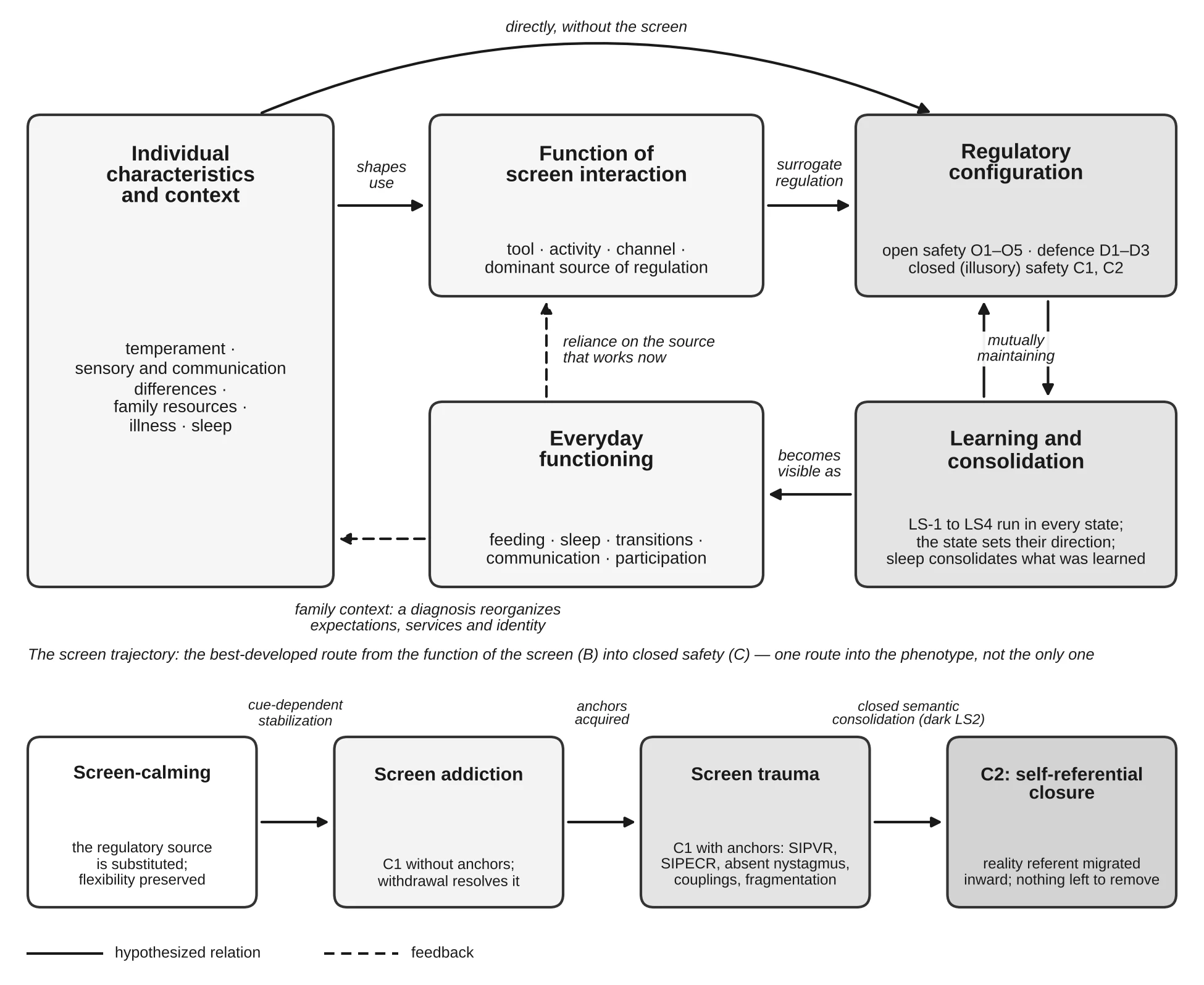
Figure 1. An integrative clinical-functional model. Individual characteristics and context influence regulation directly and through the function that screen interaction acquires. State and learning are mutually maintaining; everyday functioning feeds back into reliance on particular sources and into the family context, including the reorganization of expectations and services that follows a diagnosis. Solid arrows show the hypothesized relations, dashed arrows the feedback. The screen trajectory runs from screen-calming through screen addiction (C1 without anchors) to screen trauma (C1 with anchors) and, through closed semantic consolidation, to C2; it is one trajectory within the model, not the only route to the phenotype (Manolova & Vezenkov, 2026; Vezenkov & Manolova, 2026b, 2026c).
Pre-existing differences, subsequently compounded. Developmental differences precede intensive screen interaction in a proportion of children and explain why predictable media become attractive to the child and useful to the family. Prospective infant research shows that attention to eyes is present and declining between two and six months in infants later diagnosed; retrospective and prospective studies describe loss and declining trajectories of social-communicative skills as part of autism onset; and the cohort authors themselves recognize that emerging differences shape screen use (Barger et al., 2013; Hill et al., 2024; Jones & Klin, 2013; Kushima et al., 2022; Ozonoff & Iosif, 2019). In these children the screen arrives second, and it then does what it does to any child: it becomes a source. The environmental question does not disappear because the developmental difference came first; a child with a neurodevelopmental difference and a screen-maintained dependence has two problems, and the second is the one that can be removed. A report that development seemed typical before the screens is relevant history; records, videos and repeated assessment decide it.
Displacement of developmental opportunities. Screen activity occupies time that conversation, reciprocal play, movement and sleep should have had. This trajectory has the best independent support in the field – fewer adult words, child vocalizations and conversational turns per additional minute of screen time, more behaviour difficulties with more parental technology interruption (Brushe et al., 2024; McDaniel & Radesky, 2018). It produces delay, not re-routing: a child who can use a regulating partner and benefits from enriched participation without a separate source-dependent organization. “Screen-related developmental delay” is its correct name, and restored opportunity is its treatment.
Surrogate regulation: screen addiction, screen trauma, reversed development. This is the trajectory the field has not described and the one that produces the non-responders. The screen becomes the dominant source around which transitions, attention and participation are organized; the inverted sensory hierarchy and the anchors are acquired; regulation stabilizes in closed safety; and the learning systems build the higher functions on the inverted base. Within it the depth of the closure is decided by age of onset, intensity and duration of exposure, the quality of in-person caregiving and the extent of linguistic and social deprivation: before about 30 months, before the anchors have formed, cessation and restored human contact suffice in nearly half of the children; after consolidation they do not (Ivanova et al., 2025; Manolova & Vezenkov, 2025c, 2026; Petrova et al., 2025; Vezenkov & Manolova, 2025e, 2026a). The early audiovisual-specialization hypothesis is the independent formulation closest to this trajectory, and the population association between early exposure and atypical sensory processing is consistent with it; neither measured the hierarchy that we claim is inverted (Heffler & Oestreicher, 2016; Heffler et al., 2024).
Combined trajectories. Pre-existing differences and surrogate dependence coexist, and the true/virtual dichotomy is most harmful here because it demands one answer to two questions. Support targets the acquired dependence while continuing to address communication, sensory and developmental needs, and the test is differential change in independently described components – not the assumption that one is fully reversible and the other immutable. More interaction and better sleep help children on every trajectory; persistence after withdrawal distinguishes the trajectories only when the anchors and the state have been assessed (Vezenkov & Manolova, 2025d, 2026a, 2026c).
Table 6. Similar presentations, different organizations, and the observation that separates them
|
Feature as presented |
Reversed-development reading |
Alternatives |
Discriminating observation |
|
Reduced reciprocity; absent or scripted speech |
Tuning to an artificial source and surrogate mirroring; availability returns through human co-regulation once the source is absent |
Core social-communication difference of autism from the first months (Jones & Klin, 2013); hearing; language disorder; communicative echolalia (Prizant, 1983) |
Contingency with a person vs with the device, across modalities and partners; temporal precedence in the source history; whether a partner can enter the script. Aided or atypical communication is never a discriminator |
|
Exact repetition; islands of ability |
Compulsive LS1 and efficient learning in a closed direction |
Restricted and repetitive behaviours of autism; hyperlexia (Ostrolenk et al., 2017); typical toddler repetition |
Whether the routine tolerates one changed parameter and still serves a goal; transfer at matched demands; required vs preferred |
|
Insistence on sameness; the removal reaction |
Defence of a cue-bound closed safety |
Insistence on sameness in autism; frustration; anxiety; a learned protest |
Whether a person can settle the child without the device and how quickly; proportionality and duration; the pattern over months, observed in ordinary care |
|
Sensory features |
Inverted sensory hierarchy; the anchors as its persistent trace |
Sensory reactivity as a criterion of autism; temperament; prematurity; the population association with early exposure (Heffler et al., 2024) |
SIPVR, SIPECR and absent post-rotatory nystagmus after documented withdrawal; natural reinstatement on re-exposure; their frequency in autistic children without a screen history |
|
Calm, good sleep, robust health, little contact |
C2 with autonomic–relational dissociation |
Recovery; a quiet temperament; O1 or O5 |
Inclusion windows: frequency, duration and conditions of contingent response to a person; shared-world access assessed directly, never inferred from physiology |
Two features are deliberately absent from the Table 6: loss of acquired skills, which is part of autism onset and discriminates nothing on its own, and improvement after removal, which every trajectory predicts to some degree. Consider a child who repeats a media phrase at every transition. A clinician can count the phrase as repetitive behaviour, ask whether it is a request, examine whether it predicts a loss of regulation, or test whether a partner can enter it. Several readings can be true at once; what happens when the phrase is understood, the transition made accessible or an alternative route offered says more than the phrase’s origin. The model’s core comparison is not between children who look autistic and children who do not, but between alternative accounts of a specified pattern – and two findings would count against it directly: the anchors occurring at comparable frequency in children without intensive screen interaction, or in autistic children regardless of history, which would make them features of the presentation rather than of a trajectory; and regulatory differences preceding intensive interaction in every case where records exist, which would leave only the first trajectory standing.
8. Assessment and Recovery
What assessment adds
The framework adds a functional formulation to developmental and diagnostic assessment; it replaces neither, and a screen hypothesis never delays a hearing test, a language assessment or a diagnostic evaluation. Its first task is a timeline of abilities and of sources of regulation: who or what settled the child, when screen interaction began, what role it acquired, and which changes were documented – from videos, contemporaneous records and more than one setting rather than from a retrospective division into a normal before and an abnormal after. A missing early record is not evidence of typical development, and an account of difficult behaviour is not proof that a parent failed.
The current assessment describes function rather than hours: the activities for which the source is used, the alternatives available, what occurs during ordinary transitions, which activities have become restricted (Vezenkov & Manolova, 2026a; Vezenkov et al., 2026). It describes the anchors: SIPVR and SIPECR, observed as they occur in ordinary care or elicited in their mildest form, with the parent present, consent given and the observation stopped at the first sign of distress; post-rotatory nystagmus after the child’s own spinning; tolerance of darkness and of eye-covering in play; the body map; the couplings between particular sounds, images and states. It describes the state – across episodes, partners and accessible tasks, in the four domains of Section 5 – and the direction of learning: what is learned, in which system, and whether it transfers. Communication is assessed across speech, gesture, sign, aided and idiosyncratic forms, with the function of echoed speech examined before it is read as anything else. Sleep has its own evaluation of onset conditions, schedule and continuity. Participation makes the consequences visible in meals, dressing, outings, group care and family life. Where research classification is attempted, the assessors are independent of treatment outcomes, the information available to them is standardized, and later functioning is assessed by an observer blind to the assigned profile (Vezenkov & Manolova, 2026c).
Outcome has three levels: measured symptoms or developmental performance; changes in regulatory organization – availability to a person, the proportion of functions requiring the source, the inclusion windows, the anchors; and durable participation and transfer across everyday settings. A better score at the first level is not a change at the third, and a brief window of greater responsiveness is a process observation, not a transformed trajectory. The anchors are the outcome measure the field has lacked: a negative SIPVR, a returned nystagmus and a child who falls asleep in the dark are facts about the sensory hierarchy, and they precede the language.
Recovery is a sequence: detox changes the input, recovery changes the organization
The recovery of a child in reversed development follows the order in which the trajectory was built, bottom-up: bodily safety, then relational co-regulation, then procedures, then meaning. Regulation precedes meaning is the rule, and it yields a different programme for each depth (Vezenkov & Manolova, 2026b, 2026c).
Source restoration. Screens are removed and a human source is built in their place – low-demand co-regulation through face, voice, rhythm, touch and shared rest (O5), before and as the condition of reduced reliance. The characteristic error is abrupt removal without replacement, which creates the regulatory vacuum into which the child relapses and the family capitulates. In C1 without anchors this step is the treatment; in screen trauma it is the precondition for the rest. A communication device is a tool, not a surrogate because it has a screen; removing a child’s means of expression defeats the aim of expanding participation, and aided communication does not obstruct speech (Millar et al., 2006; Vezenkov et al., 2026). “Digital detox” therefore targets dependence that narrows functioning, not the technology through which a child communicates.
Dismantling the anchors and re-anchoring the body. Gravity is restored as the reference under co-regulation: carrying, rocking, swinging and gradually tolerated inversion with the adult’s body as the safe frame; eye-covering and darkness introduced as games within the relationship until the loss of the visual frame no longer means the loss of safety; rotation with the return of nystagmus as the marker that the vestibular signal is being heard again; differentiation of the body map through touch. This work is not the integration of retained reflexes. It is the undoing of acquired ones, and its goal is not the repeated provocation or suppression of a reaction but a change in the relationship among sensory information, bodily action and regulation, tracked through increasing comfort, adaptive movement and participation. Its measure is the disappearance of SIPVR and SIPECR together with the child’s growing ability to derive safety from its body and from a person rather than from visual control; a reflex that disappears while the cue dependence remains is an examination finding, not a developmental change (Vezenkov & Manolova, 2025c, 2025d, 2026a).
Rebuilding language on regulation. Language is rebuilt as a tool of reciprocity rather than reproduced as a configuration – from the nonverbal exchange that an inclusion window makes possible, through the scripts a partner can enter, to words that request, refuse and share. Teaching, modelling and practice proceed in accessible forms throughout; what the framework specifies is their order and their state: the same procedure that builds language in an open window builds one more exact sequence in a closed one (Mateev et al., 2025; Prizant, 1983; Schreibman et al., 2015).
Re-anchoring the reality referent. In C2 there is no source to remove, and the work is the identification, protection and extension of inclusion windows – the intervals in which a person can be used – until the criterion of reality migrates back outward. Autonomic calm is never read as recovery; shared-world access is assessed directly, and its broadening is the first sign that the trajectory has turned (Vezenkov & Manolova, 2026c).
Sleep. Sleep onset is weaned from the device as the last of the compulsive procedures, and sufficient, continuous, age-appropriate sleep is secured as the condition under which the day’s new learning, rather than the old, is consolidated (Richdale & Schreck, 2009; Vezenkov & Manolova, 2026b).
The family. The household moves from dark LS4 to guidance: from reproducing the child’s cues to lending regulation and returning autonomy. The criterion of success is the transfer of autonomy to the child and to the family; the question is whether support expands usable choices and regulation for both, and it is asked without blame, because the families in this population adopted the only strategy that made their days possible (Vezenkov & Manolova, 2026b).
Re-exposure. Re-introduction of screens before attachment to people and a working language system have been rebuilt reverses the recovery – thirty to sixty minutes of videos can return a child to the full profile within days, with the reflexes leading the way – which is why the reflexes also serve as the detector of undeclared re-exposure during treatment, and why abstinence is maintained until the new pathway is faster than the old (Petrova et al., 2025; Vezenkov & Manolova, 2025d, 2026a).
Six commitments govern the practice. No coercive procedures: no child is restrained, held or lifted to elicit a reaction. No provoked distress. No prescribed re-exposure. Diagnostic assessment neither delayed nor pre-empted by a screen hypothesis, and the environmental question never dismissed by a diagnosis. Access to support, services and communication devices preserved. Respect for all forms of communication and for families. The therapeutic pathway is ours; the sequence it follows – source, body, relationship, procedure, meaning – is the model’s, and it is what the predictions below test. The outcome it aims at is greater developmental freedom: more ways to settle, move, communicate, learn and participate without dependence on one exact sensory arrangement.
9. Predictions
Each prediction names what would refute it. Measurement comes first: inter-rater agreement on state assignment under specified conditions, coding rules for inclusion windows, operational criteria for the function of interaction, comparable tasks for transfer, and standardized assessment of the anchors in three comparison groups – children with intensive early screen interaction, autistic children without it, and typically developing children.
-
Function beyond duration. The regulatory function of screen interaction predicts later source dependence and everyday functioning beyond duration, developmental baseline and context. Refuted if reliable function measures add nothing to hours. The instrumental-variable null of Lin and colleagues is a reason to demand stronger designs for the function variable, not a verdict on it (Lin et al., 2025; Radesky et al., 2023).
-
Anchors predict non-response. Children in whom SIPVR, SIPECR or absent post-rotatory nystagmus persist after three months of documented withdrawal do not recover with withdrawal and restored contact alone; children without anchors do. Refuted if anchor status after withdrawal does not predict outcome once age and baseline functioning are accounted for.
-
The anchors are trajectory-specific. SIPVR, SIPECR and absent nystagmus occur at high frequency in children with early screen addiction, but absent in typically developing children. Measured together with sensory reweighting under changing conditions, inflexible channel dependence – not a strong sensory preference – marks the trajectory (Polastri & Barela, 2013). Refuted if the frequencies in the second group approach the first; the anchors would then be features of the phenotype, not of the trajectory.
-
The body recovers before the language. In children who recover, vestibular re-anchoring – negative SIPVR, returned nystagmus, tolerated darkness and eye-covering – precedes durable gains in reciprocity, communication and participation. Language-first programmes in children with persisting anchors produce context-bound gains that do not transfer. Refuted if durable language gains regularly precede, or occur without, the predicted sensory change.
-
State-specific intervention. Independently assigned C1 profiles respond to source restoration; C2 profiles do not respond to source logic and respond to the extension of inclusion windows, whose broadening precedes developmental recovery. Refuted if assessors cannot distinguish the profiles, or if the profiles do not predict differential response beyond baseline functioning (Vezenkov & Manolova, 2026c).
-
Re-exposure is relapse, dose-dependent on depth. After recovery, renewed screen exposure reinstates the anchors after exposures as brief as minutes and the behavioural profile within days, faster and more completely the deeper the original closure. Refuted if re-exposure after recovery produces no reinstatement, or reinstatement unrelated to the assessed depth (Petrova et al., 2025).
-
Learning acquired in closure transfers less. At comparable initial skill and task demands, learning acquired under a narrowly source-dependent configuration transfers less readily than learning acquired with flexible access to a partner, and training compliance within closure strengthens source dependence. Refuted if transfer is independent of profile (Vezenkov & Manolova, 2026b).
-
Sleep onset predicts persistence. Device-dependent sleep onset predicts continuing source dependence, and age-appropriate sleep continuity moderates the retention and generalization of gains. Refuted if sleep measures add nothing once daytime functioning is accounted for (Richdale & Schreck, 2009).
Prospective cohorts can collect baseline development, duration, function and anchors before the outcomes of interest, with infant-sibling cohorts supplying the comparison in which early autistic differences are documented independently of any screen (Jones & Klin, 2013; Ozonoff & Iosif, 2019). Enrolling children before withdrawal, retaining responders and non-responders alike, and defining the follow-up interval and the recovery outcomes in advance – participation, communication, sensorimotor functioning, source dependence – converts the clinical observation that motivates this article into a measured account of persistence and change. Multisite clinical studies can separate initial formulation, delivery of support and outcome assessment, include children across the range of improvement, and preregister hypotheses, coding and comparison groups. No design requires deliberate re-exposure; naturally occurring episodes, documented independently, supply the longitudinal information. Independent replication outside our Center is the point of stating the predictions this way.
10. Conclusion: From a Label Defined by Its Cure to a Trajectory Defined by Its Organization
“Virtual autism” was a useful mistake. It recognized that a population of children with an autism-like presentation and a history of early screen interaction improves when the screens go, and it drew attention to them. It then defined the population by that improvement, and in doing so it made the children who do not improve invisible: they became, by definition, the real autism, and their trajectory was never described. At least half of the children with early screen addiction in our clinical population belong to that invisible group.
What distinguishes them is not the number of hours but what the screen became and what development did with it. Early screen addiction is an addiction to a state. Begun in the sensitive period of sensory integration, it inverts the sensory hierarchy – vision and hearing in the place of gravity – installs acquired reflexes that no retention account explains, binds eating, sleeping and settling to exact sequences, and stabilizes regulation in a closed, illusory safety that the human world cannot reach. Development does not stop. It continues, efficiently, in another direction: the learning systems keep working, and they build language, attention and self-regulation on the inverted base. This is screen trauma, and the trajectory it produces is reversed development – not delay, because the path is different; not developmental trauma, because the organizing appraisal is safety rather than fear and the source is an object rather than a person; not retained reflexes, because the reflexes were acquired. The two forms of closed safety, C1 and C2, name the configurations that carry the trajectory and decide the intervention: a source to be restored in the one, a reality referent to be re-anchored in the other, and in both the body re-anchored to gravity before meaning is asked of it.
Four conventions follow for the words. “Developmental delay” is retained wherever delayed acquisition is the finding, and “screen-related developmental delay”, as Krijnen and colleagues propose, is the name of the displacement trajectory (Krijnen et al., 2026). “Early screen addiction”, “screen trauma” and “reversed development” are used as defined here, for the trajectory the term could not see. C1 and C2 are states, not diagnoses; a state formulation neither establishes nor excludes autism, and diagnostic assessment proceeds alongside on its own instruments (American Psychiatric Association, 2022; Detroja & Bhatia, 2026). “Virtual autism” remains the object of analysis, in quotation marks and for the history of the term.
The clinically operative questions are no longer “which autism?” They are: at what depth of the trajectory is this child – addiction, trauma, reversed development; in which state – C1 or C2; and in which direction are the learning systems running? These questions, unlike the term, determine prognosis and the therapeutic sequence, and they can be answered in a young, non-speaking child from what happens when a person is offered, when the visual frame is removed, and when the screen returns. The decisive question is not whether the child can learn, but what the child’s learning is organizing – and how to change its direction. The children who recover after detox were never the hard problem. The children who do not are, and they are not autistic by default. They are developing in a direction from which they can be brought back – in the right order, and in time.
References
American Psychiatric Association. (2022). Diagnostic and statistical manual of mental disorders (5th ed., text rev.). https://doi.org/10.1176/appi.books.9780890425787
Ayres, A. J. (1972). Sensory integration and learning disorders. Western Psychological Services.
Ayres, A. J. (2005). Sensory integration and the child: Understanding hidden sensory challenges (25th anniversary ed.). Western Psychological Services.
Barger, B. D., Campbell, J. M., & McDonough, J. D. (2013). Prevalence and onset of regression within autism spectrum disorders: A meta-analytic review. Journal of Autism and Developmental Disorders, 43(4), 817–828. https://doi.org/10.1007/s10803-012-1621-x
Brushe, M. E., Haag, D. G., Melhuish, E. C., Reilly, S., & Gregory, T. (2024). Screen time and parent-child talk when children are aged 12 to 36 months. JAMA Pediatrics, 178(4), 369–375. https://doi.org/10.1001/jamapediatrics.2023.6790
Cook, A., Spinazzola, J., Ford, J., Lanktree, C., Blaustein, M., Cloitre, M., DeRosa, R., Hubbard, R., Kagan, R., Liautaud, J., Mallah, K., Olafson, E., & van der Kolk, B. (2005). Complex trauma in children and adolescents. Psychiatric Annals, 35(5), 390–398. https://doi.org/10.3928/00485713-20050501-05
D’Andrea, W., Ford, J., Stolbach, B., Spinazzola, J., & van der Kolk, B. A. (2012). Understanding interpersonal trauma in children: Why we need a developmentally appropriate trauma diagnosis. American Journal of Orthopsychiatry, 82(2), 187–200. https://doi.org/10.1111/j.1939-0025.2012.01154.x
Detroja, S., & Bhatia, G. (2026). Early screen exposure and developmental abnormalities: Understanding the trepidations of “virtual autism.” Indian Journal of Psychological Medicine, 48(4), 446–448. https://doi.org/10.1177/02537176241263310
Ford, J. D., Spinazzola, J., van der Kolk, B., & Grasso, D. J. (2018). Toward an empirically based developmental trauma disorder diagnosis for children: Factor structure, item characteristics, reliability, and validity of the Developmental Trauma Disorder Semi-Structured Interview. The Journal of Clinical Psychiatry, 79(5), 17m11675. https://doi.org/10.4088/JCP.17m11675
Gieysztor, E. Z., Choińska, A. M., & Paprocka-Borowicz, M. (2018). Persistence of primitive reflexes and associated motor problems in healthy preschool children. Archives of Medical Science, 14(1), 167–173. https://doi.org/10.5114/aoms.2016.60503
Grossman, P. (2023). Fundamental challenges and likely refutations of the five basic premises of the polyvagal theory. Biological Psychology, 180, 108589. https://doi.org/10.1016/j.biopsycho.2023.108589
Harlé, B. (2019). Intensive early screen exposure as a causal factor for symptoms of autistic spectrum disorder: The case for «Virtual autism». Trends in Neuroscience and Education, 17, 100119. https://doi.org/10.1016/j.tine.2019.100119
Heffler, K. F., & Oestreicher, L. M. (2016). Causation model of autism: Audiovisual brain specialization in infancy competes with social brain networks. Medical Hypotheses, 91, 114–122. https://doi.org/10.1016/j.mehy.2015.06.019
Heffler, K. F., Acharya, B., Subedi, K., & Bennett, D. S. (2024). Early-life digital media experiences and development of atypical sensory processing. JAMA Pediatrics, 178(3), 266–273. https://doi.org/10.1001/jamapediatrics.2023.5923
Heffler, K. F., Frome, L. R., & Gullo, D. F. (2022). Changes in autism symptoms associated with screen exposure: Case report of two young children. Psychiatry Research Case Reports, 1(2), 100059. https://doi.org/10.1016/j.psycr.2022.100059
Heffler, K. F., Frome, L. R., Garvin, B., Bungert, L. M., & Bennett, D. S. (2022). Screen time reduction and focus on social engagement in autism spectrum disorder: A pilot study. Pediatrics International, 64(1), e15343. https://doi.org/10.1111/ped.15343
Heffler, K. F., Sienko, D. M., Subedi, K., McCann, K. A., & Bennett, D. S. (2020). Association of early-life social and digital media experiences with development of autism spectrum disorder-like symptoms. JAMA Pediatrics, 174(7), 690–696. https://doi.org/10.1001/jamapediatrics.2020.0230
Hill, M. M., Gangi, D. N., & Miller, M. (2024). Toddler screen time: Longitudinal associations with autism and ADHD symptoms and developmental outcomes. Child Psychiatry & Human Development. Advance online publication. https://doi.org/10.1007/s10578-024-01785-0
Hobson, R. P., & Lee, A. (2010). Reversible autism among congenitally blind children? A controlled follow-up study. Journal of Child Psychology and Psychiatry, 51(11), 1235–1241. https://doi.org/10.1111/j.1469-7610.2010.02274.x
Hobson, R. P., Lee, A., & Brown, R. (1999). Autism and congenital blindness. Journal of Autism and Developmental Disorders, 29(1), 45–56. https://doi.org/10.1023/A:1025918616111
Ivanova, V. D., Mitsova, S. A., Petrova, T. G., Manolova, V. R., & Vezenkov, S. R. (2025). Full recovery of a 10-year-old girl with persistent screen addiction since age 2 and autism spectrum disorder: Case report. Nootism, 1(3), 17–26.
Jones, W., & Klin, A. (2013). Attention to eyes is present but in decline in 2–6-month-old infants later diagnosed with autism. Nature, 504(7480), 427–431. https://doi.org/10.1038/nature12715
Krijnen, L. J. G., Scheeren, A. M., van Asselt, A., Begeer, S., & Plak, R. D. (2026). Why the term ‘virtual autism’ warrants caution. Autism, 30(6), 1632–1634. https://doi.org/10.1177/13623613261434478
Kushima, M., Kojima, R., Shinohara, R., Horiuchi, S., Otawa, S., Ooka, T., Akiyama, Y., Miyake, K., Yokomichi, H., Yamagata, Z., & Japan Environment and Children’s Study Group. (2022). Association between screen time exposure in children at 1 year of age and autism spectrum disorder at 3 years of age: The Japan Environment and Children’s Study. JAMA Pediatrics, 176(4), 384–391. https://doi.org/10.1001/jamapediatrics.2021.5778
Lin, P.-I., Wu, W. T., & Guo, Y.-L. L. (2025). Screen time before 2 years of age and risk of autism at 12 years of age. JAMA Pediatrics, 179(1), 90–91. https://doi.org/10.1001/jamapediatrics.2024.4432
Manolova, V., & Vezenkov, S. (2025a). Are screen-induced synesthesia and screen-induced cue-dependent behavior contributing factors in the misdiagnosis of ASD among children with screen addiction? Nootism, 1(3), 11–16. https://doi.org/10.64441/nootism.1.3.2
Manolova, V., & Vezenkov, S. (2025b). Unified Trauma-Addiction Functioning Model. Nootism, 1(4), 4–24. https://doi.org/10.64441/nootism.1.4.1
Manolova, V., & Vezenkov, S. (2025c). Screen trauma – Specifics of the disorder and therapy in adults and children. Nootism, 1(1), 37–51. https://doi.org/10.64441/nootism.2NCSC.3
Manolova, V., & Vezenkov, S. (2026). Autism as an ecosystem error: The consequences of misdiagnosed screen addiction. Nootism, 2(4), 30–56. https://doi.org/10.64441/nootism.2.4.2
Marcelli, D., Bossière, M.-C., & Ducanda, A.-L. (2018). Plaidoyer pour un nouveau syndrome « Exposition précoce et excessive aux écrans » (EPEE). Enfances & Psy, 79(3), 142–160. https://doi.org/10.3917/ep.079.0142
Mateev, M. I., Manolova, V. R., & Vezenkov, S. R. (2025). From nonverbal to language – How to counteract anti-human programming controlling children with early screen addiction. Nootism, 1(1), 52–58.
McDaniel, B. T., & Radesky, J. S. (2018). Technoference: Parent distraction with technology and associations with child behavior problems. Child Development, 89(1), 100–109. https://doi.org/10.1111/cdev.12822
McPhillips, M., & Jordan-Black, J.-A. (2007). Primary reflex persistence in children with reading difficulties (dyslexia): A cross-sectional study. Neuropsychologia, 45(4), 748–754. https://doi.org/10.1016/j.neuropsychologia.2006.08.005
Melillo, R., Leisman, G., Machado, C., Machado-Ferrer, Y., Chinchilla-Acosta, M., Kamgang, S., Melillo, T., & Carmeli, E. (2022). Retained primitive reflexes and potential for intervention in autistic spectrum disorders. Frontiers in Neurology, 13, 922322. https://doi.org/10.3389/fneur.2022.922322
Millar, D. C., Light, J. C., & Schlosser, R. W. (2006). The impact of augmentative and alternative communication intervention on the speech production of individuals with developmental disabilities: A research review. Journal of Speech, Language, and Hearing Research, 49(2), 248–264. https://doi.org/10.1044/1092-4388(2006/021)
Ophir, Y., Rosenberg, H., Tikochinski, R., Dalyot, S., & Lipshits-Braziler, Y. (2023). Screen time and autism spectrum disorder: A systematic review and meta-analysis. JAMA Network Open, 6(12), e2346775. https://doi.org/10.1001/jamanetworkopen.2023.46775
Ostrolenk, A., Forgeot d’Arc, B., Jelenic, P., Samson, F., & Mottron, L. (2017). Hyperlexia: Systematic review, neurocognitive modelling, and outcome. Neuroscience & Biobehavioral Reviews, 79, 134–149. https://doi.org/10.1016/j.neubiorev.2017.04.029
Ozonoff, S., & Iosif, A.-M. (2019). Changing conceptualizations of regression: What prospective studies reveal about the onset of autism spectrum disorder. Neuroscience & Biobehavioral Reviews, 100, 296–304. https://doi.org/10.1016/j.neubiorev.2019.03.012
Ozyazici, K. (2026). Screen time and autism-like symptoms in early childhood: Examining the concept of virtual autism. Acta Psychologica, 268, 107285. https://doi.org/10.1016/j.actpsy.2026.107285
Perry, B. D., Pollard, R. A., Blakley, T. L., Baker, W. L., & Vigilante, D. (1995). Childhood trauma, the neurobiology of adaptation, and “use-dependent” development of the brain: How “states” become “traits”. Infant Mental Health Journal, 16(4), 271–291. https://doi.org/10.1002/1097-0355(199524)16:4<271::AID-IMHJ2280160404>3.0.CO;2-B
Petrova, S. N., Manolova, V. R., & Vezenkov, S. R. (2025). Reintroducing screens: Severe regression and symptom aggravation in children with ASD/screen addiction. Nootism, 1(1), 59–65.
Polastri, P. F., & Barela, J. A. (2013). Adaptive visual re-weighting in children’s postural control. PLOS ONE, 8(12), e82215. https://doi.org/10.1371/journal.pone.0082215
Porges, S. W. (2007). The polyvagal perspective. Biological Psychology, 74(2), 116–143. https://doi.org/10.1016/j.biopsycho.2006.06.009
Prizant, B. M. (1983). Language acquisition and communicative behavior in autism: Toward an understanding of the “whole” of it. Journal of Speech and Hearing Disorders, 48(3), 296–307. https://doi.org/10.1044/jshd.4803.296
Radesky, J. S., Kaciroti, N., Weeks, H. M., Schaller, A., & Miller, A. L. (2023). Longitudinal associations between use of mobile devices for calming and emotional reactivity and executive functioning in children aged 3 to 5 years. JAMA Pediatrics, 177(1), 62–70. https://doi.org/10.1001/jamapediatrics.2022.4793
Richdale, A. L., & Schreck, K. A. (2009). Sleep problems in autism spectrum disorders: Prevalence, nature, & possible biopsychosocial aetiologies. Sleep Medicine Reviews, 13(6), 403–411. https://doi.org/10.1016/j.smrv.2009.02.003
Rutter, M., Andersen-Wood, L., Beckett, C., Bredenkamp, D., Castle, J., Groothues, C., Kreppner, J., Keaveney, L., Lord, C., & O’Connor, T. G. (1999). Quasi-autistic patterns following severe early global privation. Journal of Child Psychology and Psychiatry, 40(4), 537–549. https://doi.org/10.1111/1469-7610.00472
Rutter, M., Kreppner, J., Croft, C., Murin, M., Colvert, E., Beckett, C., Castle, J., & Sonuga-Barke, E. (2007). Early adolescent outcomes of institutionally deprived and non-deprived adoptees. III. Quasi-autism. Journal of Child Psychology and Psychiatry, 48(12), 1200–1207. https://doi.org/10.1111/j.1469-7610.2007.01792.x
Schreibman, L., Dawson, G., Stahmer, A. C., Landa, R., Rogers, S. J., McGee, G. G., Kasari, C., Ingersoll, B., Kaiser, A. P., Bruinsma, Y., McNerney, E., Wetherby, A., & Halladay, A. (2015). Naturalistic developmental behavioral interventions: Empirically validated treatments for autism spectrum disorder. Journal of Autism and Developmental Disorders, 45(8), 2411–2428. https://doi.org/10.1007/s10803-015-2407-8
Sigafoos, J., Roche, L., O’Reilly, M. F., & Lancioni, G. E. (2021). Persistence of primitive reflexes in developmental disorders. Current Developmental Disorders Reports, 8, 98–105. https://doi.org/10.1007/s40474-021-00232-2
Spinazzola, J., van der Kolk, B., & Ford, J. D. (2018). When nowhere is safe: Interpersonal trauma and attachment adversity as antecedents of posttraumatic stress disorder and developmental trauma disorder. Journal of Traumatic Stress, 31(5), 631–642. https://doi.org/10.1002/jts.22320
Takahashi, I., Obara, T., Ishikuro, M., Murakami, K., Ueno, F., Noda, A., Onuma, T., Shinoda, G., Nishimura, T., Tsuchiya, K. J., & Kuriyama, S. (2023). Screen time at age 1 year and communication and problem-solving developmental delay at 2 and 4 years. JAMA Pediatrics, 177(10), 1039–1046. https://doi.org/10.1001/jamapediatrics.2023.3057
Tronick, E. Z. (1989). Emotions and emotional communication in infants. American Psychologist, 44(2), 112–119. https://doi.org/10.1037/0003-066X.44.2.112
van der Kolk, B. A. (2005). Developmental trauma disorder: Toward a rational diagnosis for children with complex trauma histories. Psychiatric Annals, 35(5), 401–408. https://doi.org/10.3928/00485713-20050501-06
van der Kolk, B. A. (2014). The body keeps the score: Brain, mind, and body in the healing of trauma. Viking.
van der Kolk, B., Ford, J. D., & Spinazzola, J. (2019). Comorbidity of developmental trauma disorder (DTD) and post-traumatic stress disorder: Findings from the DTD field trial. European Journal of Psychotraumatology, 10(1), 1562841. https://doi.org/10.1080/20008198.2018.1562841
Vezenkov, S., & Manolova, V. (2025a). Neurobiology of autism/early screen addiction recovery. Nootism, 1(1), 19–36. https://doi.org/10.64441/nootism.2NCSC.2
Vezenkov, S., & Manolova, V. (2025b). Screen addiction – Biomarkers, developmental damage and recovery. Nootism, 1(1), 6–18. https://doi.org/10.64441/nootism.2NCSC.1
Vezenkov, S., & Manolova, V. (2025c). Screen-induced pathological eye-covering reflex in children with early screen addiction. Nootism, 1(3), 5–10. https://doi.org/10.64441/nootism.1.3.1
Vezenkov, S., & Manolova, V. (2025d). Screen-induced pathological vestibular reflex: A specific marker of early screen addiction. Nootism, 1(2), 5–10. https://doi.org/10.64441/nootism.1.2.1
Vezenkov, S., & Manolova, V. (2025e). Sensory disintegration versus sensory deprivation: Vestibular-visual dynamics and shared behavioral phenotypes in ASD and early blindness. Nootism, 1(6), 4–12. https://doi.org/10.64441/nootism.1.6.1
Vezenkov, S., & Manolova, V. (2026a). Screen addiction in children and adults: Biomarkers, screen trauma and reversed development. Nootism, 2(1), 4–45. https://doi.org/10.64441/nootism.2.1.1
Vezenkov, S., & Manolova, V. (2026b). The direction of learning: A clinical-functional model of six learning systems in regulatory-state acquisition, sleep-supported consolidation, and transformation. Nootism, 2(4), 4–29. https://doi.org/10.64441/nootism.2.4.1
Vezenkov, S., & Manolova, V. (2026c). Two safeties, ten states: A clinical-functional ontology of human regulatory states beyond the polyvagal debate. Nootism, 2(3), 4–37. https://doi.org/10.64441/nootism.2.3.1
Vezenkov, S., Petrov, P., & Manolova, V. (2026). Screen interaction, not screen time: Multidimensional framework, global policy evidence, and clinical recommendations for children with screen addiction and screen trauma. Nootism, 2(2), 17–63. https://doi.org/10.64441/nootism.2.2.2
Vygotsky, L. S. (1978). Mind in society: The development of higher psychological processes (M. Cole, V. John-Steiner, S. Scribner, & E. Souberman, Eds.). Harvard University Press.
Yamamoto, M., Mezawa, H., Sakurai, K., Mori, C., & Japan Environment and Children’s Study Group. (2023). Screen time and developmental performance among children at 1–3 years of age in the Japan Environment and Children’s Study. JAMA Pediatrics, 177(11), 1168–1175. https://doi.org/10.1001/jamapediatrics.2023.3643
Zamfir, M. T. (2018). The consumption of virtual environment more than 4 hours/day, in the children between 0–3 years old, can cause a syndrome similar with the autism spectrum disorder. Journal of Romanian Literary Studies, 13, 953–968.